This and that rock from Fischer Canyon, Oregon. According to the Central Oregon rockhounding map, published by the Bureau of Land Management, you can find petrified wood, jasper, and agate here. Other sources list calcite and quartz as being at this site.
This small conglomerate includes several types of rock that merged together.
Today I’ll share a few stories related to special flowers in my life.
Roses
Whenever I see roses, I think of a funny thing that happened to me when I was in my early twenties. I had just started dating a guy who checked parking passes where I worked. I invited him to my cozy little A-frame house on Puget Sound in Washington state. When we got to my house, I pulled open the screen door and there was a bouquet of roses tucked next to the main door. I grinned and asked if they were from him. “No,” he said sheepishly. He pulled a bouquet of roses from behind his back. Oops. The flowers in my door were from a different admirer. Awkward!
I took these photos on the High Desert Garden Tour this summer. The tour takes place in different Central Oregon locations, from sprawling rural ranches to tiny city yards. This year the featured gardens were in Bend.
There are an abundance of flowers growing along the path near the Hayden Homes Amphitheater in Bend, Oregon. I always look forward to walking there in the late summer and early fall months. Can you see why?
Here’s a picture of the new “Greetings from Bend, Oregon” mural. This mural is near the flag bridge in the Old Mill district in Bend. It’s on the Mill A Loop trail, where I walk regularly.
This colorful mural is by artist Karen Eland. I’m a big fan of her artwork and have previously featured her work in Bend. She collaborated with five other artists on this work in the Foxtail Bakery in the Box Factory district.
Foxtail closed in January 2022. The restaurant currently at that location, Papi Chulo’s Taqueria, has new murals adorning their walls. More murals for me to seek out and share!
Karen features local flora and fauna in this Greetings from Bend, Oregon mural. This mural includes columbine, lupine, and paintbrush flowers. A Western Tanager perches on “From” and a Rufous Hummingbird hovers over “Oregon.” Tiger swallowtail butterflies flit about the edges and a honeybee perches on a flower in a corner. Cascade volcanoes float in the background and the iconic smokestacks of the Old Mill stand tall in the foreground.
You can see another example of Karen’s work in this mural in Sisters, Oregon. She collaborated on that piece with fellow artist Katie Daisy .
For this First Friday Art post, I’m sharing a hibiscus photo and a few drawings. I took this picture of a Spin the Bottle Hibiscus, Hibiscus rosa-sinensis, at the Oregon Garden in Silverton, Oregon. I’m not sure who came up with the common name, but it’s a funny one!
I’m sharing a quick pen-and-ink drawing I did of Hibiscus flowers. I’m participating in Inktober, a challenge where you make a drawing a day for a month based on prompts.
I tend to fuss over my artwork a lot, so for this challenge, I’m trying to draw fast. You create a different kind of artwork when working quickly. Is it perfect? No, but it’s a freeing experience. The goal is to capture the essence of your subject.
You can interpret the prompts any way you want to. Here was my interpretation of ‘bouquet’ from the October 5 prompt.
Did you ever wonder where hula hoops come from? I think I found out. They’re grown from tiny round seeds at the community garden in Hollinshead Park in Bend. 😁
In late August, while out exploring places along the Columbia River, we stumbled upon the Northwest Mural Fest in The Dalles, Oregon. Painters from all over the country met in The Dalles to create 15 murals in three days. Yes, it was a huge undertaking, literally and figuratively.
The Walldogs
The 200+ sign painters and mural artists who took part in the event belong to a group called The Walldogs. Imagine a “pack” of artists gathering in a town for a few days to create unforgettable works of art. The murals depict places, people, and products that have local significance. The murals attract tourists and give residents a sense of hometown pride.
Honoring the History
The artists working on this mural, by Anat Ronen, must not have a fear of heights. This mural portrays photographer Benjamin Gifford. He moved from the Midwest to Portland in 1888, and to The Dalles in 1896. His work highlights scenic views of the Columbia River and the scenic highway running beside it. Gifford also featured portraits of local Native Americans.
The Benjamin Gifford mural is being painted on the back of the Clock Tower. This photo shows the building, built in 1883, from the front.
A cool place to rest at the Portland Japanese Garden last fall. There are comfortable places to pause and take in the scenery throughout the garden. Cooler temperatures and colorful autumn leaves are just around the corner in the Pacific Northwest.
If you’d like to see a large collection of amazing airplanes, be sure to visit the Western Antique Aeroplane and Automobile Museum (WAAAM) in Hood River, Oregon. The indoor hangar space is more than 3.5 acres in size.
All of the aircraft have been restored to working condition. This process takes a long time and the Museum restores an average of two per year. Our family donated a Fly Baby homebuilt plane, but it’s not yet on display.
The planes are generally arranged by type within the buildings.
Biplanes
Biplanes have interesting designs and they’re a great subject for photographs. I featured one of them in a black and white photograph in a previous post.
Mike and Linda Strong, friends of the family, donated the two 1929 WACOs pictured below. Mike worked as an airline pilot for many years and liked to fly smaller planes in his spare time. He gave me a ride in one of the WACOs years ago and it was a memorable experience.
The first WACO is a taper wing. At high speeds, tapered wings decrease drag and increase lift. They also make the plane lighter and more maneuverable.
In your travels near and far, you may find weird and wonderful sights.
Weird architecture
Sometimes you find a weird sight when you’re driving down the highway and look it up later. This is the Smith Mansion, located in Wapiti, Wyoming, halfway between Cody and Yellowstone.
Lee Smith, a former builder and engineer, began constructing this structure from locally harvested logs. However, he became obsessed with adding on to the building, which led to his divorce. For 22 years he continued construction so that eventually it was 5-stories tall. One day, unfortunately, he slipped while working and fell to his death. His daughter owned the house for many years until it was sold to a neighbor in 2020.
For a better look at this amazing structure inside and out, watch this video by Scott Richard.
Wonderful tastes
At other times you’ll go a little off the beaten path in search of a good meal. This delicious barbecue dinner is from the Apple Valley BBQ in Parkdale, Oregon. Parkdale, at the base of Mt Hood, is a small town with a population of about 650. Fruit orchards fill the valleys in this part of Oregon and the restaurant incorporates fruit into their meals. The coleslaw pictured contains slices of fresh pears. They use local cherry wood to smoke their meat. Yum, definitely one of my favorites!
The Imagine a World exhibition at the High Desert Museum focuses on past and present efforts to create utopian communities. Participants joined for assorted reasons, including religious persecution, environmental concerns, and anti-war sentiments.
The communities featured are in the Western United States. Founding members often thought of the West as an idyllic, “empty” place to settle. However, they did not always consider who was already living in these environments.
Indigenous Futurism
As you enter the gallery, two life-sized astronauts suspended in front of a bold painting of bison catch your eye. Two bright paintings adorn the walls next to this display. These works represent Indigenous futurism. They highlight how important cosmology, science, and futurism have been to Native peoples. Grace Dilon, Ph.D. (Anishinaabe) states that Indigenous futurism is part of the process of “returning to ourselves.” The goal is to recover “ancestral traditions in order to adapt in our post-Native Apocalypse world.”
The pictures featured in this post focus on part of the picture being in the spotlight. A darker background increases the contrast and draws your eye towards the lighter part.
We visited Steamboat Geyser at Yellowstone National Park in the early morning. The sun rose behind the scene, bathing the steam in light.
These two Northern River Otters at the High Desert Museum were in constant motion the day I photographed them. In this picture, sunlight illuminated both of their heads simultaneously.
Though I don’t have a favorite type of photography, I prefer to do “lens in my pocket” photography. I use a Samsung Ultra phone or a Panasonic Lumix camera that easily fit into a pocket.
Sometimes I like taking panoramas of scenes from afar with my phone, such as this photo of bison in the Lamar Valley of Yellowstone National Park.
At other times, I like a closer view of wild creatures. This Barred Owl in my backyard was photographed with my phone attached to a spotting scope. This is called “digiscoping.” The owl visited regularly last spring, feasting on the numerous Pacific tree frogs in our pond.
I bought an inexpensive phone case and glued on a universal mount for digiscoping. You can quickly pop in a phone, attach it to a scope or binoculars, and it’s ready to go.
This is a pencil sketch I drew of a White-faced Ibis. He is a character in a book I’m working on. The ibis, Arco Iris, gets his power from the rainbow obsidian stone he wears. Sometimes if you draw a character, it helps you write about their personality and physical traits.
I recently took pictures of White-faced Ibis in a field near Paisley, Oregon. The field was full of blue camas and it gave the scene a kind of magical feeling.
When you think of ibis, you may think of ancient depictions of this bird found in Egypt, but there are three species in the United States. You can find Glossy Ibis, White Ibis, and White-faced Ibis in parts of North America, Central America, and South America.
Inlay depicting Thoth as the ibis with a maat feather. Image source: Metropolitan Museum of Art, CC0, via Wikimedia Commons
The plumage of our local ibis looks black at first, but when you take a closer look, it’s iridescent. Their feathers catch the light as they plunge their long beaks into marshes and meadows in search of prey. They eat a variety of prey including insects, worms, and small fish. Ibis are particularly fond of crayfish.
When in breeding plumage, some of the White-faced Ibis’ feathers turn a bronze color, their legs turn pink, and a mask of pale white skin around their eyes appears. What better way to attract a mate than putting on a mask, pink leggings, and a bronze cape!
Do you have artwork you would like to share? Be sure to include the First Friday Art tag.
Trying to choose only three of my favorite photos for this challenge was very difficult. I decided to focus on memorable moments from home.
The first shows a glorious fall sunset behind my juniper tree muse. I like the combination of color, lightness and darkness, and texture in this photo. The branches of the western juniper tree seem to be directing a symphony of clouds.
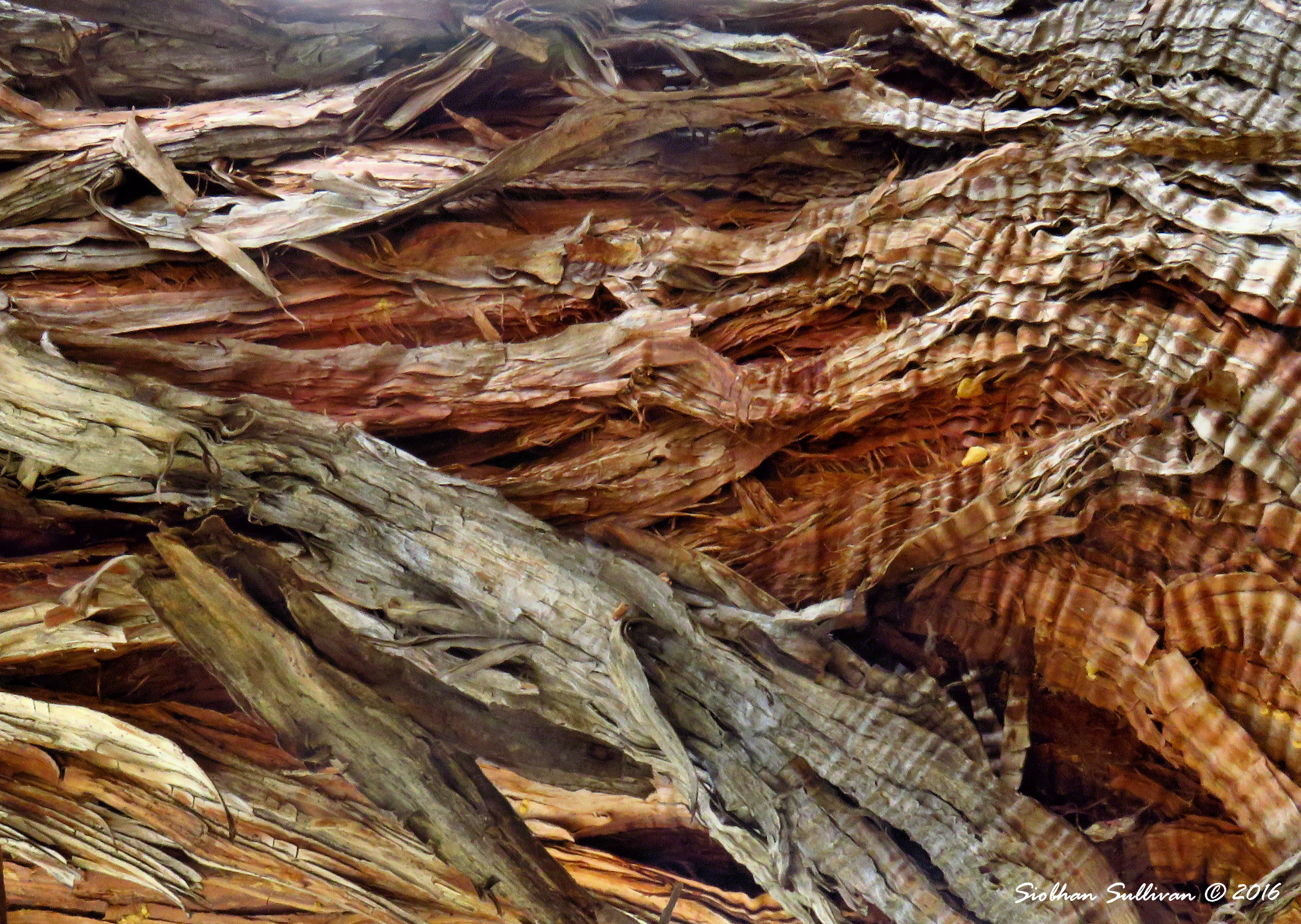
The second is a close up view of a different juniper tree’s bark. Though some see western junipers as an unwelcome invader in sagebrush habitats, I’m impressed by their beauty. Their rough bark varies in color, as does their wood. Wrinkles add to their character as they age. The birds in my yard are grateful for the shelter and food these trees provide.
The third picture is of my “pet” Cooper’s Hawk. I’ve taken a lot of pictures of her. On this day, she took an extended bath and spent a long time preening her feathers. Her fluffed up feathers, piercing gaze, and stance are not the typical view you get of these raptors. It was one of those memorable moments!
I’ve noticed odd plants, animals, and natural features recently and wondered if they were real or surreal.
I had an odd feeling when my flight flew over Mt Rainier a few weeks ago. Just as we passed over its peak, this strange creature emerged from its depths. Yikes! I was glad I was able to take a quick snapshot before it disappeared.
While exploring Crack in the Ground on a June field trip, I was overcome by a sudden feeling of peacefulness. I paused when I noticed a movement from the corner of my eye. This benevolent Picasso face emerged from the rock walls and smiled and nodded at me.
On a recent hot afternoon, I dozed off in my comfortable recliner. I was awakened by a strange noise. A few feet away, I saw a weird creature. It had the head of a ground squirrel and the body of a cat. Was it real or surreal?
When I was strolling down Hood Avenue on 9 July 2022, something across the street caught my eye. I was there to see the art of quilters at the Sisters Outdoor Quilt Show. Though the event has taken breaks due to wildfire smoke and pandemics, it proudly celebrated its 47th year in 2022.
A WOW! quilt
I had to take a closer look at this quilt. WOW! I think it was my favorite of the whole show. The intricate stitching and subtle changes in color drew me towards it. There are signs telling you not to touch the quilts, but I really wanted to touch this one.
I continued my walk and noted some of the interesting architecture in this western-themed town. This clock business was one of my favorites. I’ve always wanted to live in a house with a tower.
Attention getters
Some quilts attracted a lot of attention and I had to wait for visitors to pass by before snapping a picture. Here is one of those.
The Sisters Outdoor Quilt Show is one of the biggest events in Central Oregon. You know it’s summer when you start seeing advertisements about the show.
Set in the small town of Sisters, Oregon, this show “is internationally recognized as the world’s largest outdoor quilt show.” The show often displays more than 1,300 quilts. Visitors from all over the world gather in Sisters on the second Saturday in July to view the quilts.
The quilts shown include more traditional patterns.
North of Madras, Oregon, you’ll find giant thundereggs tucked away on a hilltop near the ghost town of Ashwood. Polka-dot agates and thundereggs occur naturally at the Priday Polka-Dot Agate Beds.
The thundereggs you’ll find here are amazing! You never know what kind of treasures you’ll find on the inside.
Today I’m sharing a primrose painting, photo, and poem I created. When I was on a field trip in early June, we saw a “field” of this plant in bloom near Crack in the Ground. Tufted evening-primrose, Oenothera caespitosa, usually only bloom at night but on that day, dark clouds filled the skies.
Here’s a watercolor I painted of the flowers.
And here’s the work in progress in my little studio space.
This is the close up photograph I took of these beautiful flowers near Crack in Ground. I’m growing evening-primrose in my landscaping and, so far, the always hungry resident mule deer have not discovered them. 🤞
Here is a Sijo poem about these remarkable flowers.
Awakened when the moon rises over the silent desert Flowers in sandy soil open, shining like pale lanterns Enchanting the world with intoxicating scent, until dawn breaks
Do you have artwork you would like to share? Be sure to include the First Friday Art tag.
The Powder House building, near Prineville Reservoir State Park in Central Oregon, makes a great subject for photographs. This historic rock structure was once used to store gunpowder. It’s located next to a popular boat ramp on the reservoir.
I’ll be showing how I processed this picture three ways with Corel PaintShop Pro 2021. Prior to trying out the various effects, I increased the contrast, brightness, and white balance slightly.
The first two show the original and the same picture with a Retro effect. For this image I went to Effects>Photo Effects>Retro Lab>Surreal. This effect blurred the edges like a vignette. I thought this effect emphasized the door in the building. It looked like a portal to another place surrounded by misty fog.
The next two show the original and the same picture with a Time Machine effect. For this image I went to Effects>Photo Effects>Time Machine>Albumen. This monotone effect reflects a technique used in the 1850s-1890s. It works well when you’re trying to emphasize the history of a place. A picture such as this might have appeared in newspapers of the time.
This beautiful exhibit at the High Desert Museum featured x-ray images of fish. X-Ray Vision: Fish Inside Out! The Smithsonian National Museum of Natural History and the Smithsonian Institution Traveling Exhibition Services (SITES) organized the exhibit.
I am presenting them in sepia tone. The photographers at the Smithsonian showed their structure in artistic layouts.
Though I wrote down the species of the fish in each display, I decided to let the x-ray images of fish speak for themselves. The wonder of Nature.
This exhibition closes at the High Desert Museum on May 8, 2022, but it will continue travelling to other museums around the country.
Last month, we collected petrified wood bits from Bear Creek, south of Prineville Reservoir in Oregon. The following pieces are one inch or less in size. Getting decent photographs of these tiny stones proved to be a challenge.
I set up a tabletop studio and tried a Panasonic Lumix and a Galaxy Ultra phone camera. I had to keep adjusting the spotlights outside of the studio. Each stone was given a quick spritz of water to bring out their color. After many unsuccessful attempts with both cameras, I finally got some good shots with the Panasonic.
You’ll find The The Bend Wall mural on the side of Newport Market, a neighborhood grocery store in Bend, Oregon. The bright painting covers a 100-foot long wall on the side of the building.
This impressive piece of artwork was created by Bend artist, Kim Smallenberg.
The mountain in the center of the mural is Pilot Butte, a dormant volcano. On the right side near the peak, you can see a small fire. On the Fourth of July, commercial fireworks are launched from Pilot Butte, and sometimes, it catches on fire. Our Fire Department is always there and ready.
A large metal sculpture of a bear sits in front of one end. The mural behind the bear shows dogs around a campfire. Bend is a dog-centered town. Many residents own one, or two, or…
The Western Antique Aeroplane & Automobile Museum in Hood River, Oregon has a large collection of cars from the “Golden Age of Transportation” – the period from the early 1920s through the 1940s. The Museum has a collection of over 130 vehicles from the 1900s to the 1960s. You can get more information on vehicles in the collection by year or manufacturer here.
Cars from the Golden Age and beyond
Artifacts from the time period are on display near many of the cars. Here’s a camping scene.
Storefronts around the perimeter of the building add visual interest to the collection.
The color and design of the cars make them great subjects for photographs.
I noticed these whimsical doors in Tumalo, Oregon while visiting a pod of food trucks. The Bite currently hosts five food trucks. You can get an assortment of beers on tap inside the main building. There is comfortable seating inside and out.
These paintings were done by local artist, Nicole Fontana. There are more pictures of her work at The Bite here. She even included her whimsical take on things in the signs for handicapped parking spots. 🙂
Here in Central Oregon, homeowners can take steps towards fighting future fires for free. In the spring, you can dispose of yard waste for no charge. In Bend this year, the free disposal runs from April 30 through May 15. Here’s a link showing dates at all locations. The landfill also takes yard waste for half price in early November.
Piles of yard waste
You may wonder why the local landfill is taking yard waste without charging the usual amount. Central Oregon is in the exceptional drought category, according to U.S. Drought Monitor.
A couple days ago, we went on a Lower Crooked River drive. We were there early in the morning, attempting to avoid an incoming storm system. I remembered I had been there about a year earlier for an afternoon drive. How would the lighting differ in the photos taken on both trips?
Just south of Prineville, Oregon, the Lower Crooked River Back Country Byway winds its way along the Crooked River. The 43-mile long road meets up with Highway 20 to the south.
This post highlights the 8-mile section between Prineville Reservoir and Castle Rock. See map at the end of the post. On this drive, the curving lines of the road and river contrast with the straight lines of geological features.
A morning drive
As we drove north from the reservoir, shadows covered the east side of the road. The morning light cast a warm glow over the canyon lands.
When taking pictures, you might want to think about composing your photo in thirds. What?
According to the Digital Photography School, the rule of thirds “is a compositional guideline that breaks an image down into thirds (both horizontally and vertically) so you have nine pieces and four gridlines. According to the rule, by positioning key elements along the gridlines, you’ll end up with better compositions.”
While browsing my photos, I realized horizontal layers are more important to me in composition. Do my pictures always follow the rule of thirds guidelines? No, it’s okay to bend the rules.
SLR Lounge notes, “Of all the “rules” in photography, the rule of thirds is one of the easiest to successfully break.”
My photo in thirds examples (with layers)
This sandhill crane is in the upper third corner, but the differing textures and colors of the plants catch your attention. This photo has four layers.
This pronghorn is near the lower third of the picture. I could have cropped it more, but I didn’t want to cut out the misty mountains in the background. This photo has five layers.