Manzanita blossoms are putting on a show right now in Central Oregon. The delicate pink blossoms contrast with the thick, leathery green leaves and red bark. The bark on these shrubs peels like on a madrone tree. It’s one of my favorite local plants but it refuses to grow in my garden. That gives me an excuse to seek them out in the wild.
Nature
A bold blue sage border: Friday Flowers
I saw this bold blue sage border in the 80-acre Oregon Garden, located in Silverton, Oregon. It’s impressive how they pay attention to all the plants surrounding bold flowers such as these. The framing brings out their best features.
Within a small seed – 4 haiku: LAPC
within a small seed
a tiny new life slumbers
awakened by sun
emerald limbs stretch
stems lengthen and reach skyward
embraced by springtime
Colorful lichen up close: Macro Monday
Rooms with a view: Wordless Wednesday
Following Pronghorn: LAPC & WWP
I’ve been following pronghorn for years. They have much to teach us.
A restless past
In the distant past, I was always restless, bounding from place to place, relationship to relationship. Once I started sensing my roots taking hold, I would break free, fleeing restraints. I sprinted towards the next place or person. Like an animal being pursued by a predator, I found it easier to run.
Following Pronghorn
One day I started thinking of pronghorns, those iconic creatures of the Wild West, differently. Maybe I could learn something from them. They are a one-of-a-kind animal, not quite fitting into any family. I felt that way too and I began following pronghorn.
Continue readingA colorful corner in Bend: Friday Flowers
Here’s a colorful corner filled with blooming summer flowers. This planting includes: hollyhocks, foxglove, blanket flowers, ‘orange blaze’ red hot poker, black-eyed Susan, pansies, and more. I’m looking forward to seeing them again in a few months.
See more photos of flowers in bloom at Flower Border at Old Mill and A peninsula of flowers.
The inventor of Velcro: Wordless Wednesday
A white coneflower up close: Macro Monday
Here’s a white coneflower up close in my garden. I usually see pink or purple coneflowers, but they’re also pretty in this color. Their scientific name, Echinacea, comes from the Latin word for ‘sea urchin’ and the Ancient Greek word for ‘hedgehog.’ The spiny cone-shaped central disk resembles some type of prickly creature.
Elusive birds captured – finally!: LAPC
One of the challenges of photography is capturing images of elusive birds. Sometimes certain species are not considered difficult to photograph, they only elude YOU. Here are a few of mine.
Intelligent & elusive birds
I have been trying to get a decent photo of a black-billed magpie for a long time. These intelligent birds usually take flight when I approach. I finally captured the essence of a magpie recently near my home. This photo shows its long, elegant tail, striking markings, and iridescent plumage.
Slide the slider to the left to see the type of photos I have taken in the past of magpies. This one was near Mammoth Hot Springs in Yellowstone National Park. It teased me by hiding behind the sagebrush.


Shy & elusive
I’m lucky because mountain bluebirds nest in my yard. When I visit Glass Buttes, an hour away, during the spring months, the bluebirds pop out ready to be photographed.
However at my home, the birds are especially shy, as you can see in the second shot. They somehow sense I’ve picked up a camera and fly away or turn their back towards me.


Distant & elusive
Continue readingThree Sisters view from Hatfield Ponds: Wordless Wednesday
Wildflowers in the Desert – Nonet poem: LAPC & SS
Wildflowers in the desert sunshine
Emerging in harsh conditions
Shining with an inner light
Colorful expressions
Jewels in the sand
Ephemeral
Presences
Fleeting
Views


Wildflowers in the desert photographs taken at Gray Butte, Oregon in the springtime.
Spring birds: Bird Weekly Photo Challenge
The challenge this week is to show photos of birds seen over the past two weeks. As spring progresses, more and more birds, and tourists, are showing up.
Here’s a California scrub-jay perched on an interpretive sign in Bend, acting like a tourist. They change the flags displayed on this bridge throughout the year. On this day, they happened to match the jay.
I’ve been seeing this lone swan near the flag bridge for several weeks. It was hard to figure out if it was a tundra swan or the less common trumpeter swan. It finally got within a few feet of me last week. It’s a tundra swan. See the bit of yellow near the eye? They don’t always have the yellow patch, but it’s the best clue.
For comparison, here’s a trumpeter swan we saw this week at Malheur National Wildlife Refuge. The skin between the eye and bill is thicker and all black.
Continue readingWater falling acrostic poem: LAPC
Water falling
And
Tumbling
Entering a
Rogue river
Finding
A course
Lyrical and
Littoral


Photographs of water falling were taken along Oregon’s Historic Columbia River Highway. For more information, and a map, see Waterfall Tour Loop.
Sockeye salmon 2-sided rock: First Friday Art
Today I’m sharing a sockeye salmon 2-sided rock painting I created. On one side you see what this fish looks like when it’s spawning, and on the other side you see what it looks like at other times in its life cycle. They look SO different!


Sockeye salmon travel from the ocean to freshwater to spawn. Kokanee are a landlocked version of sockeye. If you’re lucky enough to catch one, they are especially delicious smoked.
Here’s a video of sockeye spawning in the Adams River in British Columbia, Canada. The 3-minute video, by Luke Gibson of Life of Luke, shows aerial and underwater shots of the fish. I loved his creative solution to filming underwater shots on a limited budget! A true artist will always find a way to work around obstacles.
Do you have artwork you would like to share? Include a First Friday Art tag on your post.
Summer scene in green: Wordless Wednesday
Frosty ponderosa pine pom-pom: MM & MM
Crack in the Ground – An amazing sight!: LAPC & FFC
Last week we visited Crack in the Ground in Central Oregon near Christmas Valley. You may be wondering what exactly this place is. Well… it’s a huge crack in the ground in the middle of the desert.
I wasn’t sure what to expect, but I was impressed by the crack’s picturesque angles and curved surfaces.
There’s a 2-mile trail inside that reaches a depth of ~70 feet below the surface. We took the left path that has a more gradual entrance. It’s in the middle of the picture below. This trail is relatively easy but if you go the whole length, expect to climb over boulders and through some cracks.
But how did this crack get here? It’s an ancient volcanic fissure. I learned in most climates, fissures fill up with soil and rock from erosion. Since it’s so dry here, there has been relatively little filling.
Crack in the Ground sits within the Four Craters Lava Bed. During the Pleistocene, four cone volcanoes were active here. A shallow depression formed when older heavier rock sunk. The fissure opened near the edge where there was tension along a fault zone. This Bureau of Land Management map shows the extent of the lava beds and the location of Crack in the Ground.
Continue readingPine trees at Lava Lands: Thursday Tree Love
Pine trees towering over an ancient lava flow at Lava Lands Visitor Center, in the Newberry National Volcanic Monument, Oregon. You can see South Sister and Broken Top in the distance.
The 0.4-mile Trail of the Whispering Pines winds its way through the forest near the visitor center. You get great views of pine trees, Lava Butte, and several nearby volcanoes. This path sits on part of Newberry Volcano, a 1,200-square mile shield volcano.
South Sister, pictured on the left above, is the youngest and most geologically active of the Three Sisters volcanoes. The mountain last erupted 2,000 years ago, but a “bulge” began forming in 1997. By 2001, the bulge grew to 9 inches in height and 10 miles in diameter. Its growth since that time has slowed considerably. Both South Sister and Newberry are regularly monitored for volcanic activity.
The Lost Forest – A short story: LAPC & SWP
When I was a young child, my grandfather often told me the tale of the Lost Forest. Here is how he told it…
The people of the village disliked them for their beliefs, distrusted them for their appearance, so they fled. The villagers pursued them so they ran faster and faster.
They paused on a faraway hill and sought shelter beneath the sagebrush. The pursuers shouted in the distance. Unsure what to do, they became a part of the environment.
One by one, they stood still and extended their arms with palms tilted upward. Long green needles sprouted from their fingertips. Puzzle-like bark crept over their skin. They wiggled their toes and pale white roots snaked their way into the soil. A shudder ran through their bodies and branches poked through their buckskin clothing.
And then they grew. They shed their human form and grew taller and taller.
Continue readingRough & rippling bark: Macro Monday
Waterfowl reflections on the Deschutes: BWPC
Today I’m featuring photos of waterfowl reflections taken on the Deschutes River. The first picture is of a lone swan that has been hanging around Bend, Oregon for the last several weeks.
Here’s a pair of common mergansers taking off along the Trout Creek trail, north of Madras.
Here’s a pair of hooded mergansers in Bend, Oregon.
Continue readingAn amazing collection – Baker City Rocks!: LAPC
When I walked around a corner into a gallery at the Baker Heritage Museum a couple years ago, I didn’t know what to expect. Wow, what a special moment! As you may know, I like rocks and this is an amazing collection of rocks, minerals, and fossils.
One of the first pieces you see is a 950-pound crystal from Arkansas. I would love to have something like that in my rock garden.
Two sisters in Baker City, Mamie Cavin and Elizabeth Cavin Warfel, collected specimens for 45 years and donated their collections to the museum in 1983. The 18-ton Cavin-Warfel Collection, together with other donations at the museum, is considered to be one of the best collections in the country. In fact, at one time the Smithsonian offered $500,000 to acquire it.
Cabochons and cut pieces of picture jasper cover one wall. Cabochons are gemstones that have been shaped and highly polished, rather than faceted. Billy Wyatt donated this collection.
Colorful specimens of green malachite and blue azurite are in this cabinet. Both are secondary minerals found in copper deposits. Malachite is one of my favorites and I have a few in my collection. The Oregon Department of Geology and Mineral Industries donated specimens related to mining to the museum.
Continue readingFiery red oak tree: Thursday Tree Love


I watched the colors turning last fall on this fiery red oak tree in a local park in Bend, Oregon. This young tree doesn’t yet have the twisting branch structure of mature oaks, but those uniquely-shaped leaves are beautiful three seasons of the year.
After the fire near Warm Springs: Monochrome Monday
The Hoodoos – A story in 47 words: LAPC & WWP
Walking among the hoodoos in the morning light, feeling out of my element.
Sculpted towers surround me, casting tall shadows. Their wind-carved faces turn towards the sun,
until clouds block their view.
Continue readingA brooding High Desert sunset: Wordless Wednesday
Softness in the skies haiku: LAPC & SS
softness in the skies
adrift over layered tuff ring,
white veils eclipse sun


Skyscapes from Fort Rock, Oregon.
Snow-capped mountain ash: Thursday Tree Love
A cluster of crystals up close: Macro Monday
Steam-filled Yellowstone landscapes: LAPC
During the chilly winter months, I sometimes think of the steam-filled landscapes of Yellowstone National Park. I wish I had a natural hot spring in my backyard. The thermal activity beneath Yellowstone is always producing steamy white clouds.
This view is from the Artists’ Paint Pots trail. Lots of contrasting colors and great views of the steaming basin from the top of the trail.

This is a hot spring near Morning Glory Hot Spring, one of my favorite sites in the park. See the ravens enjoying the warm water?

Grand Prismatic has rainbow colors, layered soil, and lots of steam. Did you notice the bison tracks in the foreground?

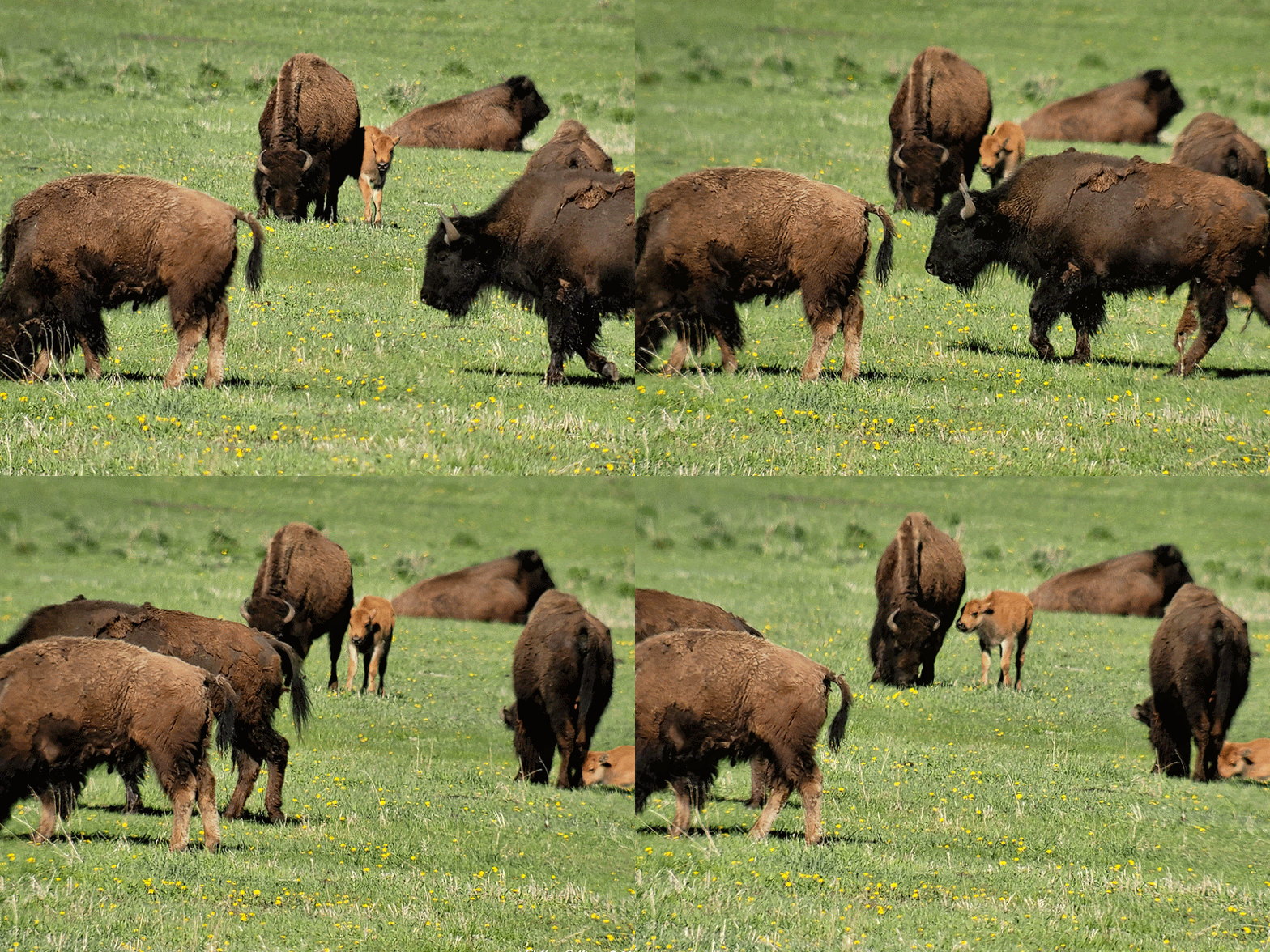
The bison spend time near the hot springs throughout the year. Here’s a pair grazing near a boardwalk trail.
Continue readingA Cooper’s hawk visited me: BWPC & SSPC
A couple weeks ago, a Cooper’s hawk visited my yard for two hours. She perched atop a snag for a long time grooming herself.
I’m guessing this was a female because it was a big bird with orange eyes. Females are larger in size than males. Cooper’s hawk eyes can be yellow, orange, or red. Mature males have deep red eyes but few females do.
Here are a few photos of her close up.
Continue readingA planter full of color: Friday Flowers
Benham Falls, Deschutes River: Wordless Wednesday
Old one’s last winter haiku: Haiku Prompt Challenge
Walking with Winter in B & W: LAPC
Walking with Winter along a River of Falls
Where snow softens hard edges of steel

And creates ephemeral works of whimsey

Where snow and ice form furrowed bridges
Continue readingFavorite songbirds of Central Oregon: Bird Weekly
I have many favorite birds, but today I’m turning my lens towards favorite songbirds that live near me in Central Oregon.
The first bird, is a sage thrasher. Plain of feather, these birds have a lovely melodic song. Thrashers are one of the songbirds of the sagebrush sea that I studied for my graduate work. They are a canary in a coal mine kind of bird.
The second bird is a varied thrush. They look like a robin with a mask, necklace, and checkered wings. I love their haunting song.
The third bird is a California scrub jay. These bold birds have expanded their range. They’re entertaining to watch and hear.
Continue readingAn Autumn meadow: Wordless Wednesday
Using digital magic to edit photographs: LAPC
I like using digital magic to bring out the best in my photographs before I post them. I use Corel PaintShop Pro, a less expensive alternative to Photoshop.
Clean up an image
This is a slide I kept in my tent during fieldwork and tiny spots of mold had grown on it. They couldn’t be removed physically so I used a digital scratch remover and cloning tool to erase them.
Crop an image
I took this picture of a pair of burrowing owls at the High Desert Museum. There was a lot of glare on the window of their enclosure. I cropped the photo, and in the edited version, they look like they’re in a natural setting.
Continue reading