pushed by hot magma
through ancient layers of rock
the pull of dawn’s light

Ronovan Writes Weekly Haiku Poetry Prompt Challenge # 371 – Pull and push
pushed by hot magma
through ancient layers of rock
the pull of dawn’s light
Ronovan Writes Weekly Haiku Poetry Prompt Challenge # 371 – Pull and push
This lone tundra swan lived in the Old Mill District of Bend, Oregon for several months this year. Its graceful silhouette, and the waves surrounding it, are highlighted in these black and white images.


These western juniper trees near the shore of Prineville Reservoir were rooted in the past. After many years of fluctuating water levels, their roots became exposed. The red volcanic soil here stands out in strong contrast with the deep blue sky and green foliage.
We planted a couple artichoke plants in our garden this year and assumed they died after a week of extreme heat. Several leaves on both plants turned brown from the sun, but the plants survived. Here are their purple blossoms up close. Artichokes are pretty and tasty!


High desert clouds fill the dawn sky
Graceful brushstrokes conceived to fly
Drifters over earth
Interspersed cloudbursts
Dusk desert, glowing high


Sometimes you visit places where the landscapes are pretty as a picture. Here are a few places I’ve visited in the western states that feature picture postcard views. I tell a tiny tale about each of them.
Kiger Gorge on Steens Mountain, Oregon is full of drama. A giant serpent tunneled through here leaving scales of deep green. Wise ones believe the sweetest water can be found in shallow wells beneath these strands of greenery.

Morning Glory in Yellowstone National Park, Wyoming is a glorious sight. The artist who created this landscape experimented with various colors. She could not settle on using a single color and discarded her pallet here for us to find.

This grandfather tree in Arches National Park, Utah often told tales of wild places to his many grandchildren. When he passed, they honored him by preserving the bones of his existence and planting golden flowers near his roots.

Once a year, in the middle of June, Clearwater Native Plant Nursery opens its gates to the public. This contract grow nursery provides native plants for restoration and landscaping projects. Plants sold here grow well in upland, riparian, and wetland habitats. The nursery is located in Redmond, Oregon.
Clearwater Native Plant Nursery provided plants to the Deschutes Land Trust for the restoration of Whychus Creek, 15 miles to the northwest. The plantings provided wildlife habitat and helped stabilize the soil near the creek.

I had never been to their annual sale before. This nursery is not open to the public the rest of the year.
We arrived soon after opening and there were already a lot of people there. Plants ranged in price from $3 for a 4-inch pot, to $27 for a 5-gallon pot.

Plants for sale are laid out in neat rows.
Continue readingIn Washington State, locals call Mt Rainier The Mountain. When clouds fill the skies and you catch a glimpse of her, people say, “The Mountain is out!” I took a quick trip up to Seattle this weekend and had a picture perfect view of Mt Rainier from above. What a gorgeous sight!

When you travel the backroads in this part of the country, it’s not uncommon to see cattle herds movin’ down the road guided by cowboys. We saw a couple cowboys on horseback moving this herd near Malheur National Wildlife Refuge.

You’ll see dust clouds long before you see the animals.

The cattle often stop in the road until they are pressured into moving. Watch for signals from the horseback riders to their dogs herding the cattle. Do your best to stay out of their way.
Continue readingThis gigantic pine is Big Tree, AKA Big Red, the biggest Ponderosa pine, Pinus ponderosa var. ponderosa, ever recorded. It’s located in LaPine State Park, north of La Pine, Oregon. Though it lost 30 feet of its crown during severe storms, it is still the largest Ponderosa pine in circumference.

Here are some facts about this tree:
LaPine State Park Manager, Joe Wanamaker, gave insights about Big Red in an article in the local Source Weekly. He thought it was spared from being logged due to evidence of fire damage. This may have affected the quality of the wood harvested. Wanamaker also pointed out this tree is growing in an ideal location where water tends to collect in the soil from the nearby Deschutes River.
A paved, ADA accessible, 1/4 mile trail leads to this unique sight. Foot traffic around this much-loved attraction caused soil compaction that threatened its growth. A protective fence was constructed around it in the year 2000.
In this map of the park, from Oregon State Parks, Big Tree is located in the lower right corner.


souls from the past send
wispy notes in azure skies
smiles of summer sun
On our recent visit to Yellowstone National Park, we took a side trip to Yellowstone Hot Springs. This attraction is located in Gardiner, Montana, about ten minutes north of the park.

In the last 100+ years, this site has passed through many hands. In 1899, French-Canadian immigrant, Julius LaDuke, staked a mining claim here and discovered it contained hot springs. He created LaDuke Hot Springs Resort to serve miners and visitors to the area. The resort included a large plunge bath and several smaller private baths. A two-story hotel was built nearby. LaDuke entered into a short-lived purchase agreement with William F. Cogswell. This was one of many setbacks in his life.
Visitors traveled by coach to Electric, later known as Aldridge, and then had to cross the 150-foot wide river to the springs. LaDuke employed barges, then a cable ferry, then a ferryboat, and finally a swinging footbridge for his guests.
Guests rumored to have visited LaDuke Hot Springs Resort include President Theodore Roosevelt and famous frontierswoman, Calamity Jane.
Continue readingI saw flowers, flowers everywhere while walking the riverside trail in the Old Mill District of Bend this morning. This is my favorite time of year to walk by the plantings near the amphitheater. Can you see why?

I saw this yellow & white iris in bloom in mid June. When you see them blooming, summer is on the way. The golden colors in this blossom mirror the warmth of summer days to come.

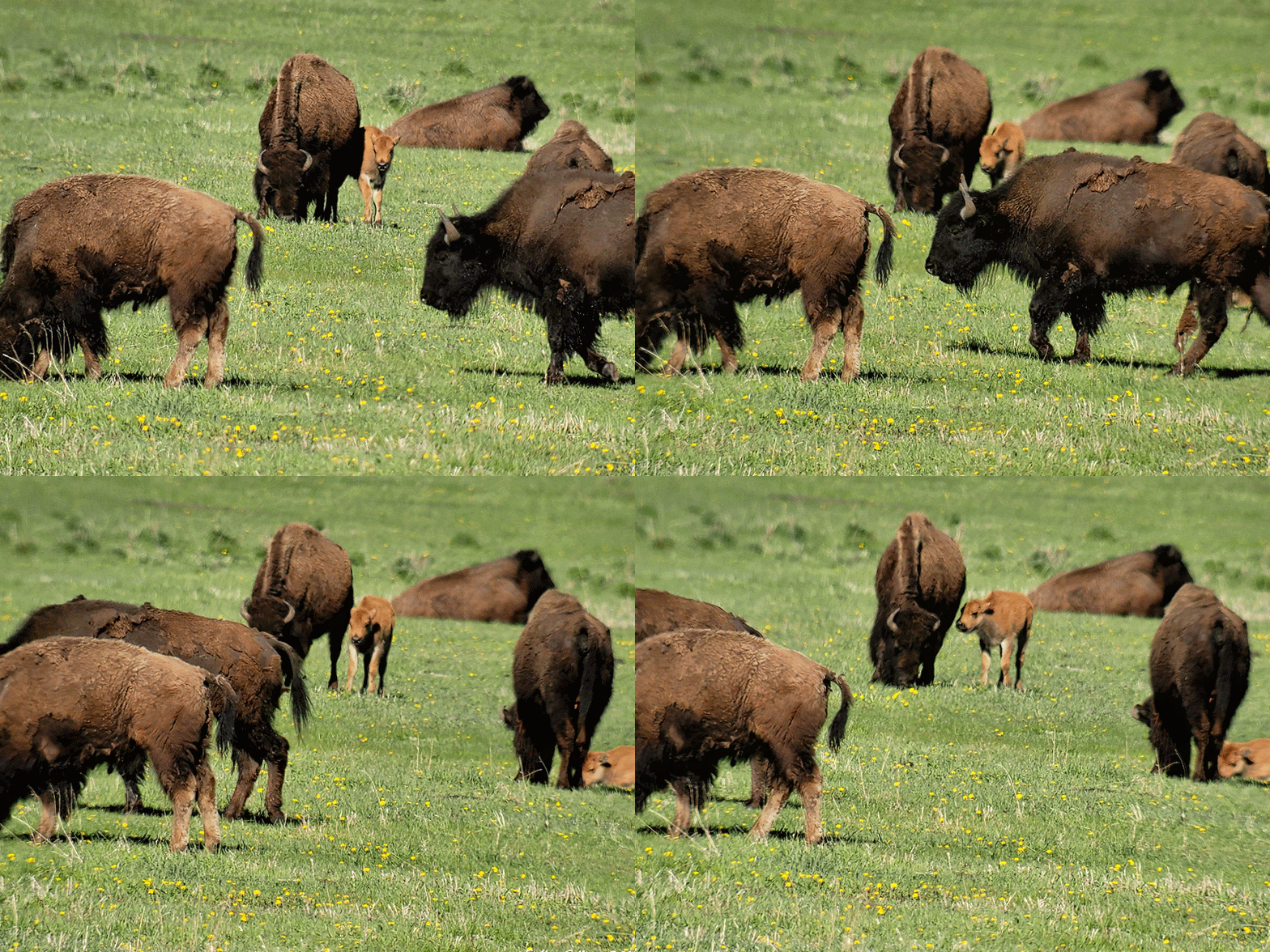
creatures of the mist
graze in meadowlands of steam
whisperers of warmth


So, the other day I heard a loud “chirp, chirp” call outside my house. I peered out the back door and spotted a baby American Robin in the middle of the yard. Maybe it was the same one we put back in its nest several days before, giving it one more chance at life.
When I approached, the young bird walked underneath some cactus in my garden. Meanwhile, both parents continued chirping loudly.
A movement nearby caught my eye. A Red-tailed Hawk lurked in the background, watching the fledgling. No wonder the parents of the baby robin were upset!

I tried to catch the young robin, but it flew. Not well, but I was pleased to see it could now fly. The bird settled in the gravel and rocks, right under my High Desert mural painting. Maybe it wanted to be a character in one of my stories. 😉
Continue readingWe went kayaking in early May at Prineville Reservoir after an unexpected change of plans. The high elevation lake we had planned to visit was not yet open.
The 15-mile long Prineville Reservoir covers 3,030 acres. It’s located south of Prineville, near the geographic center of Oregon.
I had never kayaked here before and wasn’t sure what to expect. The geology surrounding the lake was a pleasant surprise.
This formation was smooth and vegetated on one side and bursting with colorful rocks on the other.

These layers of color looked like a slice of spumoni ice cream.

When I paddled a little closer, the layers rippled with texture.

I was lucky to see the ’alae ’ula ,”burnt forehead” bird, while visiting the Waimea Valley on the island of O’ahu several years ago. This subspecies of mudhen is the Hawaiian moorhen or Hawaiian gallinule.
Population estimates range from 300-500. Due to their secretive nature, it’s difficult to know their exact numbers. Hawaiian moorhens live mainly on the islands of O’ahu and Kaua’i, with a few reports of sightings on the islands of Maui and Hawai’i. The 15 birds living at the Waimea Valley site are considered a treasured natural resource.

So where does this moorhen get the “burnt forehead” nickname? Here’s an explanation from the Waimea Valley website:
Continue readingWhirlybirds up close on a maple tree in my High Desert yard. I have fond childhood memories of collecting whirlybirds from the ground and tossing them up into the air. Watching them helicopter towards the ground was cheap entertainment in those days.

Photo editing is all about seeing things differently. I had fun with my Corel PaintShop Pro editing program in this post.
I was impressed by the rainbow of colors at our local Farmer’s Market. This photo looked like it would be a good candidate for the kaleidoscope special effect and I was right. Wow!


I took this picture near Grizzly Peak in Wyoming and I couldn’t decide which edit I liked better — color or black & white? The blue sky in the background pops in the color version, while the structure of the trees gets your attention in black & white.


We witnessed a symphony in the skies over Shoshone National Forest. Spectacular cloud formations and landforms are common sights near Cody, Wyoming. Dramatic wispy clouds such as these often fill the skies.
This morning I was out taking pictures of the sunrise and noticed this baby bird among the berries. It was lucky to have landed in a place covered with a cushioning layer of western juniper leaves.
I looked up in the tree overhead and spotted the nest. An adult American robin perched nearby, completely motionless. I talked to it and got no response at all. I have read that birds sleep with one eye open but this one didn’t follow that theory.
When we placed the baby bird back in its nest, it squawked and that finally got the attention of its parents. I hope it stays in the nest and fledges with its siblings.

Robins like junipers because they provide shelter and food. In the fall, they and other thrushes eat as many as 220 berries in a day.
The nest is in this tree. Can you spot it?

Today I’m featuring portraits of pink flowers in my Bend, Oregon yard. All of these plants are drought tolerant, once established.
The first photo is an ice plant. This groundcover has cheerful starburst flowers and succulent leaves. The leaves turn a bronze color in winter. We had an escapee take root in another part of our yard and it survived without watering.

The second plant is a Woods’ rose. This native 2-5 foot tall shrub attracts bees, butterflies, and birds. Red rose hips develop once the flowers lose their petals.


I saw this loop-de-loop lodgepole pine growing alongside Firehole Lake Drive in Yellowstone National Park. Everyone drove right past it but I had to stop and take its picture. I wondered what stopped it from going straight up. It figured out how to grow around obstacles and keep going in the right direction. A lesson for us all.
We just returned from a trip to Yellowstone National Park and the Norris geysers were spectacular, as always. Some of the geysers are big and showy; others are small but still impressive.
The picture below is of Steamboat Geyser. Gray stone, dappled with red and brown-colored rocks, surrounds the vent.
In 2020, this geyser erupted 48 times. Water shoots 300+ feet into the air, making it the tallest in the world. This year, once again, we just missed its latest eruption. It went off on May 31, 2021, the day we drove to the park from Bend, Oregon.

Here’s an overview of the basin. If you don’t have time to walk the trails, You’ll get great views from this observation area.

Here’s a view from the trail. There are geysers everywhere you look in the Norris Geyser Basin.
Continue reading
Ponderosa pine bark up close. This bark is made even more interesting with drips of amber pitch.
Macro Monday
These colorful lichens are growing on a rock in my High Desert yard. So much variety in a tiny landscape!

Macro Monday
The Warner Wetlands of south central Oregon are beautiful throughout the year. I dug into my archives to find photos taken long ago there, supplemented with a few recent ones.
You can view wispy sunsets over the wetlands in the summer.

Moody cloudscapes over them in the spring.

Snow and ice covering them in the winter.
Continue readingI recently hiked the Trail of Molten Lands at Lava Lands Visitor Center and paused to take in the volcanic views. The center is located within the Newberry National Volcanic Monument, a place with many recreational opportunities.
I took these photos from the Phil Brogan Viewpoint. On a clear day, you can see Mt. Bachelor, the Three Sisters, and other peaks in the distance. On this day, clouds covered them in soft shrouds. The visitor center reopened on May 20, a couple days after my visit. It’s a great place to learn more of this area’s volcanic past.

Here are a couple pictures of the volcanic views from a closer angle.

This 1.1 mile trail winds through basalt lava flows surrounding Lava Butte to the viewpoint.

I’ve been out and about more recently and photographed several spectacular sights seen in blue and green.
I thought the pictures deserved a story, so I made up a tiny tale to go with each one. At a virtual conference I attended yesterday, I learned a “micro-story” is a form of flash fiction with 300 or fewer words. I’m calling the following stories “mini-micros” since they range from 43 to 58 words. Not sure if they qualify as true stories, but they were fun to write.
A crowd of manzanita shrubs watches a shifting skyscape in awe. Their pink blossoms open in silent applause. Snow-covered Cascade volcanoes rumble in the background, taking in the show from a safe distance. Steam billows from their peaks, merging with the dancing clouds.

Clouds emerge from a crack in the ground on a chilly spring morning. They radiate outward from the ridgetop and tree branches stretch and reach towards them. Striated boulders celebrate by tumbling and crashing down a steep slope. An osprey drifting overhead crows in anticipation as another glorious day begins.

Though some consider Canada geese to be a “nuisance” species, they sure have cute goslings. I watched these young ones growing up fast in Bend, Oregon.

Here’s what they looked like a week later.

When I was out kayaking at Prineville Reservoir, these recently-hatched goslings struggled to conquer the huge-to-them wall.


Manzanita blossoms are putting on a show right now in Central Oregon. The delicate pink blossoms contrast with the thick, leathery green leaves and red bark. The bark on these shrubs peels like on a madrone tree. It’s one of my favorite local plants but it refuses to grow in my garden. That gives me an excuse to seek them out in the wild.