I found these remnants of a solitary life in my yard yesterday. This is what was left of a Townsend’s Solitaire thrush. I suspect one of our resident Cooper’s Hawks preyed upon it. The cycle of nature continues.

I found these remnants of a solitary life in my yard yesterday. This is what was left of a Townsend’s Solitaire thrush. I suspect one of our resident Cooper’s Hawks preyed upon it. The cycle of nature continues.
I see some of our backyard beauties often, like the chipmunks. This one came right up to our sliding glass door, driving our indoor cat crazy. It was showing me its best side.

Other animals give us unique views. This immature Cooper’s Hawk posed nicely for me on the back porch.

Our regular visitors can be very entertaining. Playful Mule Deer fawns like to run full speed around the yard (when they aren’t busy munching on my plants).

I saw this fence of gold near Mitchell, Oregon last week. Aspen trees, decked out in golden leaves, looked like someone planted them at regular intervals within the evergreen forest.


the blur of autumn
catcher of fading colors
thoughts of winter’s chill

I’m showing lighter and darker nature pictures to go with the lens-artists photo challenge of “exposure” this week. Sometimes I frame a shot with lighter and darker settings; other times I make changes during the photo editing process.
The first two pictures are of maidenhair fern growing along the trail in Silver Falls State Park. In this case I like both versions. Maybe it’s because I like all shades of green. 🙂


The next two pictures show a mountain peak near Mitchell, Oregon. The first shows the structure of the rimrock at the peak and the second brings out the clouds. I prefer the darker, more evil-looking, version.


Today I’m sharing a quick pen-and-ink drawing of an Indian peacock I drew. This was for the month-long Inktober drawing challenge. The prompt that day was “ego.” When male peacocks prance around displaying their tail feathers I think of them as being proud, egotistical birds. In reality, they are trying to attract mates and protect their territory.

Here’s a photo I took of a proud Indian peacock. I increased the color saturation when I processed it to bring out his beautiful blue and green colors.

When I think of peacocks here in Central Oregon, I think of Richardson’s Rock Ranch in Madras. They have a large indoor and outdoor rock shop and peacocks wander freely around the buildings.
Here’s a photo of their old family home with the birds perched on the front porch and foraging in the front yard. Can you see the pheasant decoration on the side of the building? The peafowl must have been attracted to it since they are also part of the pheasant family, Phasianidae.

Do you have artwork you would like to share? Be sure to include the First Friday Art tag.
First Friday Art (FFA)
Just wanted to share some Halloween greetings from my cat, Motor. He was one of our favorite pets. Small in size but big in personality!

I took this photo near Playa at Summer Lake in Oregon. Playa serves as a retreat for artists and scientists looking for a peaceful place to do their work. I was there for a workshop on Great Basin Natural History. This zigzag boardwalk was in a pond behind the cabins.
I’ll be showing how I processed this picture three ways with Corel PaintShop Pro 2021. Prior to trying out the various effects, I increased the contrast slightly. Slide the slider to see the before and after views.
The first two show the original photograph and the same picture with a Retro effect. For this image I went to Effects>Photo Effects>Retro Lab. This effect slightly blurs and darkens the edges and increases color saturation. I liked how this effect brought out turquoise colors in the sky and dark green in the marsh plants.


The next two show the original photograph and the same picture with a Black and White effect. For this image I went to Effects>Photo Effects>Black and White Film. I liked how this effect enhanced the contrast in the clouds.

Here are some peak peeks from near and far. These volcanic peaks are in the Cascade Mountains in Central Oregon.
The first picture shows a distant view of Mount Jefferson I took on a flight to Seattle. The small cloud hovering over its peak looks like a puff of smoke.

Here’s a closer view of Mount Jefferson taken from the road near Madras, Oregon.

This picture shows a distant view of Mount Washington. It’s the snowy peak in the middle of the photo.

Today I’ll share a few stories related to special flowers in my life.
Whenever I see roses, I think of a funny thing that happened to me when I was in my early twenties. I had just started dating a guy who checked parking passes where I worked. I invited him to my cozy little A-frame house on Puget Sound in Washington state. When we got to my house, I pulled open the screen door and there was a bouquet of roses tucked next to the main door. I grinned and asked if they were from him. “No,” he said sheepishly. He pulled a bouquet of roses from behind his back. Oops. The flowers in my door were from a different admirer. Awkward!
I took these photos on the High Desert Garden Tour this summer. The tour takes place in different Central Oregon locations, from sprawling rural ranches to tiny city yards. This year the featured gardens were in Bend.


Here are photographs of South Falls from 3 perspectives. This 177-foot high waterfall is located along the Trail of Ten Falls in Silver Falls State Park in Sublimity, Oregon. South Falls and Upper North Falls are the only trails where dogs, on leash, are allowed.
The first picture shows a distant view from the overlook trail in afternoon light.

The next photograph shows a closer view of the falls.

For this First Friday Art post, I’m sharing a hibiscus photo and a few drawings. I took this picture of a Spin the Bottle Hibiscus, Hibiscus rosa-sinensis, at the Oregon Garden in Silverton, Oregon. I’m not sure who came up with the common name, but it’s a funny one!

I’m sharing a quick pen-and-ink drawing I did of Hibiscus flowers. I’m participating in Inktober, a challenge where you make a drawing a day for a month based on prompts.
I tend to fuss over my artwork a lot, so for this challenge, I’m trying to draw fast. You create a different kind of artwork when working quickly. Is it perfect? No, but it’s a freeing experience. The goal is to capture the essence of your subject.
You can interpret the prompts any way you want to. Here was my interpretation of ‘bouquet’ from the October 5 prompt.

When out and about taking pictures, you never know when you might find special surprises. This delightful dragon sculpture was at The Oregon Garden in Silverton, Oregon. It brought a little cheer into a cloudy day.

Though not as much is in bloom at this time of year, I was happy to see these fall-blooming crocus at the The Oregon Garden last week.

Here’s the last glimpse of the sun going down on a nearly cloudless day near Waldport, Oregon.
Continue readingLast week we took a trip to Silver Falls State Park, in Sublimity, Oregon. We went on a short hike to visit Upper North Falls. Lush vegetation and towering trees surround the trail.
The Trail of Ten Falls in this park passes by ten waterfalls along a 7.2-mile moderate level route. Upper North Falls and South Falls are the only parts of the trail where dogs, on leash, are allowed.

We stayed a couple of nights at the campground in the park. There are cabins, RV and tent sites available for rental. This beautiful park is very popular so be sure to reserve in advance here.
On the other side of darkness,
it may be difficult to find a clear path ahead

The journey towards a viable future
may be surrounded by ghosts of what once was

Meander between colorful boulders haphazardly blocking the trail
in a landscape dark and unfathomable
How can your canine companions go so quickly from being a clean dog to a dirty dog?

I walked my dog recently along this trail bordered with flowers in the Old Mill district of Bend.
I often play fetch with her after we get home. The second picture shows what she looks like after she catches her ball a few times when we’ve had a little rain.
What a pretty girl! Can she sit on your lap? 😉

These places show contrasts in voice, feeling, and appearance.
A place’s voice can be quiet or loud.
The quietness of a vast sandy desert

And the pounding presence of a waterfall.

A place can feel ethereal or slightly evil.
Continue readingToday I received a little gift of beauty after a tragedy. A couple weeks ago, at a local grocery store, a young gunman killed an elderly customer, an employee that tried to stop him, and then himself. The community is still dealing with the tragedy, but is moving forward.
The store reopened today and employees were happy to see customers returning. Customers received an orchid plant as a token of the store’s appreciation. I thought it was interesting they chose to give customers orchids.

Orchids are epiphytes, often growing on other plants. The host plants offer support to these beautiful plants. Orchids rely on their host plants for survival, but they don’t harm them. Orchids enrich their shared environment.


Bend, Oregon and other places are learning to deal with tragedy. We are hesitant to depend upon each other for support, but when we do, our shared communities blossom and prosper.
Find beauty after a tragedy where you can and share it with others. 🙂
Geese flying high over Bend
Searching for good brews?
Soaring songs?


A cool place to rest at the Portland Japanese Garden last fall. There are comfortable places to pause and take in the scenery throughout the garden. Cooler temperatures and colorful autumn leaves are just around the corner in the Pacific Northwest.


Avian sentry alert at daybreak
Perched on cattails near High Desert lake
Dangerous clouds move in
Surrounding him
Lightning flashes
Thunder crashes
Blackbird sounds alarm
Protecting marshes from harm

If you’d like to see a large collection of amazing airplanes, be sure to visit the Western Antique Aeroplane and Automobile Museum (WAAAM) in Hood River, Oregon. The indoor hangar space is more than 3.5 acres in size.
All of the aircraft have been restored to working condition. This process takes a long time and the Museum restores an average of two per year. Our family donated a Fly Baby homebuilt plane, but it’s not yet on display.
The planes are generally arranged by type within the buildings.

Biplanes have interesting designs and they’re a great subject for photographs. I featured one of them in a black and white photograph in a previous post.
Mike and Linda Strong, friends of the family, donated the two 1929 WACOs pictured below. Mike worked as an airline pilot for many years and liked to fly smaller planes in his spare time. He gave me a ride in one of the WACOs years ago and it was a memorable experience.
The first WACO is a taper wing. At high speeds, tapered wings decrease drag and increase lift. They also make the plane lighter and more maneuverable.

In your travels near and far, you may find weird and wonderful sights.
Sometimes you find a weird sight when you’re driving down the highway and look it up later. This is the Smith Mansion, located in Wapiti, Wyoming, halfway between Cody and Yellowstone.
Lee Smith, a former builder and engineer, began constructing this structure from locally harvested logs. However, he became obsessed with adding on to the building, which led to his divorce. For 22 years he continued construction so that eventually it was 5-stories tall. One day, unfortunately, he slipped while working and fell to his death. His daughter owned the house for many years until it was sold to a neighbor in 2020.

For a better look at this amazing structure inside and out, watch this video by Scott Richard.
At other times you’ll go a little off the beaten path in search of a good meal. This delicious barbecue dinner is from the Apple Valley BBQ in Parkdale, Oregon. Parkdale, at the base of Mt Hood, is a small town with a population of about 650. Fruit orchards fill the valleys in this part of Oregon and the restaurant incorporates fruit into their meals. The coleslaw pictured contains slices of fresh pears. They use local cherry wood to smoke their meat. Yum, definitely one of my favorites!

The pictures featured in this post focus on part of the picture being in the spotlight. A darker background increases the contrast and draws your eye towards the lighter part.
We visited Steamboat Geyser at Yellowstone National Park in the early morning. The sun rose behind the scene, bathing the steam in light.

These two Northern River Otters at the High Desert Museum were in constant motion the day I photographed them. In this picture, sunlight illuminated both of their heads simultaneously.

I dip a dry brush into Titanium White and tentatively paint delicate wisps onto Cobalt Blue Wyoming skyscapes

Emboldened, I fill my brush and paint curving lines reaching towards the sky


Historic Short Bridge, built in 1945.
I saw these multi-colored trailing petunias in a hanging basket in downtown Bend. Since they produce so many flowers, another common name for this plant is ‘million bells.’

These perennials are hybrids from plants originally grown in South America. They bloom from spring through first frost and they’re easy to grow. They make a perfect addition to hanging baskets.
Though I don’t have a favorite type of photography, I prefer to do “lens in my pocket” photography. I use a Samsung Ultra phone or a Panasonic Lumix camera that easily fit into a pocket.
Sometimes I like taking panoramas of scenes from afar with my phone, such as this photo of bison in the Lamar Valley of Yellowstone National Park.

At other times, I like a closer view of wild creatures. This Barred Owl in my backyard was photographed with my phone attached to a spotting scope. This is called “digiscoping.” The owl visited regularly last spring, feasting on the numerous Pacific tree frogs in our pond.

I bought an inexpensive phone case and glued on a universal mount for digiscoping. You can quickly pop in a phone, attach it to a scope or binoculars, and it’s ready to go.


This is a pencil sketch I drew of a White-faced Ibis. He is a character in a book I’m working on. The ibis, Arco Iris, gets his power from the rainbow obsidian stone he wears. Sometimes if you draw a character, it helps you write about their personality and physical traits.

I recently took pictures of White-faced Ibis in a field near Paisley, Oregon. The field was full of blue camas and it gave the scene a kind of magical feeling.


When you think of ibis, you may think of ancient depictions of this bird found in Egypt, but there are three species in the United States. You can find Glossy Ibis, White Ibis, and White-faced Ibis in parts of North America, Central America, and South America.
Inlay depicting Thoth as the ibis with a maat feather. Image source: Metropolitan Museum of Art, CC0, via Wikimedia Commons
The plumage of our local ibis looks black at first, but when you take a closer look, it’s iridescent. Their feathers catch the light as they plunge their long beaks into marshes and meadows in search of prey. They eat a variety of prey including insects, worms, and small fish. Ibis are particularly fond of crayfish.

When in breeding plumage, some of the White-faced Ibis’ feathers turn a bronze color, their legs turn pink, and a mask of pale white skin around their eyes appears. What better way to attract a mate than putting on a mask, pink leggings, and a bronze cape!
Do you have artwork you would like to share? Be sure to include the First Friday Art tag.
First Friday Art (FFA)


wind-sculpted mountains
emerge from sandy shorelines
embrace life, vanish

Note: These sand “mountains” near Waldport, Oregon are about 1/2 inch tall.
In early June, while participating in a Great Basin Natural History workshop, I took photos of the storm over Playa. Playa, located on the shores of Summer Lake, serves as a retreat for artists and scientists looking for a peaceful place to do their work. They also offer a limited number of workshops.
We had an unusually wet spring here in the High Desert. This photograph shows a big storm over Playa. I stayed in the two-story cabin pictured and had commanding views of the Basin and Range landscape. High winds were pushing dust storms into the air near the lake’s shore.
I’ll be showing how I processed this picture three ways with Corel PaintShop Pro 2021. Prior to trying out the various effects, I slightly increased the contrast and brightness.
The first two show the original photograph and the same picture with a Retro effect. For this image I went to Effects>Photo Effects>Retro Lab>Process 2. This effect slightly blurs and darkens the edges and increases color saturation. I thought this effect made the center appear brighter and gave the photo a vintage feel.


Trying to choose only three of my favorite photos for this challenge was very difficult. I decided to focus on memorable moments from home.
The first shows a glorious fall sunset behind my juniper tree muse. I like the combination of color, lightness and darkness, and texture in this photo. The branches of the western juniper tree seem to be directing a symphony of clouds.

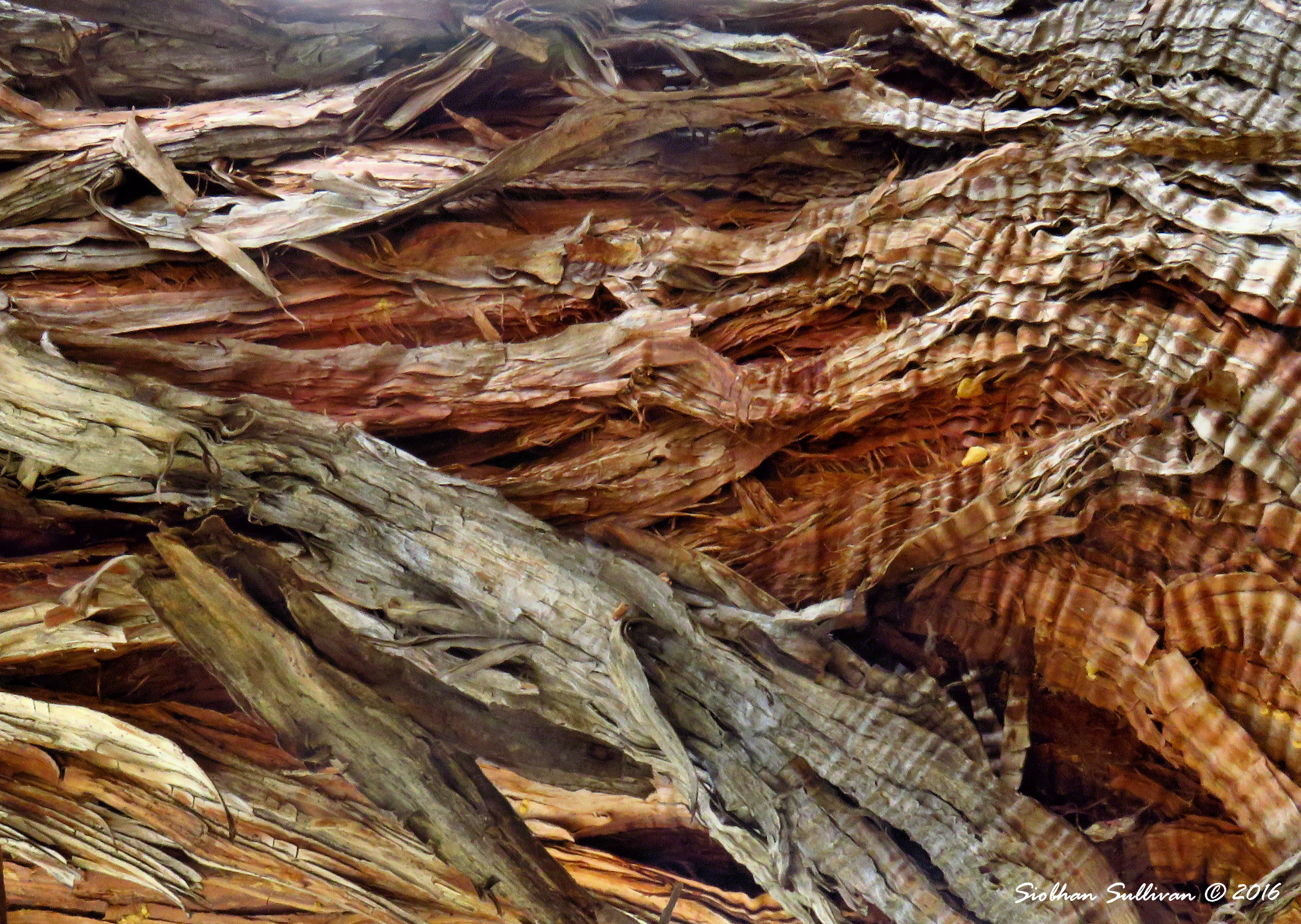
The second is a close up view of a different juniper tree’s bark. Though some see western junipers as an unwelcome invader in sagebrush habitats, I’m impressed by their beauty. Their rough bark varies in color, as does their wood. Wrinkles add to their character as they age. The birds in my yard are grateful for the shelter and food these trees provide.
The third picture is of my “pet” Cooper’s Hawk. I’ve taken a lot of pictures of her. On this day, she took an extended bath and spent a long time preening her feathers. Her fluffed up feathers, piercing gaze, and stance are not the typical view you get of these raptors. It was one of those memorable moments!

I’ve noticed odd plants, animals, and natural features recently and wondered if they were real or surreal.
I had an odd feeling when my flight flew over Mt Rainier a few weeks ago. Just as we passed over its peak, this strange creature emerged from its depths. Yikes! I was glad I was able to take a quick snapshot before it disappeared.

While exploring Crack in the Ground on a June field trip, I was overcome by a sudden feeling of peacefulness. I paused when I noticed a movement from the corner of my eye. This benevolent Picasso face emerged from the rock walls and smiled and nodded at me.

On a recent hot afternoon, I dozed off in my comfortable recliner. I was awakened by a strange noise. A few feet away, I saw a weird creature. It had the head of a ground squirrel and the body of a cat. Was it real or surreal?


