I dip a dry brush into Titanium White and tentatively paint delicate wisps onto Cobalt Blue Wyoming skyscapes

Emboldened, I fill my brush and paint curving lines reaching towards the sky

I dip a dry brush into Titanium White and tentatively paint delicate wisps onto Cobalt Blue Wyoming skyscapes
Emboldened, I fill my brush and paint curving lines reaching towards the sky
I saw these multi-colored trailing petunias in a hanging basket in downtown Bend. Since they produce so many flowers, another common name for this plant is ‘million bells.’

These perennials are hybrids from plants originally grown in South America. They bloom from spring through first frost and they’re easy to grow. They make a perfect addition to hanging baskets.
Though I don’t have a favorite type of photography, I prefer to do “lens in my pocket” photography. I use a Samsung Ultra phone or a Panasonic Lumix camera that easily fit into a pocket.
Sometimes I like taking panoramas of scenes from afar with my phone, such as this photo of bison in the Lamar Valley of Yellowstone National Park.

At other times, I like a closer view of wild creatures. This Barred Owl in my backyard was photographed with my phone attached to a spotting scope. This is called “digiscoping.” The owl visited regularly last spring, feasting on the numerous Pacific tree frogs in our pond.

I bought an inexpensive phone case and glued on a universal mount for digiscoping. You can quickly pop in a phone, attach it to a scope or binoculars, and it’s ready to go.


This is a pencil sketch I drew of a White-faced Ibis. He is a character in a book I’m working on. The ibis, Arco Iris, gets his power from the rainbow obsidian stone he wears. Sometimes if you draw a character, it helps you write about their personality and physical traits.

I recently took pictures of White-faced Ibis in a field near Paisley, Oregon. The field was full of blue camas and it gave the scene a kind of magical feeling.


When you think of ibis, you may think of ancient depictions of this bird found in Egypt, but there are three species in the United States. You can find Glossy Ibis, White Ibis, and White-faced Ibis in parts of North America, Central America, and South America.
Inlay depicting Thoth as the ibis with a maat feather. Image source: Metropolitan Museum of Art, CC0, via Wikimedia Commons
The plumage of our local ibis looks black at first, but when you take a closer look, it’s iridescent. Their feathers catch the light as they plunge their long beaks into marshes and meadows in search of prey. They eat a variety of prey including insects, worms, and small fish. Ibis are particularly fond of crayfish.

When in breeding plumage, some of the White-faced Ibis’ feathers turn a bronze color, their legs turn pink, and a mask of pale white skin around their eyes appears. What better way to attract a mate than putting on a mask, pink leggings, and a bronze cape!
Do you have artwork you would like to share? Be sure to include the First Friday Art tag.
First Friday Art (FFA)


wind-sculpted mountains
emerge from sandy shorelines
embrace life, vanish

Note: These sand “mountains” near Waldport, Oregon are about 1/2 inch tall.
In early June, while participating in a Great Basin Natural History workshop, I took photos of the storm over Playa. Playa, located on the shores of Summer Lake, serves as a retreat for artists and scientists looking for a peaceful place to do their work. They also offer a limited number of workshops.
We had an unusually wet spring here in the High Desert. This photograph shows a big storm over Playa. I stayed in the two-story cabin pictured and had commanding views of the Basin and Range landscape. High winds were pushing dust storms into the air near the lake’s shore.
I’ll be showing how I processed this picture three ways with Corel PaintShop Pro 2021. Prior to trying out the various effects, I slightly increased the contrast and brightness.
The first two show the original photograph and the same picture with a Retro effect. For this image I went to Effects>Photo Effects>Retro Lab>Process 2. This effect slightly blurs and darkens the edges and increases color saturation. I thought this effect made the center appear brighter and gave the photo a vintage feel.


Trying to choose only three of my favorite photos for this challenge was very difficult. I decided to focus on memorable moments from home.
The first shows a glorious fall sunset behind my juniper tree muse. I like the combination of color, lightness and darkness, and texture in this photo. The branches of the western juniper tree seem to be directing a symphony of clouds.

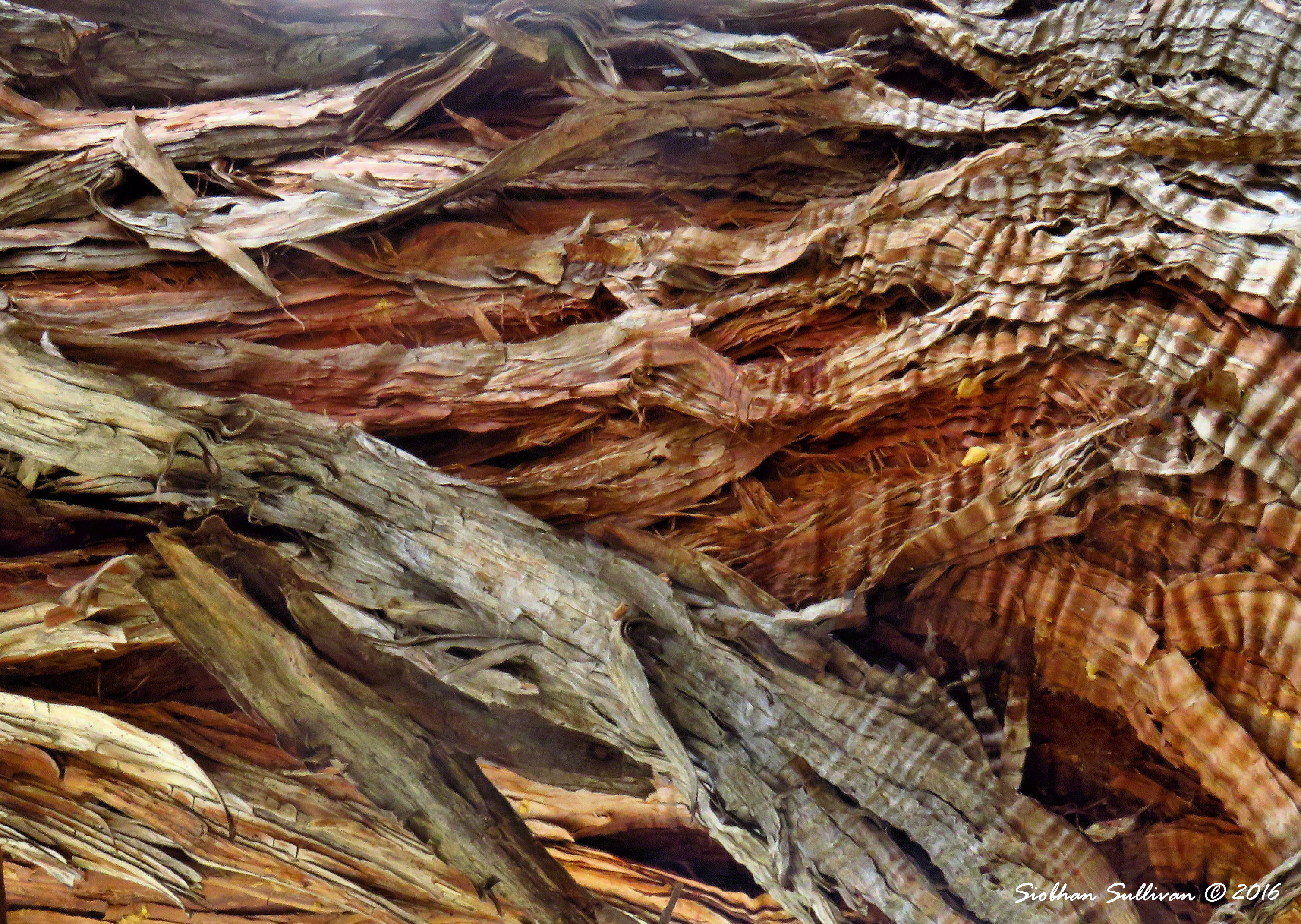
The second is a close up view of a different juniper tree’s bark. Though some see western junipers as an unwelcome invader in sagebrush habitats, I’m impressed by their beauty. Their rough bark varies in color, as does their wood. Wrinkles add to their character as they age. The birds in my yard are grateful for the shelter and food these trees provide.
The third picture is of my “pet” Cooper’s Hawk. I’ve taken a lot of pictures of her. On this day, she took an extended bath and spent a long time preening her feathers. Her fluffed up feathers, piercing gaze, and stance are not the typical view you get of these raptors. It was one of those memorable moments!

I’ve noticed odd plants, animals, and natural features recently and wondered if they were real or surreal.
I had an odd feeling when my flight flew over Mt Rainier a few weeks ago. Just as we passed over its peak, this strange creature emerged from its depths. Yikes! I was glad I was able to take a quick snapshot before it disappeared.

While exploring Crack in the Ground on a June field trip, I was overcome by a sudden feeling of peacefulness. I paused when I noticed a movement from the corner of my eye. This benevolent Picasso face emerged from the rock walls and smiled and nodded at me.

On a recent hot afternoon, I dozed off in my comfortable recliner. I was awakened by a strange noise. A few feet away, I saw a weird creature. It had the head of a ground squirrel and the body of a cat. Was it real or surreal?

As sweltering temperatures occur here and elsewhere around the world, my mind keeps wandering back to the landscape near the pagoda lantern at the Portland Japanese Garden. I visited this impressive garden on a cool day in late October. The waterfall near the sculpture, Heavenly Waterfall, enters a small pond, full of koi fish.

This ‘snow-viewing’ pagoda lantern (Yukimi-dōrō) is located in the the Lower Pond section of the garden. The roof, or umbrella, on these lanterns is designed to catch the snowfall. These sculptures are traditionally placed near water.

Though it’s still a couple of months away, I’m looking forward to the cooler temperatures of autumn and the bright splashes of colorful leaves.
On a recent trip to the Oregon coast, I was impressed by the contorted shapes of shore pines along the shorelines. The scientific name of this tree is Pinus contorta var. contorta. It’s a very fitting name.
Some shore pines are barely attached to rocky cliffs. This common tree of the coast tolerates salt spray and a wide variety of soils.

High winds are common near the shorelines and they sculpt these lovely trees into interesting shapes.

Others grow in 40-50 foot tall forests, constantly buffeted by the wind.

These resilient trees have adapted to living in a challenging environment. They twist and turn in an effort to find the best ways to survive.
Thursday Tree Love
Whatsoever is Lovely Week 27
These colorful lichens at Lake Abert look like bits of captured sunshine.

Changing seasons bring double views
Shining cactus blossoms returning

Mothers guarding their curious young

Dramatic storms hovering over landscapes

North of Madras, Oregon, you’ll find giant thundereggs tucked away on a hilltop near the ghost town of Ashwood. Polka-dot agates and thundereggs occur naturally at the Priday Polka-Dot Agate Beds.

The thundereggs you’ll find here are amazing! You never know what kind of treasures you’ll find on the inside.


Today I’m sharing a primrose painting, photo, and poem I created. When I was on a field trip in early June, we saw a “field” of this plant in bloom near Crack in the Ground. Tufted evening-primrose, Oenothera caespitosa, usually only bloom at night but on that day, dark clouds filled the skies.
Here’s a watercolor I painted of the flowers.

And here’s the work in progress in my little studio space.

This is the close up photograph I took of these beautiful flowers near Crack in Ground. I’m growing evening-primrose in my landscaping and, so far, the always hungry resident mule deer have not discovered them. 🤞

Here is a Sijo poem about these remarkable flowers.
Awakened when the moon rises over the silent desert
Flowers in sandy soil open, shining like pale lanterns
Enchanting the world with intoxicating scent, until dawn breaks
Do you have artwork you would like to share? Be sure to include the First Friday Art tag.
When you focus on the eyes of your subject, you make a connection with them to share with others.
The intense golden stare of an alert Great Horned Owl.

The ghostly ice-blue eyes of a dog with ancestry from frozen lands.

The chestnut brown gaze of an immense grizzly bear in motion.

Here’s an up close view of prickly pear cactus buds in my garden. Yes, those spikes are sharp and difficult to weed around, but I eagerly await the day when their delicate yellow flowers unfurl.

High Desert voices can be heard throughout Central Oregon if you just pause and listen.
Bold shouts of the many

Quiet whispers of the few

Raucous calls of the many

Here’s a picture of tulips up close growing in my garden. There’s something special about these two flowers.

They are the first to make it to this stage without being eaten by our resident deer!

Here’s a pen-and-ink portrait I drew of a Bald Eagle. This stylized drawing captures their intense gaze and powerful bill.

Last week while I was photographing the “eyes” of aspen trees, I noticed a bald eagle overhead. It perched briefly atop a ponderosa pine to escape the Red-winged Blackbirds attacking it. It’s always amusing to see how large birds of prey react to territorial songbirds.


Do you have artwork you would like to share? Be sure to include the First Friday Art tag.
This beautiful exhibit at the High Desert Museum featured x-ray images of fish. X-Ray Vision: Fish Inside Out! The Smithsonian National Museum of Natural History and the Smithsonian Institution Traveling Exhibition Services (SITES) organized the exhibit.
I am presenting them in sepia tone. The photographers at the Smithsonian showed their structure in artistic layouts.
Though I wrote down the species of the fish in each display, I decided to let the x-ray images of fish speak for themselves. The wonder of Nature.


This exhibition closes at the High Desert Museum on May 8, 2022, but it will continue travelling to other museums around the country.
When I’m out walking among the aspen eyes early in the morning, I always feel like somebody’s watching me. While Michael Jackson was referring to his fans or the paparazzi with those lyrics, I’m referring to the eyes of nature. These aspen trees watch over me, always making sure I’m safe. My many-eyed guardians are beginning to leaf out with their distinctive fluttering leaves.


Last month, we collected petrified wood bits from Bear Creek, south of Prineville Reservoir in Oregon. The following pieces are one inch or less in size. Getting decent photographs of these tiny stones proved to be a challenge.
I set up a tabletop studio and tried a Panasonic Lumix and a Galaxy Ultra phone camera. I had to keep adjusting the spotlights outside of the studio. Each stone was given a quick spritz of water to bring out their color. After many unsuccessful attempts with both cameras, I finally got some good shots with the Panasonic.


Today I’m sharing a photograph of a colorful walk in Portland processed three ways. We visited the Portland Japanese Garden in October 2021. The fall colors are a photographer’s dream!
I’ll be showing how I processed this picture from the garden three ways with Corel PaintShop Pro 2021. Prior to trying out the various effects, I increased the contrast slightly.
The first two show the original and the same picture with a retro effect. For this image I went to Effects>Photo Effects>Retro Lab>Hue 90. This effect blurred the edges like a vignette and cast a green glow over everything. Even the carp in the foreground is green! It’s easy to imagine this as a strange world in a fantasy or science fiction book.


Here in Central Oregon, homeowners can take steps towards fighting future fires for free. In the spring, you can dispose of yard waste for no charge. In Bend this year, the free disposal runs from April 30 through May 15. Here’s a link showing dates at all locations. The landfill also takes yard waste for half price in early November.

You may wonder why the local landfill is taking yard waste without charging the usual amount. Central Oregon is in the exceptional drought category, according to U.S. Drought Monitor.

A couple days ago, we went on a Lower Crooked River drive. We were there early in the morning, attempting to avoid an incoming storm system. I remembered I had been there about a year earlier for an afternoon drive. How would the lighting differ in the photos taken on both trips?
Just south of Prineville, Oregon, the Lower Crooked River Back Country Byway winds its way along the Crooked River. The 43-mile long road meets up with Highway 20 to the south.
This post highlights the 8-mile section between Prineville Reservoir and Castle Rock. See map at the end of the post. On this drive, the curving lines of the road and river contrast with the straight lines of geological features.
As we drove north from the reservoir, shadows covered the east side of the road. The morning light cast a warm glow over the canyon lands.

Basalt columns looked pretty in full light…

But took on more character in the shadows.

Here’s a western tiger swallowtail painting I did on a small wooden box.

Here’s one I saw on the High Desert Garden Tour a few years ago. The Western tiger swallowtail, Papilio rutulus, ranges throughout western North America.


The state insect in Oregon is the Oregon swallowtail butterfly, Papilio machaon oregonius. They have paler yellow coloring on their wings.
Would you like to attract butterflies to your garden? Here are a few things you can do, according to Gardeners.com:
For a good list of plants that attract butterflies, go to Attracting Butterflies, Hummingbirds and Other Pollinators.
Do you have artwork you would like to share? Be sure to include the First Friday Art tag.
When taking pictures, you might want to think about composing your photo in thirds. What?
According to the Digital Photography School, the rule of thirds “is a compositional guideline that breaks an image down into thirds (both horizontally and vertically) so you have nine pieces and four gridlines. According to the rule, by positioning key elements along the gridlines, you’ll end up with better compositions.”
While browsing my photos, I realized horizontal layers are more important to me in composition. Do my pictures always follow the rule of thirds guidelines? No, it’s okay to bend the rules.
SLR Lounge notes, “Of all the “rules” in photography, the rule of thirds is one of the easiest to successfully break.”
This sandhill crane is in the upper third corner, but the differing textures and colors of the plants catch your attention. This photo has four layers.

This pronghorn is near the lower third of the picture. I could have cropped it more, but I didn’t want to cut out the misty mountains in the background. This photo has five layers.


We have a resident herd of mule deer here and I refer to this buck as the guy next door. He didn’t seem to be bothered by my presence at all.
the path meanders
up a rocky desert butte
embraced by spring clouds

A white poppy up close growing in our garden last year. Poppies come in a variety of colors, but they’re also pretty in white.

I often look at bird photos I’ve taken later and find out they’re slightly blurred. Fortunately for me, the Bird Weekly Photo Challenge this week is “Blurry.” I’m highlighting funny bird moments to go along with the Lens-Artist Photo Challenge of “Humor.”
This American robin looked kind of mad that I interrupted a private moment with its Ring-necked Dove friend. Ooops!

Is this an ad for Subaru? Look a little closer to spot the Mountain Bluebird admiring its reflection in my mirror. It was quite taken with itself.


This western juniper looks like it had too much fun on Earth Day. I think it was trying to sleep it off. 😉
Thermophile color blooms near Earth’s core
In bouquets of startling brilliance
Fertilized by extreme heat
In caldera water
Where few dare to tread
The Archaea
Find a home,
Warm and
Safe


Focus on what is important and blur the distractions.

Magnify the delicacy of Nature’s architecture.

Find subjects that stand out from the herd and capture their strength.

Focus on the palette of colors used to create distant masterpieces.


