The Lens-Artists Photo Challenge this week is Seeing Double. Sometimes two heads are better than one.
With two you can share your wisdom.

With two you can have differences of opinion…

The Lens-Artists Photo Challenge this week is Seeing Double. Sometimes two heads are better than one.
With two you can share your wisdom.
With two you can have differences of opinion…

Monochrome Monday
Sometimes I look at layered rock formations and imagine stories within the layers.
This formation at Fort Rock looks like the giant prow of a ship bursting through the cliffs.

A closer look shows where the water levels were before the ship drained the basin.


This is a scene from a museum in Baker City, Oregon. I thought the rustic details came out much more clearly in black and white.
Monochrome Monday
Sometimes you get lucky when you’re taking candids of critters. This little burrowing owl gave me a knowing wink right when I took its picture.

We visited the Caswell Sculpture Garden in Troutdale, Oregon a couple days ago. This sculpture of two great blue herons is right by the entrance.

I noticed a movement near the willows right behind this sculpture. I spied a real great blue heron!


Friday Flowers

These coneflowers’ colors are fading as summer turns to fall. Their form is still beautiful and I look forward to seeing them bloom next spring.

Tiny pale flowers
Curving fragrant slender stems
Sagebrush pirouette
Friday Flowers
I watched one smart squirrel figure out how to get around the “squirrel-proof” cover on this bird feeder. It knocked seeds to the ground and feasted on them. Clever little creature.


I watched squirrels at other feeders here on another day and they gave me quite the scolding. Here’s a short poem I wrote about them.
On a recent trip revisiting Steens Mountain, I thought back on what this place looked like decades before. When I got home, I browsed my photos and realized several pictures I took on this trip were taken in nearly the exact same spot.
Places seem to me to have some kind of memory, in that they activate memory in those who look at them.
W. G. Sebald
Some places call you back to them. While revisiting Steens Mountain this summer, I realized it is one of those places for me.
Here are a few “then” and “now” pictures I took of the Steens.


I’m treasuring Friday flowers with a friend before the weather changes. It was warm and sunny here yesterday but snow is predicted this weekend. The weather in the high desert is always interesting. 😁
Friday Flowers

Wordless Wednesday


Magic in the wind
Pushes whirling windmill blades
Creating power
Lens-Artists Photo Challenge – Magical


Friday Flowers
I dug through my archives to find pictures of this mellow fellow we once had as a pet. Calypso Blue was a miniature horse and he measured 32 inches at his withers. He was one of the mellowest horses I ever met. His companion, Scooby, pictured here, was a lot more feisty.

I’m posting these because I noticed that one of the Icelandic horses in Leya’s post on the Precious Pets photo challenge looked a lot like Calypso Blue.

I think I took these photos on the day we bought him. It took a LONG time to brush out that mane and tail.

It’s hard to tell in these photos, but underneath all that mane he had piercing blue eyes. We sold him when we moved. This mellow fellow went to a home with a little girl who showered him with affection.

Wordless Wednesday
Catlow Cave artifacts, including sagebrush bark sandals, grass & bark baskets, and arrowheads & spearpoints, are displayed at the Harney County Historical Society Museum in Burns, Oregon. There are a couple pointed sticks that may be “knitting needles”, used to knit the sagebrush bark together.
These cave artifacts are between 9,000 to 10,000 years old. The Northern Paiute people lived in this region. There are several caves in the Catlow Valley cliffs. Petroglyphs adorn some of the rock faces.


Do you want to learn more about the native peoples who lived in this area thousands of years ago? Consider taking a guided tour to the Fort Rock Cave hosted by Oregon Parks and Recreation. Be sure to visit the nearby Fort Rock Valley Historical Society Homestead Museum. This small museum has more examples of cave artifacts from this region. The woven items were practical but also works of art with distinctive patterns.
Angles are often used in art and architecture and are also found in nature. Here are several photos that show art and nature from different angles.
This sculpture of a flock of birds zigzags down a foyer and flutters around the corner of a building in downtown Bend, Oregon.

Swallows collect beakfuls of mud to create these nests along the roof angles at Summer Lake Wildlife Area, Oregon.

We stumbled upon the Columbia Gorge Discovery Center in northern Oregon one autumn day . The Center opened in 1997 but we had never been there.

Wouldn’t you like to have a river winding across your floor like this one in the entry hall?

How about a cedar dugout canoe? Some were up to 50 feet in length.
Continue reading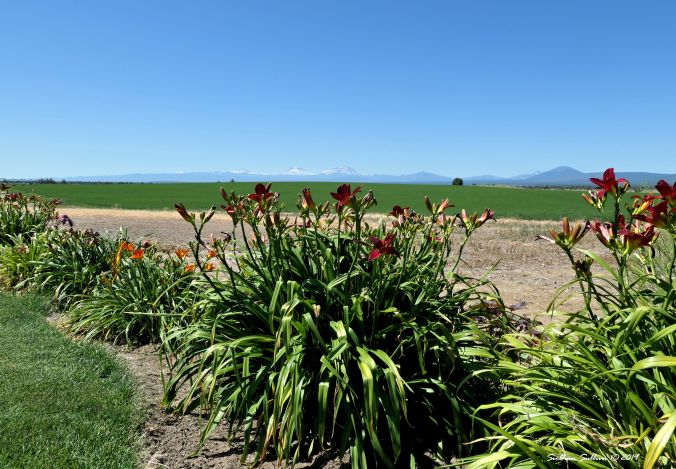
The challenge for the Lens-Artists Photo Challenge this weekend is Something old, new, borrowed, and blue. I am highlighting the recent High Desert Garden Tour in Central Oregon.
I saw many plants I’m familiar with on this tour. Some I knew the names of, others I was like, “Uh… what was your name again?” Fortunately, the plants were labeled or the person whose garden it was could tell you.
Here are some old friends.


This cat in the shadows is my cat, Motor. He turned 17 this month and he keeps healthy by getting plenty of beauty sleep.

Monochrome Monday
Birds of the shore are common in the spring in parts of eastern Oregon. Why? Because flood irrigation is one of the main methods used to water the crops. As the snow melts off surrounding mountains, it collects in rivers and reaches the lower elevations.

It is released in controlled amounts in the Harney Basin, where 320 bird species congregate. This ancient method of irrigation benefits the rancher and the birdwatcher.
Birds such as sandhill cranes take advantage of all of that water. You can see flocks of them in the photo above and a single bird below.
Continue readingI saw plenty of raptors on a Birds of Prey tour in the wide-open country of Harney County, Oregon last April. We ventured briefly into the Malheur National Forest in search of eagles. Though we didn’t see any eagles, we did get a nice view of an American kestrel.

We saw immature and mature bald eagles later that day. It’s always exciting to see them.


Some of the wildlife out there was keeping an eye on us. This herd of elk on a distant ridge top watched us for a while.
Continue readingI enjoy visiting Glass Buttes in Central Oregon to collect obsidian. Did you know there are over 24 kinds found there? Here are photos of obsidian up close. The stones are beautiful in color, but also in form.


Lens-Artists Photo Challenge – Detail
Here are a few of my purple pretties in full bloom in my High Desert yard in Central Oregon.


Ponderosa pine is a tree for the senses. These trees can grow as tall as 268 feet. Their bark turns an interesting shade of orange-red as they mature.
The branches twist and contort into interesting shapes as the tree ages.

The furrowed bark has been described as smelling like vanilla, butterscotch, or cinnamon. The bark looks like jigsaw puzzle pieces.
I love taking pictures of bark! See Silent Barks for a few more of my photos.

Oregon rocks come in a wide variety of shapes and colors. Here are a few of my favorite rocks.
Craggy cliffs circling wonder

Sculptures shaped by the sea

This is a kinetic sound sculpture that’s part of an exhibit at the High Desert Museum in Bend, Oregon. The exhibit is called Desert Reflections: Water Shapes the West and it runs through September 29, 2019. This exhibit used the combined talents of scientists, historians, and artists.
When you play the video on this post, listen carefully to the music in the background. The sounds of High Desert water and wind were recorded. They were combined with the “color” of music played on a Skinner church organ.
As the artists at Harmonic Laboratory state, “This evokes the richness of the region, a place shaped by many forces interacting in a complex way.”
As you stand underneath the sculpture, the calming tones, continuous motion, and gentle breeze helps you feel some of the energy that’s such an important part of High Desert environments.
Freedom of Expression Challenge – Art

Have you ever stepped inside a time capsule and discovered a place frozen in time? You have the opportunity to visit such a place if you stop at the Kam Wah Chung State Heritage Site in John Day, Oregon. The small building, located two blocks north of Highway 26, was, at one time, bustling with activity. Kam Wah Chung, which translates to the “Golden Flower of Prosperity,” served as a dry goods store, herbalist shop, import business, house of worship, and boarding house. It also housed an informal library and post office.


The sand lily, also known as the star lily, is a delicate perennial wildflower found in western North America. It grows in sagebrush deserts, open montane forests, and in sandy and rocky soils.
The plant above is growing near sagebrush in an uncultivated part of my property near Bend, Oregon. There is only one plant and I look forward to it blooming every spring.

The vision must be followed by the venture. It is not enough to stare up the steps – we must step up the stairs.
Vance Havner

This stairway of art in the Old Mill district of Bend invites you to hear its story. The garbage can and utility box are supporting cast members in this tale.
This work is by Yuya Negishi. I show another of his pieces and tell a bit more about him in Big Bold Art in Bend.
Here is a short video showing Yuya creating this stairway of art.
Lens-Artists Photo Challenge – Street Art

This bench awaits you at the end of the Blue Basin Island in Time Trail at John Day Fossil Beds National Monument in Eastern Oregon. When you sit there, you are surrounded by an amphitheater of greenish blue stone highlighted by hills of red volcanic soil. It’s a dramatic, and impressive, landscape.
Here is a 360-degree view of what I saw at the end of the Island in Time Trail.
When focusing on only parts of a scene, showing less can reveal more.

This fox didn’t pause to smile for the camera, but this image of her running across a sun-dappled meadow captured her spirit.

This image doesn’t include any wildlife or colorful flowers but it conveys peace.
Continue reading
Friday Flowers

Monochrome Monday


These bold little white-crowned sparrows can raise or lower their “crown”, depending upon their mood. They occur throughout North America, but their bill color varies. It can be orange, yellow, or pink depending upon where they live.
They have a cheery and distinctive song that you may recognize. Listen to it here.
Winter is a special time of the year here in Bend. Winter walks around the neighborhood are highlighted with landscapes covered in snow and ice.
He who marvels at the beauty of the world in summer will find equal cause for wonder and admiration in winter.
John Burroughs

Buildings are blanketed with snow and edged with icicles.

Twisting trails are carved through snowdrifts.
Continue reading
I immediately thought of this picture I took of a white sturgeon when I saw that this week’s photo challenge at Traveling at Wits End was Something that Doesn’t Belong.

In this photo, taken at the High Desert Museum, a young white sturgeon is surrounded by trout. It doesn’t quite fit in.
You might think this odd fish looks prehistoric and you’d be right. Sturgeon existed 200 million years ago, during the Jurassic period.
Though most sturgeon live 11-34 years, they have been known to live up to 104 years (!) They grow to an average length of 6.9 feet and sometimes grow to a length of 20 feet. The maximum weight recorded was 1,799 pounds. In fact, they are North America’s largest fish. So the fish in the picture may look small now, but it has a lot of growing to do!
When I last visited Yellowstone, I was searching for a new world to inspire me in my fiction writing. Here are some that I found…

A new world of waves and wonder

A world of contrasting colors

A world of muted rainbows
Continue reading