Here are a few photos of wildlife sightings at Yellowstone from our trip in early June. Visitors have opportunities to see many furred and feathered creatures within Yellowstone National Park.
Sometimes you see wildlife, such as this snowshoe hare, that you may not have seen in the park before. This hare’s population peaks about every ten years and this must be a peak year.
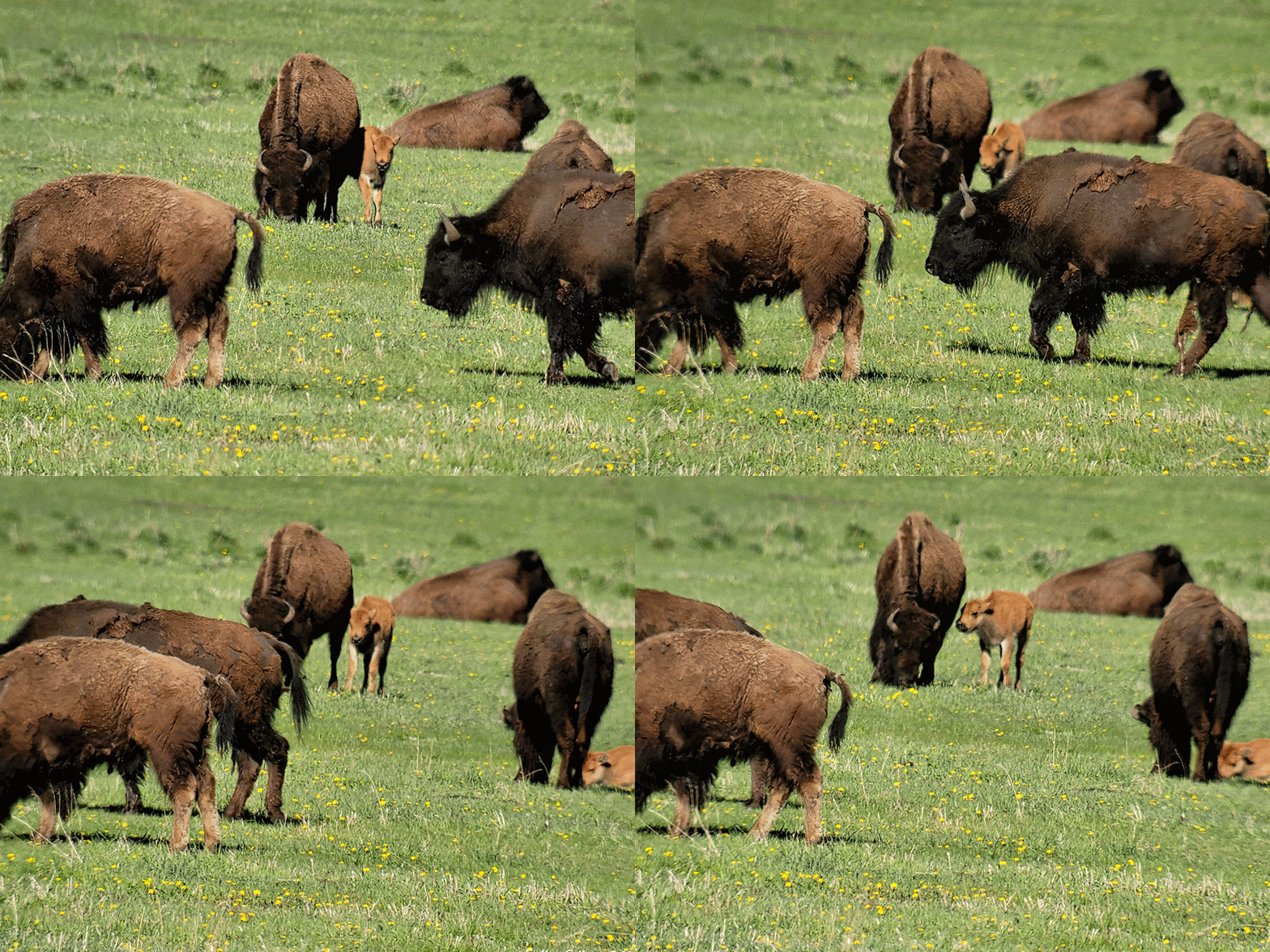
Sometimes you’ll see wildlife interacting within close proximity of each other. This radio-collared gray wolf got a little too close for comfort to the bison calves in this herd. The bulls and cows quickly chased it away.
A couple I once knew had a memorable experience involving mushrooms, up close and personal. They went out mushroom picking with friends in the rainforests near Olympia, Washington. That night, they prepared a fancy meal that included the mushrooms they harvested.
After dinner, they sat around the table exclaiming how wonderful the freshly-harvested mushrooms tasted. Suddenly, they noticed the family cat had jumped onto the counter and eaten a little of the mushroom sauce. She immediately began to vomit.
The dinner guests looked at each other with horror. When they picked the mushrooms, they weren’t sure of the exact species. Even when you look at mushrooms up close they can be difficult to identify. If you eat the wrong type, it might kill you.
Out of an abundance of caution, they decided to go to the hospital. Everyone had their stomach pumped in case the mushrooms were poisonous.
When they returned home, they were surprised to find the cat with a litter of newborn kittens. The cat wasn’t sick from poisoning—the vomiting was due to her labor.
At the time it happened they decided to err on the side of caution, but later, they thought their reaction was pretty funny. 😀
I have been patiently waiting for fall at the Japanese Garden in Portland, Oregon. Every day, I visited their Fall Color Status Update website. In mid-October, the site indicated good leaf color in their plantings. Off we went!
A brilliant rainbow of colors bordered the Flat Garden. The green Circle and Gourd Islands in the sea of white gravel represent enlightenment and happiness.
This nearby path is bordered by more subtle colors.
The Garden limits the number of visitors, but they crowded around this maple tree with its bright red leaves.
After the rain in the Painted Hills of eastern Oregon, the colors stand out in bold contrast. I live an hour and a half away from these strange geological features and patiently wait for the storms of fall to arrive.
Though I’ve been here several times, I’d never hiked the 1/2 mile Painted Hills Overlook Trail. The easy trail leads you past this dramatic scene. Wow!
Here’s a closer view.
These hills are on the south side of the trail.
There are four short, easy trails and a more moderate longer trail a short distance away.
This photo shows part of the Painted Cove Trail after the rain.
This Born Again Babaylan mural, created by Bekah Badilla, is located on the eastside of Bend, Oregon. Bekah is a Filipina/White American who was born in Alaska and now lives in Bend.
The first photo shows a close up of Babaylan.
The second photo shows the entire 18′ x 44′ mural in the light of dawn.
The artist put a lot of thought into this work. Here is an excerpt from her site describing the Born Again Babaylan mural:
Here in the High Desert, things tend to last well past their prime. Though this old truck shows signs of wear and tear, chances are it still runs.
This truck is located on rural property along Deschutes Market Road. This is one of 51 “market” roads in and around Deschutes County. These farm-to-market roads were built following passage of the Oregon Market Road Act of 1919. Prior to their construction, farmers navigated many miles of bumpy, rutted dirt roads to deliver their goods.
A label on the truck’s door reads S & M, Land & Livestock. I’m not sure if this was a local company. There were many ranching operations in Central Oregon, large and small, in the 1870-1920 pre-Industrial period.
I have always been impressed by the elegance of terns. Terns in flight have pointed wingtips and some species have deeply forked tails. Today I’m sharing a stylized pencil sketch I did of a Forster’s tern. These wetland birds can be spotted in much of North America at certain times of the year.
Here are a few Caspian terns I saw at The Narrows in Malheur National Wildlife Refuge, south of Burns, Oregon. They don’t have the black-tipped bill and forked tail of Forster’s terns, but still have the elegance of ferns.
Do you have artwork you would like to share? If so, include a First Friday Art tag on your post.
If you’re looking for something artistic to do this month, consider participating in Inktober. Create a pen-and-ink drawing every day for a month based on prompts. Fun and challenging!
These photos show rocky seating at Yellowstone National Park. The Park Service constructed several types of places to sit that blend into the environment.
in the first picture, tourist gather to take in the dramatic views of the Grand Canyon of the Yellowstone. Young children are taking a brief rest with their family on a rocky bench.
The second picture shows a boulder sofa at the head of the trail. It’s unoccupied at the moment since everyone is drawn towards the waterfalls a short distance away.
Here’s a picture of the waterfalls. Can you see why people travel thousands of miles to sit on rough rocky seating to take in the view?
I’m always on the lookout for beavers when walking the river trails in the Old Mill District of Bend. I listen for the sound of a tail slapping the water and search for the silhouette of a rounded head breaking the water’s surface. Why look for beavers next to a shopping area? Because these industrious creatures found an ideal spot to build a lodge there. I’ve always wanted to know more about beavers, so I visited the Museum’s Dam It! Beavers and Us exhibition.
This multimedia interactive exhibit offers visitors the opportunity to learn all about the North American beaver, Castor canadensis. Tall, cutout panels representing forest trees divide the room. Dappled light shines onto the imaginary forest floor. A re-creation of a beaver dam is tucked into a corner for kids to explore.
In another corner, a large box suspended from a parachute drifts towards the ground—more on that later. An Oregon flag, featuring a beaver, flutters against a wall near the entrance. Video featuring the important connection of beavers with Native Americans plays in another section. A colorful animation featuring the life cycle of beavers plays on a large screen on the back wall.
At one time, the Diablo Dam in Washington state was the world’s tallest dam. This 389-foot tall dam is located on the Skagit River. Construction began in Diablo Canyon in 1927. Though completed in 1930, the Great Depression delayed generation of electricity until 1936. The 1920s architecture stands out in this black and white photograph.
I saw this impressive bison jump sculpture at the Buffalo Bill Center of the West in Cody, Wyoming. Free Fall, created by T.D. Kelsey in 2001, depicts a hunting method in use for hundreds of years. Hunters herded bison toward a steep cliff, where they fell to their death. As I’ve mentioned before, bison are dangerous and this is a safer alternative for harvesting them. At the base of this sculpture, piles of bones appear in a recreated archaeological dig.
T.D. Kelsey was born and raised on a ranch near Bozeman, Montana. T.D. Kelsey: Realist, Romantic, and Inspired Sculptor describes his background, including time spent as a rodeo cowboy, pre-med student, rancher, and airline pilot. With encouragement from his wife, Sidni, Kelsey eventually began working full time as an artist. His love for animals shows in this piece and other sculptures and paintings he created over the years.
This is a flying unicorn mural I painted in my daughter’s room when she was little. She could not decide between a flying horse and a unicorn so I painted both in one. 😀
I prefer working on small projects and had never worked on something so large. Piles of eraser dust accumulated on the floor beneath my rough sketches. I used acrylic paints, and a lot of patience, to complete this mural.
Do you have artwork you would like to share? If so, include a First Friday Art tag on your post.
I saw these fading hibiscus flowers at a local garden center in early June. The petals are past their prime, but the flowers still have a style all their own.
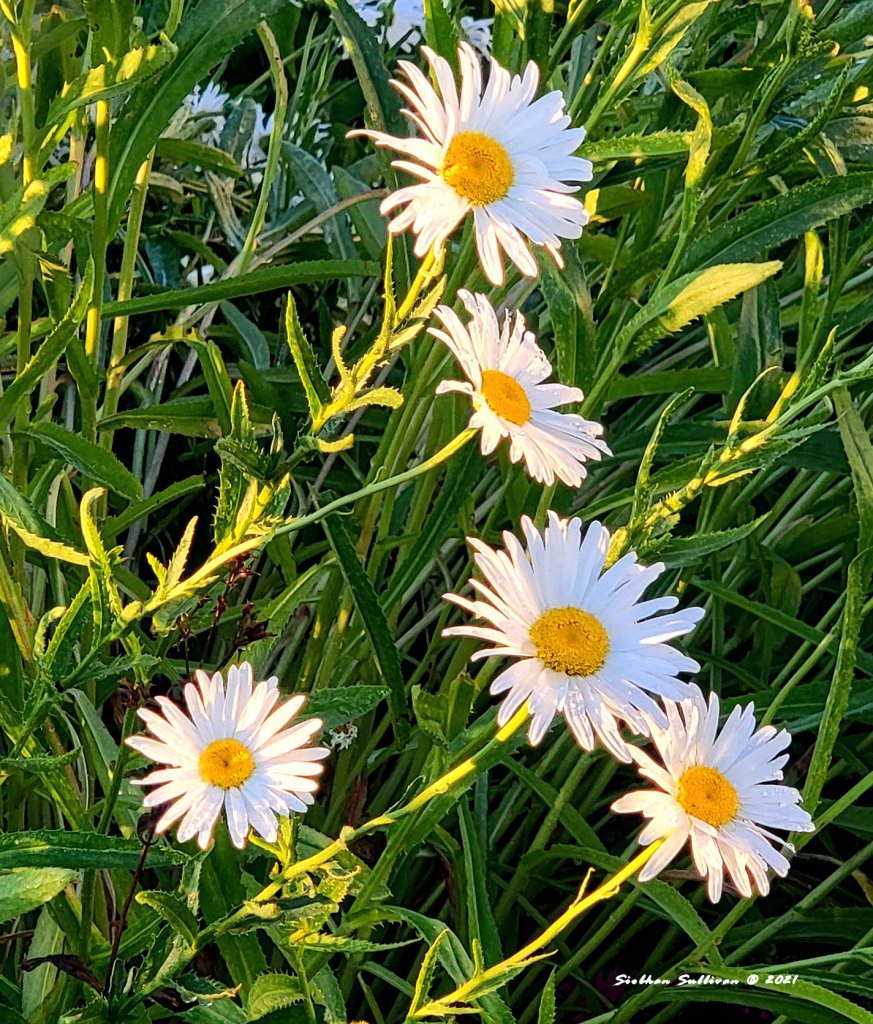
Here are pictures of daisies three ways I took on the Mill A Loop trail in Bend, Oregon. I used Corel PaintShop Pro 2021 to do the photo processing.
The first two show the original photo compared to a soft focus adjustment. I think it works well for these soft flowers.
The second two show the original photo compared to a colored edges effect. I like to draw and this effect created a work of art, minus all the erasing I usually do. 😉
The South Tunnel Murals, designed in 2012 by local artist, Paul Allen Bennett, are located in the Old Mill District of Bend, Oregon. These works were completed by 20+ designers from Nike working side by side with Arts Central Art Academy students and Boys and Girls club members.
See the tracks of shoes running along the lower border? I wonder if those could possibly be from Nike shoes. Hmm…
These brightly colored images of fish echo the inhabitants of the Deschutes River, located right next to this tunnel.
For now, there are no paintings on the exterior walls of the South Tunnel Murals. I’m hoping another artist will brighten up the dull concrete like they did for the “Tunnel of Joy” nearby.
In these portraits of creatures, the lighting is a major part of the scene.
In the first picture, a family of Sandhill Cranes struts across a meadow in the morning light. The lead bird, in the strongest light, keeps an eye out for predators.
In the next photo, a bull elk grazes in a grassy field. Bright fluffy clouds and dark forest trees are major parts of this shot. The elk, with its bright back fur and dark legs, blends into that environment.
In this photo, a northern river otter drifts through the water. Mid-day sun cuts through the water and dapples the bottom surface. A trail of bubbles emphasizes the otter’s streamlined form.
I was impressed by this Sacagawea sculpture in a garden at the Buffalo Bill Center of the West. The sculpture was created in 1980 by Harry Jackson. Jackson created abstract and realistic art while living in Cody, Meeteetse, and Lost Cabin, Wyoming. Much of his collection is housed at the Center in Cody.
This large bronze sculpture has such a calm yet powerful presence. Arms folded across her chest, Sacagawea appears to be gazing towards wind blown plains on the path ahead.
This lone tundra swan lived in the Old Mill District of Bend, Oregon for several months this year. Its graceful silhouette, and the waves surrounding it, are highlighted in these black and white images.
These western juniper trees near the shore of Prineville Reservoir were rooted in the past. After many years of fluctuating water levels, their roots became exposed. The red volcanic soil here stands out in strong contrast with the deep blue sky and green foliage.
We planted a couple artichoke plants in our garden this year and assumed they died after a week of extreme heat. Several leaves on both plants turned brown from the sun, but the plants survived. Here are their purple blossoms up close. Artichokes are pretty and tasty!
Today I’m sharing kingfisher art. I drew the following images several years ago. In studies such as these you attempt to capture the essence of the subject. You’re not going for detail in this type of drawing.
John James Audubon
I’m also sharing images of belted kingfishers from a couple wildlife artists. The first painting is by John James Audubon. It’s featured in The Birds of America,published in 1827. I was fortunate to see a volume of this book in a library at a university.
At present, there are only 120 complete sets of The Birds of America known to exist. The 435 engraved plates used to create the original books measure 39″ x 26.” These enormous illustrations helped educate the public about the importance of birds. Interest in The Birds of America persists to this day. In 2018, a full set sold for $9.65 million dollars.
I saw this abandoned building on a corner in Howe, Idaho. Though I could not learn the history of this specific building, I learned a well-known historical figure spent part of his life nearby.
The Little Lost River, located north and east of this site, was once known as “John Day’s River” or “Day’s River.” In 1810, the John Jacob Astor Pacific Fur Company set out to establish a base of operations at the mouth of the Columbia River. They made many discoveries along the way while searching for the easiest routes of travel. John Day, an experienced hunter and trapper, was a member of the party.
John Day’s travels
The group, led by Wilson Price Hunt, divided into four parties when food became scarce. John Day became ill and was left behind with Ramsay Crooks on the shores of the Snake River. The two men eventually made their way to the mouth of the Mah-Mah River, where it joins the Columbia. At that site, the two were robbed of all their belongings and stripped naked by Natives. Because of this incident, the river was renamed the John Day River. Crooks and Day were rescued days later by Robert Stuart, of the Pacific Fur Company, and taken to Fort Astoria at the mouth of the Columbia River.
Sometimes you visit places where the landscapes are pretty as a picture. Here are a few places I’ve visited in the western states that feature picture postcard views. I tell a tiny tale about each of them.
Kiger Gorge on Steens Mountain, Oregon is full of drama. A giant serpent tunneled through here leaving scales of deep green. Wise ones believe the sweetest water can be found in shallow wells beneath these strands of greenery.
Morning Glory in Yellowstone National Park, Wyoming is a glorious sight. The artist who created this landscape experimented with various colors. She could not settle on using a single color and discarded her pallet here for us to find.
This grandfather tree in Arches National Park, Utah often told tales of wild places to his many grandchildren. When he passed, they honored him by preserving the bones of his existence and planting golden flowers near his roots.
Once a year, in the middle of June, Clearwater Native Plant Nursery opens its gates to the public. This contract grow nursery provides native plants for restoration and landscaping projects. Plants sold here grow well in upland, riparian, and wetland habitats. The nursery is located in Redmond, Oregon.
Clearwater Native Plant Nursery provided plants to the Deschutes Land Trust for the restoration of Whychus Creek, 15 miles to the northwest. The plantings provided wildlife habitat and helped stabilize the soil near the creek.
Clearwater Native Plant Nursery Annual Sale
I had never been to their annual sale before. This nursery is not open to the public the rest of the year.
We arrived soon after opening and there were already a lot of people there. Plants ranged in price from $3 for a 4-inch pot, to $27 for a 5-gallon pot.
When you travel the backroads in this part of the country, it’s not uncommon to see cattle herds movin’ down the road guided by cowboys. We saw a couple cowboys on horseback moving this herd near Malheur National Wildlife Refuge.
You’ll see dust clouds long before you see the animals.
The cattle often stop in the road until they are pressured into moving. Watch for signals from the horseback riders to their dogs herding the cattle. Do your best to stay out of their way.
This gigantic pine is Big Tree, AKA Big Red, the biggest Ponderosa pine, Pinus ponderosa var. ponderosa, ever recorded. It’s located in LaPine State Park, north of La Pine, Oregon. Though it lost 30 feet of its crown during severe storms, it is still the largest Ponderosa pine in circumference.
Here are some facts about this tree:
Circumference: 28 feet 11 inches
Height: 167 feet
Crown spread: 68 feet
Approximate age: 500+ years
Board feet: 25,000
LaPine State Park Manager, Joe Wanamaker, gave insights about Big Red in an article in the local Source Weekly. He thought it was spared from being logged due to evidence of fire damage. This may have affected the quality of the wood harvested. Wanamaker also pointed out this tree is growing in an ideal location where water tends to collect in the soil from the nearby Deschutes River.
A paved, ADA accessible, 1/4 mile trail leads to this unique sight. Foot traffic around this much-loved attraction caused soil compaction that threatened its growth. A protective fence was constructed around it in the year 2000.
In this map of the park, from Oregon State Parks, Big Tree is located in the lower right corner.
On our recent visit to Yellowstone National Park, we took a side trip to Yellowstone Hot Springs. This attraction is located in Gardiner, Montana, about ten minutes north of the park.
An interesting history
In the last 100+ years, this site has passed through many hands. In 1899, French-Canadian immigrant, Julius LaDuke, staked a mining claim here and discovered it contained hot springs. He created LaDuke Hot Springs Resort to serve miners and visitors to the area. The resort included a large plunge bath and several smaller private baths. A two-story hotel was built nearby. LaDuke entered into a short-lived purchase agreement with William F. Cogswell. This was one of many setbacks in his life.
Visitors traveled by coach to Electric, later known as Aldridge, and then had to cross the 150-foot wide river to the springs. LaDuke employed barges, then a cable ferry, then a ferryboat, and finally a swinging footbridge for his guests.
Guests rumored to have visited LaDuke Hot Springs Resort include President Theodore Roosevelt and famous frontierswoman, Calamity Jane.
I saw flowers, flowers everywhere while walking the riverside trail in the Old Mill District of Bend this morning. This is my favorite time of year to walk by the plantings near the amphitheater. Can you see why?
I saw this yellow & white iris in bloom in mid June. When you see them blooming, summer is on the way. The golden colors in this blossom mirror the warmth of summer days to come.
So, the other day I heard a loud “chirp, chirp” call outside my house. I peered out the back door and spotted a baby American Robin in the middle of the yard. Maybe it was the same one we put back in its nest several days before, giving it one more chance at life.
When I approached, the young bird walked underneath some cactus in my garden. Meanwhile, both parents continued chirping loudly.
Oh no!
A movement nearby caught my eye. A Red-tailed Hawk lurked in the background, watching the fledgling. No wonder the parents of the baby robin were upset!
I tried to catch the young robin, but it flew. Not well, but I was pleased to see it could now fly. The bird settled in the gravel and rocks, right under my High Desert mural painting. Maybe it wanted to be a character in one of my stories. 😉