If you’re looking for a short hike to a couple small, quiet lakes, try out the hike to Blow Lake and Doris Lake southwest of Bend. It’s only a mile to Blow Lake and another mile and a half from there to Doris Lake. There are 400 feet of elevation gain. You can park at the Six Lakes Trailhead along the Cascade Lakes Scenic Byway. As the trail name implies, there are six wilderness lakes to explore here.
Doris Lake, Oregon
The elevation here is 5,310 feet and you pass through subalpine forest on your way to the lakes. Blow Lake is 45 acres in size. Windfall trees form a frame along one edge of the lake and can be seen resting on the bottom of this clear lake. Doris Lake, a mile and a half away, is slightly larger at 69 acres in size.
Some of the local sights that I cherish the most are ones that I have seen in my own backyard. Here is my favorite western juniper silhouetted by an autumn sunset.
Looking out of the mouth of the Fort Rock cave at the Sagebrush Sea, one can only imagine the thoughts of those that lived there thousands of years ago. Sagebrush sandals, found inside Fort Rock Cave, were determined to be 9,300-10,250 years old. These sandals are the oldest ever found in the world.
Cave entrance
A small hearth was found in the cave and it was radiocarbon dated to be 15,000 years old. Several stone tools were found nearby. Though that date was questioned by some, in 2009 human coprolites (fossilized poop) determined to be from 14,300 years ago were found in nearby Paisley Cave. In 2009 a multiple function tool made from agate was discovered in Rimrock Draw Rock Shelter, near Riley, Oregon. It may have been made as long ago as 16,000 years ago.
Inside Fort Rock Cave
Other ancient sandals have been found but never in the quantity found at Fort Rock. Nearly 100 sandals were found ranging from child-sized to adult. They are all the same style with a flat bottom and flap covering the toe area. The sagebrush bark is woven in a distinctive twining style. Sandals of this type were found at various locations in southeast Oregon and northern Nevada. In more recent times, ethnographers found that members of the Klamath and Paiute tribes, who lived in the Fort Rock area, wore footwear woven from sagebrush and tule.
Inside Fort Rock Cave in the past and present
The location where the sandals were found was likely a lake shore 10,000 years ago. Native peoples may have lived there because of the easy access to game, fish, and edible plants. At the present time, the cave borders a huge expanse of dry sagebrush steppe habitat. The climate changed after Mount Mazama blew 7,600 years ago. A thick layer of ash from that eruption blanketed an area covering 500,000 square miles in western North America.
If you want to see this site, you will need to go with a guide since access is regulated by Oregon Parks and Recreation Department in partnership with the University of Oregon. Go here for more information – Fort Rock Cave.
Fort Rock Valley Homestead Museum – Sagebrush Sandal display
If you want to see the sandals in person, there are some on display at the University of Oregon Museum of Natural and Cultural History. Click here for a good photo of them – sandals. The Museum also has a collection of stone tools and other fiber artifacts excavated from the cave. You can see a small display about the sandals at the Fort Rock Valley Homestead Museum. See my post on that Museum and information about the Fort Rock formation here.
Exploring the Deschutes River near Sunriver, Oregon
We recently went on a nice leisurely kayaking trip down the Deschutes River. We parked one car at Benham Falls East Day Use area and parked the other where we launched at Harper’s Bridge, Sunriver, Oregon. It took a little over 3 1/2 hours on a warm September day. The trip is about 10 river miles long.
This is a meandering river that passes through beautiful meadows and forested areas. We saw a few people close to the Sunriver Marina but didn’t see many more on the trip. This float ended near parts of the lava lands of Newberry National Volcanic Monument.
As I hiked to Blue Pool, I wondered if it would really have the jewel-toned blue water I had seen in so many pictures. We walked for four miles and finally caught a glimpse of this small lake. Walking to the edge of a steep cliff, we looked down at its crystal clear waters.
About Blue Pool
Blue Pool, also known as Tamolitch Pool, was breathtakingly beautiful on this bright and sunny day. The turquoise and sapphire blue waters sparkled up at us. The leaves of trees surrounding the pool were just beginning to change color. Their reflections in the water looked like an Impressionist painting.
Sunken sights await you at Clear Lake in Linn County, Oregon. This “young” lake was formed by nearby volcanic activity 3,000 years ago. The McKenzie River originates here.
Clear Lake Underwater Forest
The cold water temperatures preserved a forest of ghostly trees beneath the surface. The water temperature averages 35-43° F. Brrrr! The leaves and needles of the trees are long gone but their trunks and limbs stand like some prehistoric creature preserved in time. Some visitors get a closer look at the underwater sights by scuba diving here.
I recently went on a two-mile trek to the center of the earth. Okay, not quite the center of the earth but the trail did lead underneath Highway 97 – the main North-South highway in these parts. I decided to visit Lava River Cave before it shut down for the season. This cave is located 12 miles south of Bend, Oregon in the Newberry Volcanic National Monument area.
I heard parking is limited so I arrived early. WAY too early! I forget that I only live a half an hour from many of these geological attractions.
For more information on operating hours and entrance requirements, check here. You must make reservations for timed entry into the cave. Make reservations here.
Set along the scenic Deschutes River, the Art in the High Desertevent features 110 artists from throughout North America. Based on its sales of fine art, it is ranked number 12 for best fine arts festival in the nation. This is the ninth year of the event. The show features a wide variety of two- and three-dimensional artwork.
My favorite works there this year were created by local artist, Jason Waldron. He makes three-dimensional works created with wood and metal scraps salvaged in Central Oregon. They are large, dramatic, and expressive. Check them out at Waldron 3D.
Have you ever finally made it to a place that people had told you you HAD to go to? For me that place was Hosmer Lake. Why didn’t I go here sooner?!
We went early on a mid-weekday morning. I had heard about the crowds sometimes here on weekends. It can get very crowded – especially in the summer.
Bald eagle, Haliaeetus leucocephalus
There is a concrete boat ramp leading into a bulrush-lined meandering lake. After boarding our kayaks, we were soon greeted by a bald eagle perched in a nearby tree. It was almost as if it had been planted there for a photo opportunity. We paddled on and took a channel to the left.
Young Western fence lizard, Sceloporus occidentalis
So I was sitting in my living room when I saw this lizard scamper across my porch. Seeing a rare opportunity to get a good picture, I jumped up, dropped everything off of my lap, and grabbed my camera. The lizard moved fast but I managed to grab it. After it calmed down from the initial shock of being grabbed by a towering giant, it sunned itself calmly in the warm summer rays while perched on my hand.
Soaking up some rays
I quickly snapped several pictures as it posed for me. After I felt like I had snapped enough photos, I gently placed it down on the grass. That was when the fun began. It climbed up my pants leg and vanished from sight.
I brushed my pants this way and that but no lizard. I went into my bathroom and stripped off my pants and shook them and turned them inside out – no lizard. I took off my shirt and thoroughly searched it – still no lizard. I got dressed and happened to look in the mirror and saw a teeny tiny head peering over the top of my head. The little sneak! I grabbed it and took it back outside.
“She will never see me here!”
The pictures that you see at the beginning and end of this post are of the lizard after it had temporarily hidden from me. Do you see the look of satisfaction in its eyes? It took advantage of the situation and saw a rare opportunity to hitch a ride so it could explore new worlds.
Dee Wright Observatory in the distance from the trail
Dee Wright Observatory, McKenzie Pass, Oregon
Looking like some medieval castle about to be attacked by dragons, the Dee Wright Observatory is located near the top of McKenzie Pass at an elevation of 5,187 feet. No, there is not a telescope set up here for star viewing, but you can see several Cascade Mountain peaks nearby standing tall amidst 65 square miles of black lava rock.
The lava is from relatively recent flows from Yapoah, Little Belknap, and Belknap Craters. One of the types of lava you will see here is called Block or A A lava.
Though there is little rainfall in this area, there can be up to 20 feet of snow. The melting snow travels through cracks in the lava to underground reservoirs that feed the McKenzie and Metolius Rivers.
History of Dee Wright Observatory
The McKenzie Pass Highway follows parts of the McKenzie Salt Springs and Deschutes Wagon Road that was built in the period of 1866-1872. It was used to move cattle east. The wagon road was established as a toll road in 1872. It’s hard to imagine how travelers made it over the rough lava rocks at the pass and many had to abandon their wagons. See my previous post on the Santiam Wagon Road for a little bit more history on the wagon road.
Life can take a lot of twists and turns so it’s nice to get a bouquet once in a while. This giant size balloon bouquet was my cherry on the top of a great weekend. They were here for the annual Balloons Over Bend event.
Tucked away in Oregon’s Outback, you will find a unique place that hearkens back to an earlier time. The Cowboy Dinner Tree is a small restaurant located in Silver Lake Oregon, about an hour and a half southeast of Bend. The restaurant is only open from 4:00-8:30 pm four days per week and reservations are required. They give you ample portions of food here and you are advised to bring a cooler for leftovers. They do not take credit cards or debit cards so have cash on hand.
Steak at Cowboy Dinner Tree
Roasted chicken
You have your choice of a 26-30 oz. top sirloin steak or a whole roasted chicken. Both are accompanied by several tasty side dishes. There is green salad, hearty soup, old fashioned sweet yeast rolls, baked potato, and a dessert. You can have coffee, iced tea, or pink lemonade with your meal. On the day we were there, they served bean soup and a small shortcake with fresh berries. Everything is homemade and made daily.
Last weekend I was out looking for some of the 11+ species of woodpeckers that can be seen near Sisters, Oregon. The Dean Hale Woodpecker Festival brings birdwatchers from all over the world into the woodpecker-rich habitats in the area. East Cascades Audubon Society has been putting on the well-attended event since 2011. There were 17 different field trips this year.
Black Butte & Mt Jefferson, Oregon
It was a hot day and stunning views of the Sisters peaks, Black Butte, and Mt Jefferson welcomed us.
Sky. Where I live in central Oregon, it’s big and bold. The sky is rarely shrouded in shades of gray. Sunsets are painted with bold strokes of golds, pinks, and purples.
Scattered clouds on sunny days are referred to as “beauty clouds” by the local weatherman. My daughter thinks they look like the clouds in The Simpsons cartoon. Flat on the bottom with perfectly sculpted puffs on the top.
Wild creatures and plants
The colors of the sky are reflected in the local plants and wildlife. Mountain bluebirds surprise with their intense colors. Wildflowers like Oregon sunshine shine forth in warm golden tones. Perfect pink bitterroot flowers provide punctuation. Ancient twisting western juniper trees frame the scene.
Volcanoes bordering the High Desert are often encircled with crowns of clouds. Cool white clouds appear to temporarily cool the hot magma rumbling below.
The sky here is an ever-changing message. Clouds, rainbows, and rain and snow are the emojis on the big blue screen. Wind sweeps them to the side to create another conversation. Look up and notice what the sky is saying and listen to its meaning.
Is this Mendel’s garden? I think the Gene Jeannie has been at work in my backyard. I planted one purple and white lupine and it has multiplied. Now I have a violet and purple one, two purple and white ones, a violet and white one, and an all white one.
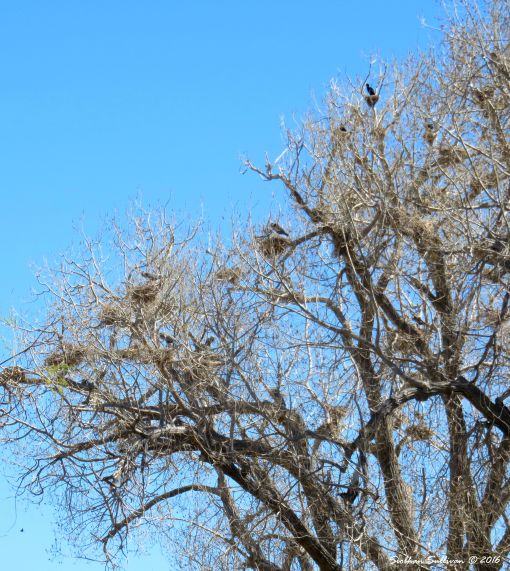
If we learn to focus in on things and look closer, we sometimes find the unexpected.
In this case, it’s a double-crested cormorant and great blue heron rookery. These birds look and act so differently yet they manage to get along.
This rookery is located at the Sod House Ranch at Malheur NWR. It was built by cattle-baron Peter French in the late 1800’s. The ranch was the headquarters of the French-Glenn Livestock Company that at one time covered 140,000 acres.


 Some of the local sights that I cherish the most are ones that I have seen in my own backyard. Here is my favorite western juniper silhouetted by an autumn sunset.