I saw this purple Cattleya orchid up close at the Volunteer Park Conservatory in Seattle recently.
This plant is part of a collection started by a donation from Anna Clise in 1921. Her donation inspired others to donate their plant collections as well.
I saw these iceplants in California up close at Leffingwell Landing Park. This plant, Carpobrotus chilensis, is known as an iceplant or sea fig.
Iceplants in California are considered an invasive species. It is native to South Africa. The iceplants form dense mats in habitats near the sea. The picture below shows them growing under pine trees.
I was a little puzzled when I noticed they had some flowers that were pink, and others that were yellow. Then I read about how the flowers start out yellow and fade to pink. Interesting…
These blanket flowers of summer were growing near the Deschutes River in the Old Mill District of Bend, Oregon. I took this picture last August, but Gaillardia plants are known to bloom “profusely all summer long.”
A colorful daylily trail in the Oregon Garden in Silverton, Oregon.
These perennials have showy, long-lasting flowers that attract butterflies and hummingbirds. Daylilies grow well in full sun to partial shade.
Here’s a closer view of violet purple daylilies with bright yellow throats. I’m not sure what variety of daylily this is, but I loved its ruffled edges.
Here’s a picture of beautiful purple clematis blossoms up close in July of last year.
Clematis vines do well in sunny locations with moist, well-drained soil. A thick layer of mulch over their roots helps keep them cool, which they prefer. Once mature, these plants can reach a height of 10 to 20 feet. There are nearly 300 species of clematis. The distinctive blossoms of clematis come in a wide variety of colors, including white, yellow, pink, purple, blue, green, and bi-color.
Florists and gardeners use red flowers to represent a wide variety of emotions and characteristics. You may associate them with love, but they have many other meanings.
Columbines are symbols of strength, wisdom, and peace. Red columbines symbolize love, intense emotions, and encouragement.
Western columbine, Aquilegia formosa
Hibiscus are symbols of youth, beauty, success, glory, and femininity. Red hibiscus symbolize romance and love.
Red hibiscus, Hibiscus sp.
Black-eyed Susans are symbols of justice, inspiring motivation and positive changes. They are sometimes associated with the sense of wonder of childhood.
Black-eyed Susan, Rudbeckia sp.
Poppies are symbols of remembrance and hope. The flowers are used to recognize members of the Armed Forces around the world. In some cultures, red poppies represent love and success.
Iceland poppy, Papaver nudicaule
Indian paintbrush are symbols of creativity, passion, and the pursuit of dreams. Their red and orange flowers represent fiery energy and the drive needed to achieve your goals.
Indian paintbrush, Castilleja sp.
Red flowers stand out in both wild and cultivated landscapes.
Meanings of flowers may vary, depending on the source. For this post, I relied on information on Petal Republic.
I saw this beautiful Western Tiger Swallowtail on a penstemon flower in my front yard recently. We try to plant flowers that attract bees, butterflies, and other pollinators. We’ve seen LOTS of butterflies this year.
I saw this little bit of everything garden on the High Desert Garden Tour in Bend, Oregon in July 2022. The long, narrow yard at this house included fruits, vegetables, and lots of flowers. The homeowners have been working on it for 22 years.
The owners created large, elevated raised beds from wood and tin roofing. You can see sweet alyssum blooming near the front edge. Hummingbird feeders hang near them. They’re growing pear, cherry, and apples on espaliers behind the raised beds.
This raised bed was at ground level. It included red lantana, yellow petunias, orange ganzia, purple salvia, and dark pink snapdragons.
This tiered bed surrounded a tree. It included common sunflowers, orange marigolds, and golden celosia.
This small but bountiful garden was behind a house in northeast Bend, Oregon. This was one of the featured stops on the High Desert Garden Tour in July 2022.
These purple clematis were beautiful. There’s also a peek of an Annabelle hydrangea shrub in this photo.
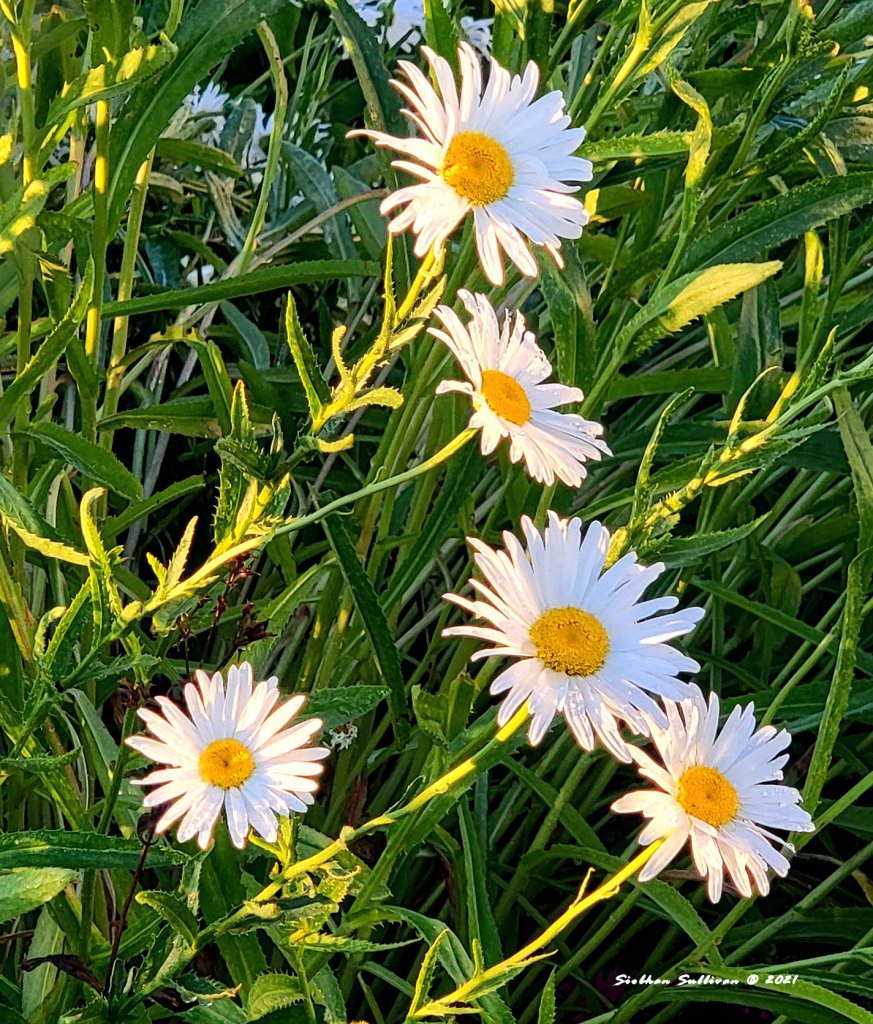
These long-blooming flowers are a type of daisy. I think they’re Shasta daisies. You can see a multi-colored Euonymus shrub on the left side.
I saw this gorgeous pink chrysanthemum on the High Desert Garden Tour last year. Though native to China and northeastern Europe, these plants do well in many parts of the world. The long-lasting flowers are available in a variety of colors. These include pink, purple, orange, yellow, white, and red. Unlike many of the plants that grow in High Desert gardens, this one is not appetizing to deer. A big plus around here!
The power of red blossoms radiating in the garden. Crimson petals briefly unfold, reaching towards a cloudless sky And the memory of their fire burns deep within your soul.
Today I’ll share a few stories related to special flowers in my life.
Roses
Whenever I see roses, I think of a funny thing that happened to me when I was in my early twenties. I had just started dating a guy who checked parking passes where I worked. I invited him to my cozy little A-frame house on Puget Sound in Washington state. When we got to my house, I pulled open the screen door and there was a bouquet of roses tucked next to the main door. I grinned and asked if they were from him. “No,” he said sheepishly. He pulled a bouquet of roses from behind his back. Oops. The flowers in my door were from a different admirer. Awkward!
I took these photos on the High Desert Garden Tour this summer. The tour takes place in different Central Oregon locations, from sprawling rural ranches to tiny city yards. This year the featured gardens were in Bend.
There are an abundance of flowers growing along the path near the Hayden Homes Amphitheater in Bend, Oregon. I always look forward to walking there in the late summer and early fall months. Can you see why?
For this First Friday Art post, I’m sharing a hibiscus photo and a few drawings. I took this picture of a Spin the Bottle Hibiscus, Hibiscus rosa-sinensis, at the Oregon Garden in Silverton, Oregon. I’m not sure who came up with the common name, but it’s a funny one!
I’m sharing a quick pen-and-ink drawing I did of Hibiscus flowers. I’m participating in Inktober, a challenge where you make a drawing a day for a month based on prompts.
I tend to fuss over my artwork a lot, so for this challenge, I’m trying to draw fast. You create a different kind of artwork when working quickly. Is it perfect? No, but it’s a freeing experience. The goal is to capture the essence of your subject.
You can interpret the prompts any way you want to. Here was my interpretation of ‘bouquet’ from the October 5 prompt.
I saw these multi-colored trailing petunias in a hanging basket in downtown Bend. Since they produce so many flowers, another common name for this plant is ‘million bells.’
Trailing petunias Calibrachoa hybrida
These perennials are hybrids from plants originally grown in South America. They bloom from spring through first frost and they’re easy to grow. They make a perfect addition to hanging baskets.
This photo of memories of summer at Old Mill shows one of the many colorful plantings bordering the trails. This border is located along the Mill A Loop trail, one of my favorites in Bend, Oregon.
Here’s a photo of blanket flowers up close that I took last summer. These perennial flowers are big and showy. Their contrasting colors make them stand out as a star in any garden. These easy to grow plants are also drought tolerant. They attract butterflies and birds.
I saw these marigolds up close in a park at the end of July. These vignettes show orange, yellow, and white flowers that were growing in a border planting. Marigolds are an easy to grow annual that blooms for weeks during the summer months.
Here are three photos of a milkweed seedpod up close. As you may know, milkweed flowers are a favorite of monarch butterflies. North American populations of this butterfly have been rapidly declining.
I got a packet of seeds for free from Deschutes Land Trust, one of our local conservation nonprofits. To find milkweed seeds near you, use the Milkweed Seed Finder courtesy of the Xerces Society.
We planted milkweed starts in our garden this year, but they fried during a week of unusually hot weather. 🙁
My friend, Suzy, planted hers last year and had greater success. This seedpod she gave me measures 4 inches in length. A couple of days ago it split along a seam. Each seed is attached to a little wispy fluff known as coma.
Does this milkweed seedpod remind anyone else out there of the pods in Invasion of the Body Snatchers?
Poppies & honeybee up close in our garden this spring. This bee has full pollen baskets on its hind legs. Did you know these pollen pellets can account for 30% of a bee’s weight?
I saw these fading hibiscus flowers at a local garden center in early June. The petals are past their prime, but the flowers still have a style all their own.
Here are pictures of daisies three ways I took on the Mill A Loop trail in Bend, Oregon. I used Corel PaintShop Pro 2021 to do the photo processing.
The first two show the original photo compared to a soft focus adjustment. I think it works well for these soft flowers.
The second two show the original photo compared to a colored edges effect. I like to draw and this effect created a work of art, minus all the erasing I usually do. 😉
We planted a couple artichoke plants in our garden this year and assumed they died after a week of extreme heat. Several leaves on both plants turned brown from the sun, but the plants survived. Here are their purple blossoms up close. Artichokes are pretty and tasty!
I saw flowers, flowers everywhere while walking the riverside trail in the Old Mill District of Bend this morning. This is my favorite time of year to walk by the plantings near the amphitheater. Can you see why?
I saw this yellow & white iris in bloom in mid June. When you see them blooming, summer is on the way. The golden colors in this blossom mirror the warmth of summer days to come.
This week I’m featuring pictures of green, red, blue, and white. These are colors in What a Wonderful World, a song that brings back a special memory. Many years ago, I helped a kindergartner class with an art project related to the song. I assigned each student a color and let them paint anything they wanted. It was a “wonderful” experience!
Here’s my take on the colors from the song.
This picture shows the vibrancy of green foliage surrounding a great blue heron in Troutdale.
Here’s a picture featuring the power of red in an up close portrait of a hibiscus.
Today I’m featuring portraits of pink flowers in my Bend, Oregon yard. All of these plants are drought tolerant, once established.
The first photo is an ice plant. This groundcover has cheerful starburst flowers and succulent leaves. The leaves turn a bronze color in winter. We had an escapee take root in another part of our yard and it survived without watering.
The second plant is a Woods’ rose. This native 2-5 foot tall shrub attracts bees, butterflies, and birds. Red rose hips develop once the flowers lose their petals.