I enjoy visiting Glass Buttes in Central Oregon to collect obsidian. Did you know there are over 24 kinds found there? Here are photos of obsidian up close. The stones are beautiful in color, but also in form.
Lens-Artists Photo Challenge – Detail
I enjoy visiting Glass Buttes in Central Oregon to collect obsidian. Did you know there are over 24 kinds found there? Here are photos of obsidian up close. The stones are beautiful in color, but also in form.


Lens-Artists Photo Challenge – Detail

Monochrome Monday

Friday Flowers

Monochrome Monday
I can be jubilant one moment and pensive the next, and a cloud could go by and make that happen.
Bob Dylan
Here are few clouds in my sky from the last year’s worth of Lens-Artists Photo Challenges. These pictures were taken in Eastern and Central Oregon, my favorite country. Enjoy their many moods.


Here are a few of my purple pretties in full bloom in my High Desert yard in Central Oregon.


Wordless Wednesday
I always have a way of finding serenity when I’m in a kayak.
Majestic mountains can surround you in a gentle hug.
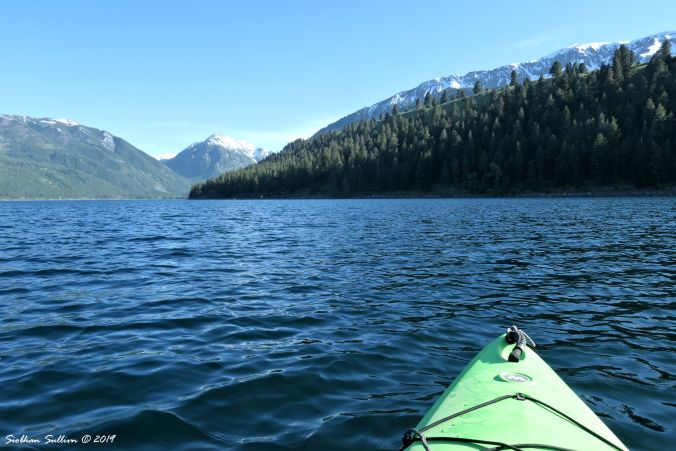
You can pause and reflect on your life.


Wordless Wednesday
It’s always a thrill to see these lacy-leaved springtime cosmos in the morning sun.


A Photo a Week Challenge – Flowers
The Lens-Artists photo challenge today is “unique.” I thought of several unique sights I’ve seen in Oregon that fit this category.

Our guide in Harney County referred to this ancient petroglyph as the Super 8. Do you see a resemblance to an old movie camera? Petroglyphs are carved into stone while pictographs are painted onto stone.

I saw these hairy clematis flowers at the Hell’s Canyon Overlook earlier this month. This unusual flower has a lot of common names including lion’s beard, leather flower, vase flower, and sugar bowl. They look similar to prairie smoke flowers featured in a previous post.

I can’t help but think of the words “unique sights” when I recall this toad I found in my high desert yard. I thought it was so interesting that I wrote a short story about it called The Toad Queen.
Continue reading
This spring I tried something new by going on two nature walks with llamas. The first hike was part of the Harney County Migratory Bird Festival in eastern Oregon. The second hike, just north of Burns, Oregon, was to help a llama get certification for the Pack Llama Trial Association (PLTA).
On the first 4-mile hike, my llama was Marty McFly, AKA “The Professor.” He was not the most dominant llama there, but he was considered to be the smartest. He was always on the lookout. Llamas have large eyes, much like pronghorns, so they can spot predators.


Wordless Wednesday

Monochrome Monday
Ponderosa pine is a tree for the senses. These trees can grow as tall as 268 feet. Their bark turns an interesting shade of orange-red as they mature.
The branches twist and contort into interesting shapes as the tree ages.

The furrowed bark has been described as smelling like vanilla, butterscotch, or cinnamon. The bark looks like jigsaw puzzle pieces.
I love taking pictures of bark! See Silent Barks for a few more of my photos.


Wordless Wednesday
Oregon rocks come in a wide variety of shapes and colors. Here are a few of my favorite rocks.
Craggy cliffs circling wonder

Sculptures shaped by the sea


Wordless Winter


These petroglyphs at Newspaper Rock State Historic Monument near Monticello, Utah look otherworldly in infrared. To see the whole amazing rock in color, see Newspaper Rock – Ancient Messages in Stone.
There are many wild Oregon places and this post highlights just a few of them. The ever changing skies can make familiar landscapes look completely different. Here are some portraits of Oregon’s wild places.
Oregon is an inspiration. Whether you come to it, or are born to it, you become entranced by our state’s beauty, the opportunity she affords, and the independent spirit of her citizens.
Tom McCall, former governor of Oregon

This is a kinetic sound sculpture that’s part of an exhibit at the High Desert Museum in Bend, Oregon. The exhibit is called Desert Reflections: Water Shapes the West and it runs through September 29, 2019. This exhibit used the combined talents of scientists, historians, and artists.
When you play the video on this post, listen carefully to the music in the background. The sounds of High Desert water and wind were recorded. They were combined with the “color” of music played on a Skinner church organ.
As the artists at Harmonic Laboratory state, “This evokes the richness of the region, a place shaped by many forces interacting in a complex way.”
As you stand underneath the sculpture, the calming tones, continuous motion, and gentle breeze helps you feel some of the energy that’s such an important part of High Desert environments.
Freedom of Expression Challenge – Art

Have you ever stepped inside a time capsule and discovered a place frozen in time? You have the opportunity to visit such a place if you stop at the Kam Wah Chung State Heritage Site in John Day, Oregon. The small building, located two blocks north of Highway 26, was, at one time, bustling with activity. Kam Wah Chung, which translates to the “Golden Flower of Prosperity,” served as a dry goods store, herbalist shop, import business, house of worship, and boarding house. It also housed an informal library and post office.


Wordless Wednesday

I saw this old switchboard at the Harney County Historical Museum in Burns, Oregon. I could imagine Ernestine sitting in front of it saying, “One ringy dingy…two ringy dingy. Is this the party to whom I am speaking?” Making calls is a little easier today.
The Lens-Artists Photo Challenge this week is the five elements of metal, wood, water, fire, and earth. Here are pictures that feature several of the elements that I took at Yellowstone National Park.


I don’t see the desert as barren at all; I see it as full and ripe. It doesn’t need to be flattered with rain. It certainly needs rain, but it does with what it has, and creates amazing beauty.
Joy Harjo
Here are a few delicate beauties growing in the High Desert near Bend, Oregon. Enjoy their rainbow colors and gentle grace.


This interesting Double O Ranch sign is on part of the Malheur National Wildlife Refuge in eastern Oregon. At one time this 17,000 acre ranch was privately owned by Bill Hanley. The U.S. Government purchased most of it in 1941 and added it to the refuge. The ranch was originally owned by Amos W. Riley and James A. Hardin. It was established in 1875 and was one of the first permanent pioneer settlements in Harney County.

The sand lily, also known as the star lily, is a delicate perennial wildflower found in western North America. It grows in sagebrush deserts, open montane forests, and in sandy and rocky soils.
The plant above is growing near sagebrush in an uncultivated part of my property near Bend, Oregon. There is only one plant and I look forward to it blooming every spring.


Wordless Wednesday
The vision must be followed by the venture. It is not enough to stare up the steps – we must step up the stairs.
Vance Havner

This stairway of art in the Old Mill district of Bend invites you to hear its story. The garbage can and utility box are supporting cast members in this tale.
This work is by Yuya Negishi. I show another of his pieces and tell a bit more about him in Big Bold Art in Bend.
Here is a short video showing Yuya creating this stairway of art.
Lens-Artists Photo Challenge – Street Art

This bench awaits you at the end of the Blue Basin Island in Time Trail at John Day Fossil Beds National Monument in Eastern Oregon. When you sit there, you are surrounded by an amphitheater of greenish blue stone highlighted by hills of red volcanic soil. It’s a dramatic, and impressive, landscape.
Here is a 360-degree view of what I saw at the end of the Island in Time Trail.

Wordless Wednesday

This drum painting is part of the new Desert Reflections: Water Shapes the West exhibit at the High Desert Museum. The artist, Ka’ila Farrell-Smith, blends traditional indigenous art forms and contemporary installation art. The traditional concept of a drum is extended into a large rectangular form. Two “hitchhiker” rocks anchor it to the ground.
The sounds and views of this instrument change as it reacts to sunlight. The shadows of the sinew on the back move across the front as the sun moves across the sky. The sinew expands and contracts as temperatures change.

The painting on the front references the Long Lake abstract petroglyphs. It is an example of Great Basin Curvilinear, Rectilinear, and Representational rock art styles.
I liked the back of this work just as much as the front. Loved the lines!
Monochrome Monday
“I’d rather learn from one bird how to sing than teach ten thousand stars how not to dance.” e.e. cummings
At this time of the year, I often think of harmony in nature. Every time I go outside, I hear the songsters of spring. Here are a few local songsters whose voices and plumage are full of gold.
Click on the word “song” in the caption below each photograph to hear the harmony in nature these birds share with us.


Lens-Artists Photo Challenge – Harmony
You start by preparing either a quick type by the seat of your pants or
One that cooks longer and involves more planning
Once it’s cooked, the oatmeal, and the book draft, may be dull and boring

So you spice it up by sprinkling it with cinnamon
Continue reading
Wordless Wednesday
When focusing on only parts of a scene, showing less can reveal more.

This fox didn’t pause to smile for the camera, but this image of her running across a sun-dappled meadow captured her spirit.

This image doesn’t include any wildlife or colorful flowers but it conveys peace.
Continue reading
Friday Flowers

Wordless Wednesday
