 Some of the local sights that I cherish the most are ones that I have seen in my own backyard. Here is my favorite western juniper silhouetted by an autumn sunset.
Weekly Photo Challenge – Local
Some of the local sights that I cherish the most are ones that I have seen in my own backyard. Here is my favorite western juniper silhouetted by an autumn sunset.
Weekly Photo Challenge – Local

Wordless Wednesday

River otters are very well adapted to their water environment. When you watch them you can’t help but smile and think they look like they are living a joyful life. Here is one showing its otter joy by giving a big smile for the camera.
To learn more about otters, visit my post You Otter Know.
Weekly Photo Challenge – H20

Wordless Wednesday

We recently went on a nice leisurely kayaking trip down the Deschutes River. We parked one car at Benham Falls East Day Use area and parked the other where we launched at Harper’s Bridge, Sunriver, Oregon. It took a little over 3 1/2 hours on a warm September day. The trip is about 10 river miles long.

This is a meandering river that passes through beautiful meadows and forested areas. We saw a few people close to the Sunriver Marina but didn’t see many more on the trip. This float ended near parts of the lava lands of Newberry National Volcanic Monument.
We saw some interesting things along the way.


When I start feeling nostalgic about Yellowstone National Park, I know I can always go back and look at some of my many pictures. They remind me of my great Yellowstone memories. Maybe these bears were out looking for a pic-a-nic basket. 😉
Weekly Photo Challenge – Nostalgia

Wordless Wednesday

Blue Pool, Oregon
As I hiked to Blue Pool, I wondered if it would really have the jewel-toned blue water I had seen in so many pictures. We walked for four miles and finally caught a glimpse of this small lake. Walking to the edge of a steep cliff, we looked down at its crystal clear waters.
Blue Pool, also known as Tamolitch Pool, was breathtakingly beautiful on this bright and sunny day. The turquoise and sapphire blue waters sparkled up at us. The leaves of trees surrounding the pool were just beginning to change color. Their reflections in the water looked like an Impressionist painting.

Blue Pool reflections

Fall leaves
Bursting with color
Explosions of warms and cools
Reflecting the last rays of summer
On a quest towards the
Cold crispness to come
Weekly Photo Challenge – Quest

Wordless Wednesday

Sunken sights await you at Clear Lake in Linn County, Oregon. This “young” lake was formed by nearby volcanic activity 3,000 years ago. The McKenzie River originates here.

Clear Lake Underwater Forest
The cold water temperatures preserved a forest of ghostly trees beneath the surface. The water temperature averages 35-43° F. Brrrr! The leaves and needles of the trees are long gone but their trunks and limbs stand like some prehistoric creature preserved in time. Some visitors get a closer look at the underwater sights by scuba diving here.

Wordless Wednesday

Weekly Photo Challenge – Edge

I recently went on a two-mile trek to the center of the earth. Okay, not quite the center of the earth but the trail did lead underneath Highway 97 – the main North-South highway in these parts. I decided to visit Lava River Cave before it shut down for the season. This cave is located 12 miles south of Bend, Oregon in the Newberry Volcanic National Monument area.
I heard parking is limited so I arrived early. WAY too early! I forget that I only live a half an hour from many of these geological attractions.
For more information on operating hours and entrance requirements, check here. You must make reservations for timed entry into the cave. Make reservations here.


Weekly Photo Challenge: Mirror

Wordless Wednesday

Our National Park Service is celebrating its 100th birthday this week. I thought it appropriate to share pictures of our parks as works of art – with each framed and matted. Our 59 parks represent diverse and beautiful places and the Park Service works within a framework that helps to protect them. Hope that my “gallery” inspires you to visit some of them soon.
I have only been to 14 National Parks. How many have you been to? Do you have any photos to share of our parks as works of art?
Weekly Photo Challenge (WPC) – Frame


Wordless Wednesday

Have you ever finally made it to a place that people had told you you HAD to go to? For me that place was Hosmer Lake. Why didn’t I go here sooner?!
We went early on a mid-weekday morning. I had heard about the crowds sometimes here on weekends. It can get very crowded – especially in the summer.

There is a concrete boat ramp leading into a bulrush-lined meandering lake. After boarding our kayaks, we were soon greeted by a bald eagle perched in a nearby tree. It was almost as if it had been planted there for a photo opportunity. We paddled on and took a channel to the left.
Continue reading
So I was sitting in my living room when I saw this lizard scamper across my porch. Seeing a rare opportunity to get a good picture, I jumped up, dropped everything off of my lap, and grabbed my camera. The lizard moved fast but I managed to grab it. After it calmed down from the initial shock of being grabbed by a towering giant, it sunned itself calmly in the warm summer rays while perched on my hand.

I quickly snapped several pictures as it posed for me. After I felt like I had snapped enough photos, I gently placed it down on the grass. That was when the fun began. It climbed up my pants leg and vanished from sight.
I brushed my pants this way and that but no lizard. I went into my bathroom and stripped off my pants and shook them and turned them inside out – no lizard. I took off my shirt and thoroughly searched it – still no lizard. I got dressed and happened to look in the mirror and saw a teeny tiny head peering over the top of my head. The little sneak! I grabbed it and took it back outside.

The pictures that you see at the beginning and end of this post are of the lizard after it had temporarily hidden from me. Do you see the look of satisfaction in its eyes? It took advantage of the situation and saw a rare opportunity to hitch a ride so it could explore new worlds.
Weekly Photo Challenge – Rare


Wordless Wednesday

I figured out these were not bad pictures, they were just bird bloopers so I had a little fun with them. Enjoy!
Weekly Photo Challenge – Fun!


Wordless Wednesday

One of my favorite things to do when I get up in the morning is to look out my window at this night-blooming primrose. I love getting a glimpse of its bold yet delicate blossoms before they go to sleep and close up during the day.
Weekly Photo Challenge – Morning

Wordless Wednesday
Did you know that you can surf on the Deschutes River? Yes, thanks to the creation of the Bend Whitewater Park you too can hang ten on the river that flows through Bend, Oregon. Maybe you would rather float down in an inner tube – you can do that too. Maybe you want to get a glimpse of some wildlife – that’s also an option. The river was split into three channels: the Habitat Channel for wildlife; the Whitewater Channel for kayaks, surfboards, and stand up paddleboards; and the Passageway Channel for inner tubes and small rafts.

A 100-year old dam was recently removed from the river near the Colorado Avenue Bridge and an “amusement park” was put in by Bend Parks and Recreation. At a cost of nearly $10 million dollars, some questioned its value. Bend Paddle Trail Alliance, one of the local groups in support of this park, contributed over $1 million towards the project. The voter-approved bond said that water recreationists would have “safe passage” once the project was completed. That’s a good idea since people were injured or lost their lives because of the dam.
Continue reading
Weekly Photography Challenge – Narrow

Hiding in plain sight
In a cradle of summer
She patiently waits

Wordless Wednesday

Bitterroot, Lewisii redviva
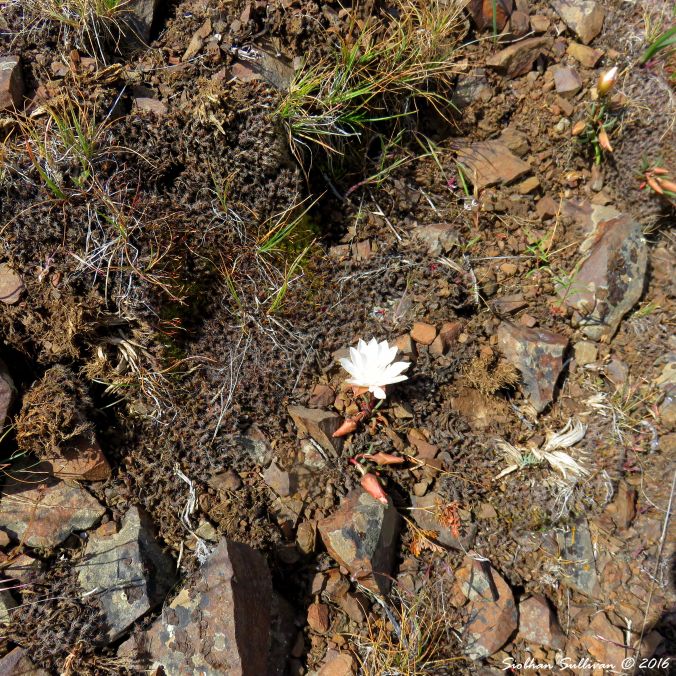
Oasis moments sometimes happen in the desert. While hiking to Chimney Rock near Prineville, Oregon, we came across a patch of bitterroot flowers. The small flowers burst forth from cracks in the sandy soil in shades of pink and white. The flowers are only about an inch and a half across. The plant is delicate yet hardy at the same time.
I had never seen so many blossoms in one place. Bitterroot has always been a plant that amazes me. It was hard for me to keep walking with our group when a part of me just wanted to crouch down to their level and marvel at their perfection.


Beneath the soil, a taproot gives this plant its name. Meriwether Lewis, of the Lewis and Clark Expedition, first saw the bitterroot plant in Lemhi County, Montana on August 22, 1805. Lewis tasted the root and described it in his journal:
this the Indians with me informed were always boiled for use. I made the exprement, found that they became perfectly soft by boiling, but had a very bitter taste, which was naucious to my pallate, and I transfered them to the Indians who had eat them heartily.

Baskets & photo of digging stick, Warm Springs Museum
Bitterroot can be found in much of western North America in drier areas with well-drained gravelly soils and several tribes made use of the plant. Shoshoni, Flathead, Nez Perce, Paiute, Kutenai, and other tribes used digging sticks to collect the roots in the spring. The roots were dried and were often mixed with berries and meat.
The roots were traded and bartered and were considered to be of great value. A bagful was worth as much as a horse. They were used as food but also had medicinal uses. Bitterroot was used for several ailments including heart problems and sore throats. They were also used to treat wounds and to increase milk flow in nursing mothers.
President Thomas Jefferson had asked Lewis to collect plant specimens on their expedition. Bitterroot plants were collected on the return trip in June of 1806. The area in Montana where the plants were collected is now known as the Bitterroot Valley. Specimens were given to the botanist Frederick Pursh in Philadelphia. Pursh named the plant Lewsii redviva in honor of Lewis.
Fun fact: The species name redviva means “reviving from a dry state.” The specimens presented to Pursh came back to life even though they had been dug up many months before.

Looking down at the details in a rock smorgasbord near Thermopolis, Wyoming. This site is a rockhounders dream! 😀

Wordless Wednesday

Look beneath your feet
And notice

Notice the textures
Notice the colors blending
And bold


Bold and brilliant hues
Bold and distinct edges
And patterns

Patterns of cracks
Patterns of smoothness
And transitions


Transitions moving towards new
Transitions moving in a rhythm
And beat

Beat into the earth
Beat into your memory
And soul
I am re-posting one of my favorite posts in celebration of one year of blogging and 100 entries. Hope you are enjoying my blog!

Wordless Wednesday

Here’s a picture of bison in Yellowstone National Park. Happy 4th of July from our new national mammal in the U.S., the bison. Their scientific name is Bison bison bison. If only all scientific names were that easy!
Bison are a conservation success story. Due to over-hunting in the late 1800’s, their population was down to a few hundred animals. As a result of the conservation strategies employed by President Theodore Roosevelt and like-minded individuals, the bison were able to make a dramatic comeback.
Here’s a link to a U.S. Department of the Interior page that has 15 interesting facts about them – Bison

Earth and water photographed at Spring Creek near Camp Sherman, OR
Daily Post Photo Challenge – Opposites

Fox kit at Yellowstone National Park
A gust of wind
Can take them away
Embrace them and guide them
With gentle breezes

Wordless Wednesday

Wordless Wednesday

Last weekend I was out looking for some of the 11+ species of woodpeckers that can be seen near Sisters, Oregon. The Dean Hale Woodpecker Festival brings birdwatchers from all over the world into the woodpecker-rich habitats in the area. East Cascades Audubon Society has been putting on the well-attended event since 2011. There were 17 different field trips this year.

It was a hot day and stunning views of the Sisters peaks, Black Butte, and Mt Jefferson welcomed us.
Continue reading