
Wordless Wednesday
Wordless Wednesday
I decided to feature some furry & feathered frame fillers for this week’s lens-artists photo challenge. The challenge is Filling the Frame. Here are some photos I took at Yellowstone National Park.
This high-flying eagle is in a small museum near Fishing Bridge. It looked so real swooping over our heads.

We saw this pronghorn buck near Mammoth Hot Springs. Most people drove right past him. You have to learn to look for pieces that don’t quite fit into the landscape puzzle to spot wildlife.


Killdeer in the rushes bordering a hot spring at Yellowstone National Park, Wyoming. I assume they have tough feet since we saw them regularly wading into the hot springs in various locations.
Granny Shot It – BOTD
The Lens-Artists Photo Challenge this week is the five elements of metal, wood, water, fire, and earth. Here are pictures that feature several of the elements that I took at Yellowstone National Park.


The fringed gentian, Gentianopsis thermalis, grows in meadows, bogs, and on moist ground. This species prefers growing in warm places and it’s common near geysers and hot springs in Yellowstone National Park. It is the official flower of the park.
This plant grows to a height of 4-16 inches and blooms in May through August. This annual has purple flowers 1.5-3 inches in length. The showy flowers are fringed along the edges.
Fringed gentians can be found across northern Canada and south through the Rocky Mountains and into parts of New Mexico, Utah, and Nevada.
Native Americans used gentians to treat headaches and as an antidote to witchcraft.
Fun fact: The flowers curl up and close on cloudy days leaving just the tops visible. The closed flowers resemble a small windmill.

Wordless Wednesday
Wordless Wednesday
When I last visited Yellowstone, I was searching for a new world to inspire me in my fiction writing. Here are some that I found…

A new world of waves and wonder

A world of contrasting colors

A world of muted rainbows
Continue readingThe water in some of the springs presents to the eye the colors of all the precious gems known to commerce. In one spring the hue is like that of an emerald, in another like that of the turquoise, another has the ultra-marine hue of the sapphire, another has the color of topaz; and the suggestions has been made that the names of these jewels may very properly be given to many of these springs.
Nathaniel Pitt Langford in Diary of the Washburn Expedition to the Yellowstone and Firehole Rivers in the Year 1870.
Grand Prismatic Spring is the crown jewel of hot springs at Yellowstone National Park. The landscape of Grand Prismatic has all the colors of the rainbow. The cracks and tracks add some interesting texture as well. This 370-foot wide spring is the largest in the United States and third largest in the world.


In The Story Who Came to Visit, I mentioned I would be doing an Open Mic event here in Bend. Yes, it does take a bit of courage to do something like that. Yesterday I read a short piece from the children’s book I wrote during NaNoWriMo. The audience was eager to hear the work of local writers.
I read a story about a bullied girl who finds her courage after talking with a magpie and a badger. They both have hidden weaknesses but found their inner strength. Nuǎn, the main character in the story, finds her strength just when she needs it most. A snow leopard that had attacked her and left her scarred is about to attack another child.
Here’s an excerpt from that scene:
Continue reading
Wordless Wednesday
In Yellowstone National Park, much of the wildlife is hidden from view. You have to look carefully to find the animals and sometimes they will reveal themselves to you.
 Elk in the Lamar Valley are hidden as they blend into the landscape traveling along a ridge top.
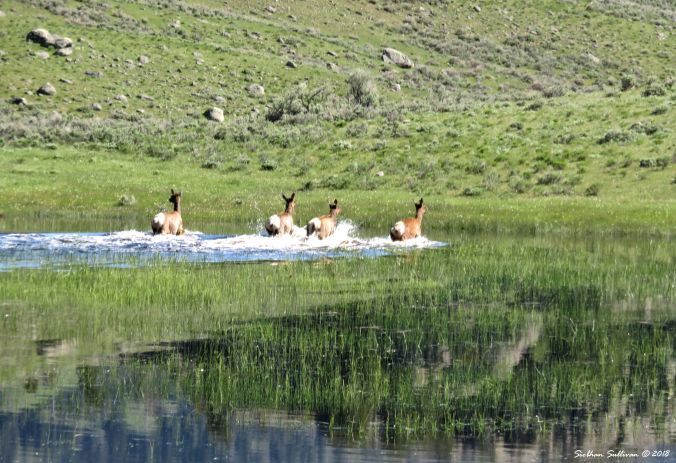 However, when they cross a pond they are revealed. The splashing water draws your attention and their pale colored rumps make you take notice of them.

We saw this red fox in Yellowstone National Park in June of this year. This is the Rocky Mountain subspecies, Vulpes vulpes macroura.
The red fox is not seen often in the park because they are nocturnal and they blend into their preferred habitats along the edges of meadows and forests. The females nurse their kits during late spring and this may have been a female out looking for food. Foxes usually use dens created by other animals.

We were fortunate to see a female with kits on another spring visit to Yellowstone. Litter size averages four to eight kits. Vixens gives birth in late March to April. Both parents care for the young through their first few months of their life.
When wolves were introduced into the park, many coyotes were eliminated by the wolves and this may have caused an increase in the number of foxes. Coyotes prefer sagebrush and open meadow habitat and hunt more by day so they don’t compete as much with foxes.

The red fox is the smallest dog-like mammal in the park. The males weigh 11-12 pounds and the females weigh 10 pounds. They average 43 inches in length. Most foxes live 3-7 years but in Yellowstone can live up to 11 years.

There are many soft sights to see in Yellowstone National Park’s harsh environments. Soft and steaming mist drifts over Sunset Lake. Soft puffy clouds float over rounded hills in the distance.

The colors along the shorelines blend softly into one another giving the lake its name. To me, it is a mystical sort of place that has many stories to tell.
Lens-Artists Photo Challenge – Soft

I was glad I was inside my car when I saw these bison coming right at us. Some people think they are calm and tame like a domestic cow. They’re not! Bulls weigh up to 2,000 pounds and cows weigh up to 1,000 pounds. Since they can run up to 30 miles per hour, it’s best to keep your distance.
Here’s another post on them plus a link to more information. Bison Celebrating 4th.
Travel with Intent Photo Challenge – Action
I had fun watching these yellow-bellied marmot pups playing while their mom kept a watchful eye on them. A mother’s work is never done!

Circles of varying size dissected with cracks and surrounded by steaming mists arising from a rainbow of color at North America’s largest hot spring. Oh the wonder!

“Nature always wears the colors of the spirit.” Ralph Waldo Emerson
To see a photo of this spring as a thunderstorm approaches, see An Artist’s Wish.
Travel with Intent – Circle
Here’s a group of elk making their way through a small lake in the Lamar Valley in Yellowstone National Park. A peaceful scene is mirrored in the lake. However, the elk are in an area where several wolf packs live.


Did you know that the environment is changing in a positive way since reintroducing wolves? To see a fascinating video about this, click How Wolves Change Rivers.
Fandango’s One-Word Challenge – Mirror
I have so many Yellowstone favorite places it’s hard to choose. Here’s a collection of photos of things that make the park special. I start this post with a quote from President Theodore Roosevelt who was known as the “conservation president.”
“The only way that the people as a whole can secure to themselves and their children the enjoyment in perpetuity of what the Yellowstone Park has to give is by assuming the ownership in the name of the nation and by jealously safeguarding and preserving the scenery, the forests, and the wild creatures.”
Theodore Roosevelt, April 24, 1903 at the laying of the cornerstone of Gateway to Yellowstone National Park
 Yellowstone National Park, with its larger-than-life landscapes, dramatically changing weather conditions, amazing menagerie of wildlife, variety of plant life, and geology in action, is one of my favorite places. It also has a rich history as the world’s first national park.
 Silent Sunday

Grand Prismatic Spring, Yellowstone National Park
Sometimes an artist’s greatest wish is that others will be able to see the emotion and spirit of a place in their work. I hope you can feel some of what I was trying to capture in this photo from Yellowstone National Park.
Art is about expressing the true nature of the human spirit in whatever way one wishes to express it. If it is honest, it is beautiful. If it is not honest, it is obvious.
Corin Nemec
Weekly Photo Challenge – Wish
 I have always had a special feeling about Spasmodic Geyser in Yellowstone National Park. Why? I think part of it has to do with the interesting name. Check out this short video and watch for the butterfly that tempts fate.
Eruptions from this geyser range from a few inches to 20 feet in height. The time between eruptions varies but is usually in the range of 1-3 hours. Spasmodic Geyser has a temperature of 198° F. This geyser was named by Geologist A.C. Peale when he was doing work with the 1878 Hayden survey team. Peale chose this name due to the geyser’s erratic behavior.
Weekly Photo Challenge – Names

When I start feeling nostalgic about Yellowstone National Park, I know I can always go back and look at some of my many pictures. They remind me of my great Yellowstone memories. Maybe these bears were out looking for a pic-a-nic basket. 😉
Weekly Photo Challenge – Nostalgia

Wordless Wednesday

Look beneath your feet
And notice

Notice the textures
Notice the colors blending
And bold


Bold and brilliant hues
Bold and distinct edges
And patterns

Patterns of cracks
Patterns of smoothness
And transitions


Transitions moving towards new
Transitions moving in a rhythm
And beat

Beat into the earth
Beat into your memory
And soul
I am re-posting one of my favorite posts in celebration of one year of blogging and 100 entries. Hope you are enjoying my blog!

Here’s a picture of bison in Yellowstone National Park. Happy 4th of July from our new national mammal in the U.S., the bison. Their scientific name is Bison bison bison. If only all scientific names were that easy!
Bison are a conservation success story. Due to over-hunting in the late 1800’s, their population was down to a few hundred animals. As a result of the conservation strategies employed by President Theodore Roosevelt and like-minded individuals, the bison were able to make a dramatic comeback.
Here’s a link to a U.S. Department of the Interior page that has 15 interesting facts about them – Bison

Fox kit at Yellowstone National Park
A gust of wind
Can take them away
Embrace them and guide them
With gentle breezes

Hmmm…a predominantly pink woodpecker named after a famous early American explorer and a wily relative of the crow named after his partner. That might make for an interesting bit of writing. I started to research the topic and decided to create a Lewis and Clark Critter Quiz.
Little did I know there was controversy linked to the plants and animals “discovered” on the Lewis and Clark expedition. The expedition supposedly discovered 178 plants and over 122 animals previously unknown to science. Or did they?
Other sources say they “encountered” or “reported” certain wildlife and plants. Due to discussions as to the accuracy of previously published lists, one recent list is divided into two sections: Discovered (for the first time by European Americans) and Described. Some of the flora and fauna species had been discovered in other parts of North America (or the world) prior to the time of the expedition while others had been a part of native people’s life for many years.
I am lucky to have seen many of the wildlife species that Lewis and Clark discovered and described. Many of these creatures live in and around Yellowstone National Park, which I have often visited. Here is a quiz that includes pictures of wildlife encountered on the expedition.
Did the Lewis & Clark expedition Discover them or Describe them? The answers are at the end of this quiz.
Continue reading
Look beneath your feet
And notice

Notice the textures
Notice the colors blending
And bold


Bold and brilliant hues
Bold and distinct edges
And patterns

Patterns of cracks
Patterns of smoothness
And transitions


Transitions moving towards new
Transitions moving in a rhythm
And beat

Beat into the earth
Beat into your memory
And soul

His twittering voice kept leading me on through the wilderness. It seemed like every time I raised my binoculars to my eyes, he would make a quick getaway.
I followed him on winding trails bordered by bubbling and spouting geysers. He flitted through pine forests doused by thunderstorms. Gusts of wind kept pushing him just out of my reach.

Finally, finally, I came eye to eye with the mysterious beast. A Yellow-rumped warbler, Setophaga coronata auduboni. This pint-sized songbird perched in the tree and stared at me as if he was shouting, “Ollie, Ollie in come free!” Our game of hide and seek was over and he stayed in plain sight on his home base.
The tree clung to the side of a cliff overlooking Tower Fall. The little bird had lead me to an important spot in Yellowstone National Park.
Continue reading


Clouds…
Obscure what was once clear
Release things that burden them
Blanket the cold nights
Shine brightness on what’s to come
Surround us in the divine

I recently went on a Deschutes Land Trust hike just west of Bend, OR to learn about fire ecology. The area we hiked in is known as the Skyline Forest. There were fires in this vicinity in 2010 and 2014 and together they burned about 6,000 acres. The area is currently privately owned but the Deschutes Land Trust has been trying to acquire it.
Our guide, Pete Caligiuri with The Nature Conservancy, informed us that this area has about the steepest environmental gradient in the world. In the Cascade Mountains the precipitation can be as high as 160 inches per year while less than 25 miles away, it can be as low as 10 inches per year. Plants respond to the extreme amount of variability in this gradient. In the past, fire and moisture limited the number of trees in the forest. Now there can be as many as 800-900 trees per acre in this area.

We looked around to see how many large stumps left over from timber harvesting we could see. There weren’t many at all. At one time this forest had the trees much more widely spaced. We noticed the high number of young trees with branches reaching down closer to the ground. There was also a thick growth of underbrush that included bitterbrush and manzanita. The forest floor was covered with pine needles and fallen branches. The closer spacing, higher number of shrubs, and accumulation of litter on the forest floor makes this forest more vulnerable to fire.
Continue reading
Some places just take your breath away with their beauty. The Morning Glory geyser at Yellowstone National Park is one of them for me. Mine eyes have seen the glory…

Listen to the smallest voices for they often have the most to say.
(Close-up of heat loving thermophiles near Dragon’s Cauldron at Yellowstone National Park).