A soggy sage contemplating the rain at Crystal Springs Rhodendron Garden in Portland, Oregon.

A soggy sage contemplating the rain at Crystal Springs Rhodendron Garden in Portland, Oregon.
She’s surfin’ the Deschutes River at the Bend Whitewater Park in Oregon
Bend Branches always appreciates your comments and likes. Comments may not appear right away since they’re screened for spam prior to posting. Thanks!

Roundabout created by Mother Nature in Yosemite National Park, California.
Bend Branches always appreciates your comments and likes. Comments may not appear right away since they’re screened for spam prior to posting. Thanks!
Today I’m featuring photographs of blazingstars near and far.
The first picture shows the Sierra blazingstar, or saffron blazing star, Mentzelia crocea. I took this picture in Kings Canyon National Park, California. This 3-foot tall plant blooms from April to June. I like the numerous delicate stamens in the middle of each flower. It is classified as an annual wildflower.
This blazingstar grows in the foothills of the Sierra Mountains. It grows in a relatively small area of California. It is endemic to that region.

The next photo shows the giant blazingstar, or smoothstem blazingstar, Mentzelia laevicaulis. I took this photo at Pilot Butte State Scenic Viewpoint, Oregon. Pilot Butte is an extinct cinder cone in Bend, Oregon. This species grows from 3-6 feet tall and blooms from June to September. The petals are narrower on their flowers, but they still have a lot of stamens. It is classified as a biennial or short-lived perennial wildflower.

The giant blazingstar grows from southern Canada through the western United States. It’s much more widespread than the Sierra blazingstar.
As I noted on a previous post, the flowers stay open from mid-morning through the night. Blazingstars attract pollinators during evening hours, including hawk moths. The giant blazingstar can also self-pollinate.
Bend Branches always appreciates your comments and likes. Comments may not appear right away since they’re screened for spam prior to posting. Thanks!
Delicate symbols
Of peace
Vying for space
Endure
Settle

Bend Branches always appreciates your comments and likes. Comments may not appear right away since they’re screened for spam prior to posting. Thanks!
You can get creative on blog posts in several ways.
You may want to showcase your own artwork.
This rock was the perfect shape for a barn owl painting. I used acrylic paint on this rock. First, I applied a cream colored base coat, then used small brushes to add the details. I perched it in the fork of a tree in my yard for the photo.

The next photo shows a magpie flying over the Painted Hills. As I’ve mentioned in previous posts, the bird is a character in a book I’m working on. For this painting, I used watercolors and ink from a Chinese inkstick.

In the next drawing, I used pen and ink. This a stylized drawing of a grizzly bear. I had forgotten it was on the back of another drawing I had done of a bear.

You can be creative in other ways. I like to occasionally post photo bloopers. This is where I post pictures that didn’t turn out as expected, so I add a little humor to them.
One day, I was following a family of Trumpeter Swans near the Sunriver Nature Center in Oregon. As soon as I started taking pictures, they did this.

The caption reads, “She’s about to take our picture. Quick, everyone put your head underwater!”
The next one shows the Three Gossips rock formation in Arches National Park in Utah.

One of the gossips is saying, “Then Rocky told me he’d give me the latest scoop.” Another says, “Really?” The last one says, “Cliff, you really shouldn’t spread that kind of dirt.”
The next photo shows a close up of wrinkly bark on a western juniper tree.

The caption reads, “Uh… the anti-wrinkle cream doesn’t seem to be working.”
Another way to get creative on your blog is to use photo processing effects. I use Corel PaintShop Pro 2021 to edit my pictures.
The first shows a cloud-filled sky over Playa at Summer Lake. If you move the slider, you can see how the original compares to the edited version. I increased the contrast and used a black and white film effect. This effect works well with cloud formations.


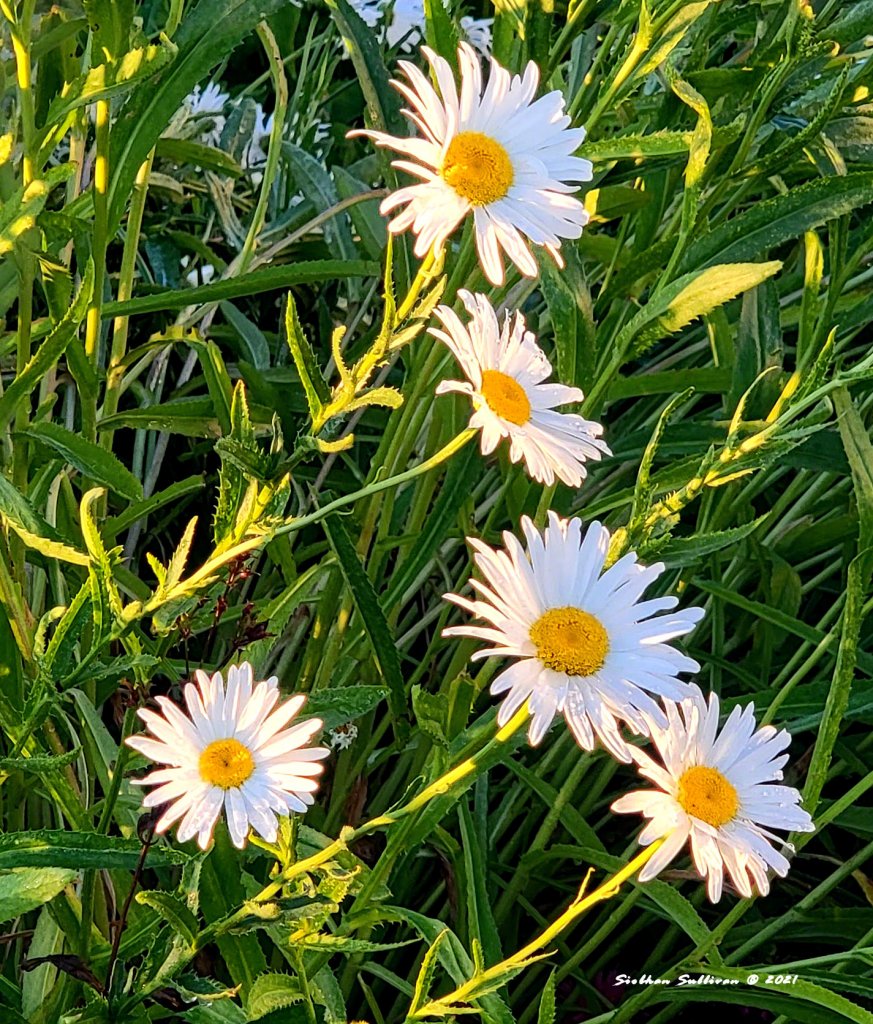
In the next photo, I used a colored edges effect on a picture I took of daisies. I like this one because it almost looks like a drawing with this effect.

The last photo shows a windmill at Fort Rock Homestead Village Museum in Oregon. For this picture I used a glowing edges artistic effect. It makes all the details stand out.


Lens-Artists Photo Challenge – Creativity
Bend Branches always appreciates your comments and likes. Comments may not appear right away since they’re screened for spam prior to posting. Thanks!
Today I’m sharing a couple photos of a dwarf purple monkeyflower up close. This tiny flower is blossoming now in my High Desert yard near Bend, Oregon. They bloom from May to August. In years with ample precipitation, this plant produces branches bearing dozens of flowers.

The dwarf purple monkeyflower, Diplacus nanus or Mimulus nanus, is a native plant that grows in parts of California, Oregon, Washington, Idaho, Nevada, Montana, and Wyoming. It grows in sagebrush-steppe and open pine forest habitats.
To show just how small they are, I photographed two plants next to a quarter.

Macro Monday (MM)
Bend Branches always appreciates your comments and likes. Comments may not appear right away since they’re screened for spam prior to posting. Thanks!

Porcupine chew toy white-tailed deer antler

Bend Branches always appreciates your comments and likes. Comments may not appear right away since they’re screened for spam prior to posting. Thanks!
Today, I’m sharing a pygmy rabbit drawing I created with pen and ink. These tiny rabbits are the epitome of cute. They are the smallest rabbit in the world.
This rabbit weighs between 9 to 15 ounces and measures between 9.2 to 11.6 inches in length, small enough to fit in your hand.

Pygmy rabbits, Brachylagus idahoensis, live in sagebrush-steppe habitats. Unlike other rabbit species in North America, they dig their own burrows. Their range includes parts of Oregon, Montana, Idaho, Utah, Nevada, and California. Washington and Wyoming’s populations are genetically isolated. The Washington state population is endangered and attempts to captive breed them with rabbits from other locations have met with limited success. Elsewhere in their range, biologists classify them as Least Concern.
I saw this rabbit on my back porch one day and I believe it’s a pygmy rabbit. Their fur color is uniformly brown to dark grey and their ears are small and rounded. Pygmy rabbit’s short brown tail is nearly invisible under their fur.

I’ve also seen black-tailed jackrabbits and mountain cottontails on our property. This photo, also taken on my back porch, shows a mountain cottontail face to face with my cat for comparison. It had a white tail and undersides and large ears. Yes, my cat enjoyed the free show. 😉

In the winter, pygmy rabbits feed primarily on sagebrush. In spring and summer months, they add grasses to their diet. Pygmy rabbits also eat roots, wood, bark, stems, and seeds, grains, and nuts. Weasels, coyotes, foxes, badgers, bobcats, owls, and birds of prey feed on this rabbit. Predation can eliminate up to 88% of juveniles and adults. Other threats include habitat loss, competition with heavy livestock grazing, severe weather, isolation of populations, and road mortality.
Though we have limited information on their reproduction, they produce 4-8 offspring in late winter and early spring. They may raise their young inside burrows, but no one has found any.
Do you have artwork you would like to share? Be sure to include the First Friday Art tag.
Bend Branches always appreciates your comments and likes. Comments may not appear right away since they’re screened for spam prior to posting. Thanks!
Watching wild things
Ruminating on what they’ve left behind

And looking forward to what lies ahead

Watching winged wonders
Considering what’s best to leave buried

And what’s worth soaring towards

Watching wild creatures
Surfacing from turbulent waters

And basking in their many accomplishments

Watching wild things
Transforming from earthbound organisms,
Into many-eyed sages of the skies

Lens-Artists Photo Challenge (LAPC) – It’s a Wild Life!
Fandango’s One Word Challenge (FOWC) – Bury
Bend Branches always appreciates your comments and likes. Comments may not appear right away since they’re screened for spam prior to posting. Thanks!
Favorite moments at an old homestead in the Oregon Outback

and with a Great Blue Heron at Crystal Springs Rhododendron Garden, Oregon

Remembering time spent near Grand Prismatic Hot Spring in Yellowstone National Park, Wyoming

and beside a weathered tree in Arches National Park, Utah

Favorite moments with a pronghorn buck in Yellowstone National Park, Wyoming

and near a prickly pear cactus blooming in Bend, Oregon

Lens-Artists Photo Challenge (LAPC) – Personal favorites
Bend Branches always appreciates your comments and likes. Comments may not appear right away since they’re screened for spam prior to posting. Thanks!
Plants grow in bunches in dry environments

And in dense carpets in moist places

Plants grow with sharp defenses in dry places

And rounded edges in wet environments

Plants disperse in rockbound dry environments

And collect along waterway edges in wet places

Sunday Stills – All shades of green
Bend Branches always appreciates your comments and likes. Comments may not appear right away since they’re screened for spam prior to posting. Thanks!
When I’m trying to decide if I should use black and white processing on an image, I ask myself one important question: Does the structure of the elements justify its usage?
When you think of structure, you may think of architectural details. Yes, that’s one interpretation, but everything has a structure.
The first two images show a Hosta plant during a downpour of rain at Lan Su Chinese Garden in Portland, Oregon. Initially, I was disappointed to visit on a rainy day. However, while researching the garden later, I found visitors often seek out rainy days.
The color image shows off the green colors in the leaves. The monochrome image shows off the structure of the elements. The contrasting edge color, the curving veins of the leaves, and the glossiness created by the rain, shine in the black and white version.


The next two images show a Borealosuchus crocodile skeleton cast at the Museum of the Rockies in Bozeman, Montana. As soon as I entered this museum, the photographer part of my brain started imagining everything in black and white.
The color version shows the skeleton in warm tones and a recreation of what they looked like in life focuses on a vibrant creature. The black and white version highlights the structure of the elements. Whenever a skeleton is displayed well, you’ll notice its exquisite details.
Sometimes when you create a monochromatic version, you’ll find hidden surprises. The reflections from other displays across from the crocodile made this into what appeared to be a double exposure.


The next two images show barrels at Deschutes Brewery in Bend, Oregon. For certain brews, beer is aged in barrels once containing whiskey, tequila, and other liquor.
The color version shows the varying colors of the aged wood in the barrels. The black and white version also shows the age of the barrels, but emphasizes the orderliness of the storage and the structure of the stairs.


The last two images show the view from an overlook at the Paint Pots trail in Yellowstone National Park, Wyoming. This picture shows dense forests, mountains in the distance, steaming thermal features, and a sky full of puffy clouds.
The color version highlights the cool tones of the sky and forest and the warm tones of the soil around the hot springs. The black and white version lets the cloudscape be the main feature. The thermal features blend into the foreground.


Is a color or monochrome version best? Sometimes there is no right answer. As photographers, we try to capture a moment in time for viewers. With a touch of magic, we help them “see” what they may not have noticed, in color or black and white.
Lens-Artists Photo Challenge (LAPC) – Exploring Color vs Black & White
Memories of…
Relentless rain falling on a wise heron in a serene scene

Pronghorn pausing beside boulders layered with lichen

Crabs pacing and pirouetting in sun dappled darkness

Dust devils twisting over distant desert playas

Storms soaring past mountain peaks and lingering over large lakes

Waves, drifting and defiant, pummeling sandy shorelines

Wagon wheels carrying settlers to the promised land on treacherous treks

Trash turned into whimsical creatures making nests in restful retreats

Memories of…
Relentless rain falling on graceful dancers in a serene scene

Lens-Artists Photo Challenge – Last chance
Bend Branches always appreciates your comments and likes. Comments may not appear right away since they’re screened for spam prior to posting. Thanks!
This week the Central Oregon Writers Guild (COWG) launched their 2024 literary collection. This 304-page anthology includes fiction, non-fiction, and poetry by published and emerging writers.

There were way more entries this year than in years past. I was honored to have one of my short stories selected for this book. The fictional story, The Lost Forest, is based on an actual place in Central Oregon. I included a few fun facts at the end of the piece about this unique forest.

I’m including a recording of myself reading an excerpt from the story. A few days ago, I was one of seven readers chosen to read their pieces aloud at a local bookstore in Bend.
If you’re looking for a special gift, please consider purchasing a copy of the Central Oregon Writers Guild 2024 Literary Collection. It’s available at Roundabout Books & Cafe in northwestern Bend and at Amazon books.
I suppose I should also mention that a couple pieces of my work are featured in the 2022 edition as well. So please consider buying previous editions of this book.
We appreciate your support!
Siobhan Sullivan
On-line Writer’s Guild (OLWG) – I suppose
Bend Branches always appreciates your comments and likes. Comments may not appear right away since they’re screened for spam prior to posting. Thanks!
High Desert wonders
Roam and rest in grassy meadows

Emerge from burrows, full of curiosity

The visitor center at Fossil Butte National Monument may be small, but it’s jam packed with AMAZING fossils, many excavated here or nearby. Fossil Lake once covered this area and the conditions existing at that time preserved fossil remains especially well. Fossil Butte National Monument is in Kemmerer in southwestern Wyoming.
The fossils were discovered in this area in the mid 1800s. One well-known collector, Lee Craig, quarried and prepared fossils for museums and private collectors from 1897 to 1937. When collectors illegally used bulldozers in fossil beds nearby, preservation became a higher priority. The conservation of this site’s unique treasures was ensured in 1972, when it was established as a national monument.
This fossil was huge! It’s from the genus Borelosuchus, neither a true crocodile nor a true alligator. They could grow to a length of 16 feet.

Here are some of the fish fossils on display. Twenty seven species have been found in this area.

As I mentioned in my Fishing for Fossils post, this is one of the best places in the world to find fossils of fish. Since you cannot collect fossils at the monument, we dug fossils at a commercial business just east of Fossil Butte National Monument.

Years ago, I volunteered at an artists’ cooperative gallery in Bellingham, Washington. A man named Corky regularly visited the gallery. He had special needs and, despite his challenges, always had a sunny outlook on life. One day, he asked if I could draw him a rabbit. I drew him this pen and ink drawing that I titled, “Corky’s Bunny.” I decided to portray this rabbit looking up because that’s what Corky always did.
I’ll never forget how excited Corky was when I gave him the final drawing. I only charged him ten dollars for the original artwork. To him, this drawing was something of immeasurable value that he would always treasure.

Bison grazing under the beautiful Lamar Valley sky in Yellowstone National Park, Wyoming.

Here’s the High Desert Voices August 2024 newsletter for your reading pleasure. Lots of nice photos as well! This newsletter is published by and for volunteers at the High Desert Museum in Bend, Oregon. I’ve been working there as a volunteer since 2013.

Articles this month include one on the Natural History Pub lectures, one on the Lost in Place writing workshop, one on sea otters, and one on the Sensing Sasquatch exhibition at the Museum.
Please enjoy the High Desert Voices August 2024 issue!
Bend Branches always appreciates your comments and likes. Comments may not appear right away since they’re screened for spam prior to posting. Thanks!
Seeing pairs of bronze bulls bash together in winter blizzards

and a couple of cascades crashing down craggy cliffs

Seeing two octopi slip and slide over seaside skyscrapers

I enjoy using cameras small enough to fit in a pocket. I recently got a new flying lens as a gift.
Here it is. What, can’t you see that it’s a camera?

How about if I unfold it? Yeah, it’s a drone. I still have the lens protector on the front in this photo.

Here’s the controller. I like my new flying lens because it stops itself from crashing into things in 360 degrees of direction. It will also land from where it took off with the touch of a button.

Here’s the High Desert Voices June 2024 newsletter for your reading pleasure. Lots of nice photos as well! This newsletter is published by and for volunteers at the High Desert Museum in Bend, Oregon, where I volunteer.
Articles this month include one on accommodating visitors with disabilities, one on facts about local wildlife mothers, one on the High Desert Ranger Station, and one on a birding event at the Museum.
Please enjoy this month’s issue!
I recently saw this white sturgeon sculpture at the Oregon Coast Aquarium in Newport, Oregon. They are the largest freshwater fish in North America.

A couple months later, I watched these white sturgeon swimming around at the Oregon Zoo. These fish were three or four feet long, but this species can reach lengths of over 14 feet and weigh more than 1,500 pounds. Sturgeon can live more than 100 years.

Here in Oregon, white sturgeon live mainly in large freshwater streams and estuaries along the coast. They occasionally travel into the ocean.
Here is a picture of a much younger white sturgeon taken at the High Desert Museum several years ago. I wouldn’t mind having a sturgeon sculpture of this size fish. The other fish pictured are trout.

Bend Branches always appreciates your comments and likes. Comments may not appear right away since they’re screened for spam prior to posting. Thanks!
A Jenday conure up close at my house. I sometimes take care of my son’s conure when he goes on vacation. It has beautifully colored feathers and a very LOUD voice.

Last weekend, we drove to Brasada Ranch resort in Powell Butte, Oregon for a BBQ and art show event. They have spectacular views of the Cascade volcanoes from their restaurant. These red chairs around a firepit were a nice accent in this scene.

Here’s a closer view of some of the marvellous mountains.

This beautiful resort has received recognition from Condé Nast Traveler, Travel + Leisure, Golfweek, USA Today, and other sources. Since we live close by, we did a staycation in one of their cabins a couple of years ago and it was great!
When I process pictures, I think about how to enhance the beauty of the subject.
The natural features at the Red Canyon Overlook in Dutch John, Utah are beautiful, but so is the visitor center. The roof looks like wings swooping upwards. A fence with a modern design and a standing dead tree add to the beauty.

To enhance the architecture of the building, I used a cold filter and a dark vignette. I framed it with a simple white slide mount effect.

As you may know, I’ve been volunteering at the High Desert Museum in Bend, Oregon since 2013. I work on their volunteer newsletter. We are sharing the April HDV newsletter with staff and volunteers and we’d like to also share it with you. High Desert Voices (HDV) is a newsletter published by and for Museum volunteers.
The newsletter covers events and exhibitions at the High Desert Museum, as well as other topics. The museum features wildlife, living history, and culture topics related to the High Desert region.
The April HDV newsletter includes articles on the relationship of Indigenous people with Mother Earth, a behind the scenes look at the Museum’s birds of prey, and the progress being made on returning steelhead to the Crooked River in Oregon.
Please enjoy this month’s HDV newsletter. I’m very proud of the work our Newsletter Team accomplishes. We’re always grateful for the input we receive when working on articles from staff, speakers, and other sources. Comments from you, our readers, would also be appreciated. Thanks!
I was driving near my house early one morning when I saw this sight. It was a hawk eating breakfast on the road.
I had interrupted a Red-tailed Hawk while it was feasting on a rabbit or hare. The local Black-billed Magpies appeared out of nowhere to get the leftovers.
As you can see, if you zoom in, the magpie pictured below was moving at a speed of 0 MPH. 😉

The hawk wisely decided to move its breakfast off the road.

Finding drama in branches haphazardly woven together

Or planted in concise rows bearing intoxicating fruit

Here are some of my 2023 favorites. Enjoy!
Quiet places to sit and ponder the wonders of nature

Bridges swaying over stormy seas, with thundering waves below

Landscapes uplifted over eons to reveal the colors of earth’s core


Here’s a picture of beautiful purple clematis blossoms up close in July of last year.
Clematis vines do well in sunny locations with moist, well-drained soil. A thick layer of mulch over their roots helps keep them cool, which they prefer. Once mature, these plants can reach a height of 10 to 20 feet. There are nearly 300 species of clematis. The distinctive blossoms of clematis come in a wide variety of colors, including white, yellow, pink, purple, blue, green, and bi-color.
Today I’m sharing a pen and ink drawing I did of a painted turtle. I have fond memories of them as a child, when I kept painted turtles as pets.

I’m also sharing a couple photos of them I took in Custer State Park in South Dakota. When we made a quick stop to walk the dogs, I was surprised to see this “island” near the road.

When I took a closer look, I discovered the island was covered with painted turtles, taking a break in the warm sun. Cool! 🙂

Do you have artwork you would like to share? Be sure to include the First Friday Art tag.
First Friday Art (FFA)
When I think about waterlilies, I think about perfection on the water. Delicate blossoms radiate over thick floating leaves. No more words needed.

We recently returned from a long road trip through several western states and spotted hundreds of pronghorn along the way. I’m a big fan of this antelope of the west and love taking pictures of them.
Pronghorn, Antilocapra americana, also known as antelope or pronghorn antelope, are quirky animals in many ways. Their scientific name means “American goat-antelope.”
In September of 1804, upon first seeing pronghorn, Lewis and Clark expedition members assumed they were goats. Captain Lewis noted the “superior fleetness of this anamal which was to me really astonishing.” Upon examining them more closely, Lewis referred to them as antelope, based on their resemblance to African antelopes.
In reality, pronghorn are the only surviving members of the North American Antilocapridae family. Goats and true antelopes are in the Bovidae family.

In this post, I’ll share more about their natural history.
Pronghorn range from the southern prairie provinces of Canada, southward into the western states of America and into northern Mexico.

I saw this grove of lovely maidenhair fern near South Falls, at Silver Falls State Park, Oregon. The 7.2-mile Trail of Ten Falls wanders through forested lands where you get great views of the waterfalls. You’ll also see many types of fern.

The genus name of maidenhairs is Adiantum. It comes from the Greek word for “unwetted” since this plant sheds water without getting wet.
Here’s a picture I took of some growing near Upper North Falls in the park. On this image, I increased the contrast, giving it an almost black background.

This fern, with its delicate, arching fronds growing in fanlike arrangements, is one of my favorites. I experimented with developing pictures of it in black and white when I first became interested in photography. Here’s a picture from my archives.


