
What is chaos to some is orderliness to another.
Weekly Photo Challenge – Chaos

Wordless Wednesday

Looking out of the mouth of the Fort Rock cave at the Sagebrush Sea, one can only imagine the thoughts of those that lived there thousands of years ago. Sagebrush sandals, found inside Fort Rock Cave, were determined to be 9,300-10,250 years old. These sandals are the oldest ever found in the world.

A small hearth was found in the cave and it was radiocarbon dated to be 15,000 years old. Several stone tools were found nearby. Though that date was questioned by some, in 2009 human coprolites (fossilized poop) determined to be from 14,300 years ago were found in nearby Paisley Cave. In 2009 a multiple function tool made from agate was discovered in Rimrock Draw Rock Shelter, near Riley, Oregon. It may have been made as long ago as 16,000 years ago.

Other ancient sandals have been found but never in the quantity found at Fort Rock. Nearly 100 sandals were found ranging from child-sized to adult. They are all the same style with a flat bottom and flap covering the toe area. The sagebrush bark is woven in a distinctive twining style. Sandals of this type were found at various locations in southeast Oregon and northern Nevada. In more recent times, ethnographers found that members of the Klamath and Paiute tribes, who lived in the Fort Rock area, wore footwear woven from sagebrush and tule.
The location where the sandals were found was likely a lake shore 10,000 years ago. Native peoples may have lived there because of the easy access to game, fish, and edible plants. At the present time, the cave borders a huge expanse of dry sagebrush steppe habitat. The climate changed after Mount Mazama blew 7,600 years ago. A thick layer of ash from that eruption blanketed an area covering 500,000 square miles in western North America.
If you want to see this site, you will need to go with a guide since access is regulated by Oregon Parks and Recreation Department in partnership with the University of Oregon. Go here for more information – Fort Rock Cave.

If you want to see the sandals in person, there are some on display at the University of Oregon Museum of Natural and Cultural History. Click here for a good photo of them – sandals. The Museum also has a collection of stone tools and other fiber artifacts excavated from the cave. You can see a small display about the sandals at the Fort Rock Valley Homestead Museum. See my post on that Museum and information about the Fort Rock formation here.

Did you know that a princess is buried at Lake View Cemetery in Seattle? I bet many people don’t even know who she was. The woman known as “Princess Angeline” was the daughter of Chief Sealth, aka Chief Seattle or Chief Si’ahl. Born in the early 1800’s, she passed away on May 31, 1896.
I posted a nine-part essay on photographer Edward S. Curtis last year and in Part 3, recalled the importance of Princess Angeline to Curtis’ future career. She was the first Native American that he photographed. He entered several pictures of tribal members in a National Photographic Society contest. Consequently, one photograph won the grand prize and a gold medal.


Life can take a lot of twists and turns so it’s nice to get a bouquet once in a while. This giant size balloon bouquet was my cherry on the top of a great weekend. They were here for the annual Balloons Over Bend event.
Weekly Photo Challenge – Cherry on the Top

Bitterroot, Lewisii redviva
Oasis moments sometimes happen in the desert. While hiking to Chimney Rock near Prineville, Oregon, we came across a patch of bitterroot flowers. The small flowers burst forth from cracks in the sandy soil in shades of pink and white. The flowers are only about an inch and a half across. The plant is delicate yet hardy at the same time.
I had never seen so many blossoms in one place. Bitterroot has always been a plant that amazes me. It was hard for me to keep walking with our group when a part of me just wanted to crouch down to their level and marvel at their perfection.


Beneath the soil, a taproot gives this plant its name. Meriwether Lewis, of the Lewis and Clark Expedition, first saw the bitterroot plant in Lemhi County, Montana on August 22, 1805. Lewis tasted the root and described it in his journal:
this the Indians with me informed were always boiled for use. I made the exprement, found that they became perfectly soft by boiling, but had a very bitter taste, which was naucious to my pallate, and I transfered them to the Indians who had eat them heartily.

Baskets & photo of digging stick, Warm Springs Museum
Bitterroot can be found in much of western North America in drier areas with well-drained gravelly soils and several tribes made use of the plant. Shoshoni, Flathead, Nez Perce, Paiute, Kutenai, and other tribes used digging sticks to collect the roots in the spring. The roots were dried and were often mixed with berries and meat.
The roots were traded and bartered and were considered to be of great value. A bagful was worth as much as a horse. They were used as food but also had medicinal uses. Bitterroot was used for several ailments including heart problems and sore throats. They were also used to treat wounds and to increase milk flow in nursing mothers.
President Thomas Jefferson had asked Lewis to collect plant specimens on their expedition. Bitterroot plants were collected on the return trip in June of 1806. The area in Montana where the plants were collected is now known as the Bitterroot Valley. Specimens were given to the botanist Frederick Pursh in Philadelphia. Pursh named the plant Lewsii redviva in honor of Lewis.
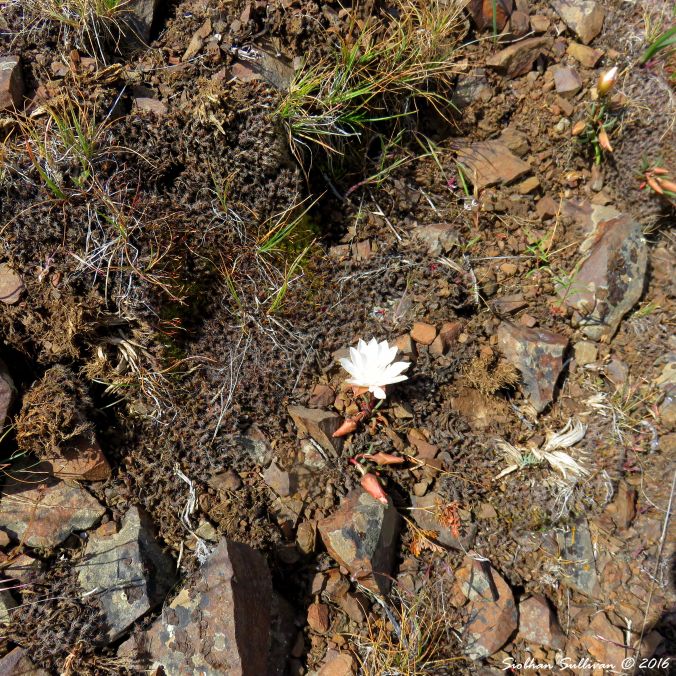
Fun fact: The species name redviva means “reviving from a dry state.” The specimens presented to Pursh came back to life even though they had been dug up many months before.

Look up at the water pumping windmill at Fort Rock Valley Homestead Museum in central Oregon.
Daily post – Looking up

Here’s a picture of bison in Yellowstone National Park. Happy 4th of July from our new national mammal in the U.S., the bison. Their scientific name is Bison bison bison. If only all scientific names were that easy!
Bison are a conservation success story. Due to over-hunting in the late 1800’s, their population was down to a few hundred animals. As a result of the conservation strategies employed by President Theodore Roosevelt and like-minded individuals, the bison were able to make a dramatic comeback.
Here’s a link to a U.S. Department of the Interior page that has 15 interesting facts about them – Bison

Wordless Wednesday

Cowboy Dinner Tree gift shop
Tucked away in Oregon’s Outback, you will find a unique place that hearkens back to an earlier time. The Cowboy Dinner Tree is a small restaurant located in Silver Lake Oregon, about an hour and a half southeast of Bend. The restaurant is only open from 4:00-8:30 pm four days per week and reservations are required. They give you ample portions of food here and you are advised to bring a cooler for leftovers. They do not take credit cards or debit cards so have cash on hand.


You have your choice of a 26-30 oz. top sirloin steak or a whole roasted chicken. Both are accompanied by several tasty side dishes. There is green salad, hearty soup, old fashioned sweet yeast rolls, baked potato, and a dessert. You can have coffee, iced tea, or pink lemonade with your meal. On the day we were there, they served bean soup and a small shortcake with fresh berries. Everything is homemade and made daily.


Looks like an old homestead, right?

Look closer.
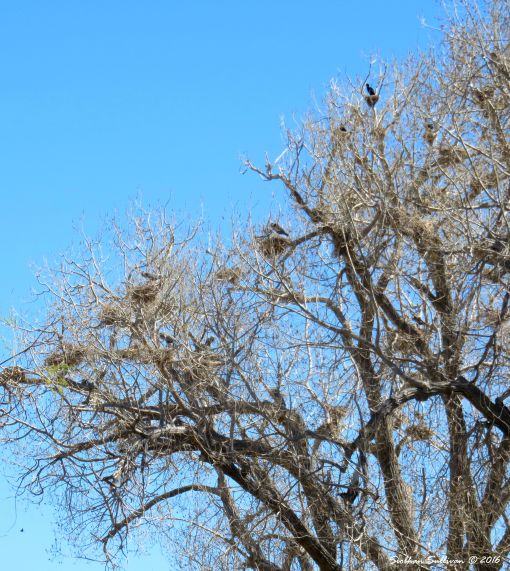
Go on…zoom in.

If we learn to focus in on things and look closer, we sometimes find the unexpected.
In this case, it’s a double-crested cormorant and great blue heron rookery. These birds look and act so differently yet they manage to get along.
This rookery is located at the Sod House Ranch at Malheur NWR. It was built by cattle-baron Peter French in the late 1800’s. The ranch was the headquarters of the French-Glenn Livestock Company that at one time covered 140,000 acres.

Hmmm…a predominantly pink woodpecker named after a famous early American explorer and a wily relative of the crow named after his partner. That might make for an interesting bit of writing. I started to research the topic and decided to create a Lewis and Clark Critter Quiz.
Little did I know there was controversy linked to the plants and animals “discovered” on the Lewis and Clark expedition. The expedition supposedly discovered 178 plants and over 122 animals previously unknown to science. Or did they?
Other sources say they “encountered” or “reported” certain wildlife and plants. Due to discussions as to the accuracy of previously published lists, one recent list is divided into two sections: Discovered (for the first time by European Americans) and Described. Some of the flora and fauna species had been discovered in other parts of North America (or the world) prior to the time of the expedition while others had been a part of native people’s life for many years.
I am lucky to have seen many of the wildlife species that Lewis and Clark discovered and described. Many of these creatures live in and around Yellowstone National Park, which I have often visited. Here is a quiz that includes pictures of wildlife encountered on the expedition.
Did the Lewis & Clark expedition Discover them or Describe them? The answers are at the end of this quiz.
Continue reading


Oregon WinterFest celebrates the winter season here in Central Oregon. This is the 17th year of the event. Here are few photos from the recent event.
Continue reading


Things I’ve learned while antiquing that apply to life…
You can find wonderful and amazing things if you just remember to look up.
Imperfections may make things less valuable but they are the most treasured.
The experience is worth more than finding the thing you seek.

Hanauma Bay, Hawaii
What does the Owhyee River in southeastern Oregon and Kanaka Flat near Jacksonville, Oregon have in common? Both place names refer to the Hawaiians that lived in Oregon in the 1800’s.
In 1811, Jacob Astor hired the first Owyhees, an older spelling of Hawaii, to work in the fur trade. A post was established in Astoria, Oregon and was later turned over to the Montreal-based North West Company. The fort was eventually renamed Fort George and it was moved to another location.
How did Hawaiians get to the mainland? Captain James Cook discovered the Hawaiian islands in 1778 and named them the Sandwich Islands after the Earl of Sandwich. Ships stopped in Hawaii for provisions and since the native people were well known for their maritime expertise, they were hired as replacement workers. They were also known to excel in swimming, fishing, hunting, and in the construction of posts and forts.

Waimea Falls, Hawaii

His twittering voice kept leading me on through the wilderness. It seemed like every time I raised my binoculars to my eyes, he would make a quick getaway.
I followed him on winding trails bordered by bubbling and spouting geysers. He flitted through pine forests doused by thunderstorms. Gusts of wind kept pushing him just out of my reach.

Finally, finally, I came eye to eye with the mysterious beast. A Yellow-rumped warbler, Setophaga coronata auduboni. This pint-sized songbird perched in the tree and stared at me as if he was shouting, “Ollie, Ollie in come free!” Our game of hide and seek was over and he stayed in plain sight on his home base.
The tree clung to the side of a cliff overlooking Tower Fall. The little bird had lead me to an important spot in Yellowstone National Park.
Continue reading

When you go outside into parts of the 135-acre property, you will be able to visit various exhibits. The Autzen Otter area is being renovated and won’t be open again until sometime in the spring of 2016. Be sure to stop by to see the entertaining otters once the exhibit reopens.


Keep going around the trail and make a brief stop at the wildlife viewing area. Here you might get a glimpse of woodpeckers, nuthatches, chickadees, squirrels, and chipmunks. You might get lucky and spot a hawk or owl waiting to get a snack.
The Wind, Earth, and Fire Trail is nearby and it shows how fire plays an important role in forest development. Keep following the trail and stop into the Changing Forests exhibit to learn about forests in the area.


Next you will see the Miller Family Ranch. The buildings there are built to show what a farm in 1904 would have looked like. Peek inside the cabin to see how a family lived and watch interpreters demonstrate life in those times. There’s also a barn, corral, chicken coop, saw mill, and even an outhouse. The woven wood corral is practical but also a work of art. You may see horses, donkeys, and chickens at the ranch.


Tucked away in the pines south of Bend, you will find a magical place. The High Desert Museum may not be what you expect when you see the word “Museum” in its name. Yes, it does have artifacts in permanent and rotating exhibits but they are beautifully displayed in buildings that blend into the environment. There is much more to this place than traditional exhibits.


The rotating exhibits cover many facets of the high desert. In December of 2015, these included one on weather, one on sage grouse, and another on women of the American West. There are daily talks and demonstrations about nature and history related to exhibits at the Museum. The Museum also has people dressed in period clothing interpreting history and a small collection of desert wildlife.

One of the first things you see as you drive up the long driveway is the small High Desert Ranger Station. This was an actual station and it was built in 1933 and moved here in the 1980’s. It’s only open during the summer months.
Continue reading
Images by Edward S. Curtis are still being pushed out into the world. There are many inexpensive prints available. In the last presentation of the Curtis Fever series, Dr. Julia Dolan wondered what Edward S. Curtis conclusions would be over this citywide event. She wondered what the tribes thought about it as well. Though Curtis photographed native peoples because he thought they were vanishing, that idea was wrong since they still exist. An advertisement for a TV show showing a portrait of Curtis on a bed stand was shown. It was from a program called, “The New Normal”. Ironically, it has become the new normal to see pictures of Curtis and the photos he took all over the world thanks to the Internet.


It was assumed that all of Edward S. Curtis’ photogravure copper plates were lost or destroyed. It’s common practice to destroy the plates after the initial printing so more can’t be made. However, many were sold to the Charles E. Lauriat Company in Boston. In 1972, decades after he passed away, there was a Edward S. Curtis discovery surprise. A treasure trove of Curtis’ work was discovered in the Lauriat basement by photographer Karl Kernberger. This cache included 19 complete bound sets of The North American Indian, thousands of paper prints, copper plates, unbound pages, and the original glass plate negatives. It’s important to realize how significant this discovery was. This collection subsequently passed through several hands. In 2005, Kenneth Zerbe purchased the copper plates. New prints were eventually made from the plates. However, they aren’t printed on the high quality Van Gelder paper favored by Curtis.
In recent times, Christopher Cardozo has launched a repatriation project to return some of Curtis’ works to Native American people. As a result of this work, we now know the names of 3,500 people featured in the photographs.
Three contemporary Native American photographers, and their responses to Edward S. Curtis’ work, will be the subject of an upcoming exhibit. The exhibit runs from February 6, 2016 to May 8, 2016 at the Portland Art Museum. Photographs from Zig Jackson, Wendy Red Star, and Will Wilson will be featured in the exhibit.
Each artist responded in different ways to the Curtis photographs. Zig Jackson noted that people still “take” a photograph of Native Americans. He even pokes a little fun at this concept in one of his pictures entitled Indian Photographing Tourist Photographing Indian. Several volumes of The North American Indian will also be displayed in the upcoming exhibit. Digitized versions of Curtis’ original audio recordings of native language and song will be a part of the exhibit. The Museum is also trying to crowdsource a way for descendants of people featured in The North American Indian to be able to input information about themselves and their ancestors.
Photo by Edward S. Curtis in this article from the following source: http://curtis.library.northwestern.edu/index.html
Posts in this series:
Edward S. Curtis Fever in Bend, Oregon
Edward S. Curtis Photo Techniques & Artistic Movements Pt. 2
Edward S. Curtis History – Childhood to Businessman Pt. 3
Edward S. Curtis’ Mission – A History (continued) Pt. 4
Edward S. Curtis’ life of twists & turns Pt. 5
Edward S. Curtis’ Film – In the Land of the Head-Hunters – Pt. 6
Controversy surrounding Edward Curtis & documentary – Pt. 7

There is controversy surrounding Edward Curtis’ work. Some think the photos were staged and that they degraded and dehumanized the people into mere caricatures. Some think he dressed the people portrayed in a certain way; others say they actually dressed in the clothing they wished to be photographed in. Oftentimes they are portrayed wearing traditional clothing that had been outlawed for them to wear. In Geronimo’s case, he is pictured wrapped in an Army blanket because that is all the white man gave him.
In the 2000 film, Coming to Light: Edward S. Curtis and the North American Indian, many present-day Native Americans were interviewed in regards to Curtis and his work. It has deeply affected modern day tribal members. Some treasure the images and recordings as reminders of their ancestors while others want references to that time to be over. One of the people interviewed about the images remarked that “the world came alive again when viewing them.” During that period in history Native Americans could be thrown in jail for wearing their traditional clothing, speaking their language, and practicing their rituals.
Continue reading
In 1914, Edward S. Curtis’ film, In the Land of the Head-Hunters, featuring the Kwakiutl tribe, was shown to theater audiences. He worked on the film with George Hunt, an adopted member of the tribe. Hunt had been indispensable when he had worked for anthropologist Franz Boaz. The Kwakiutl tribe is from Vancouver Island and they rely on salmon fishing for their way of life. However, Curtis had them pretend to hunt whale in the film. Creating the film had its hardships including an incident when Curtis was dropped off on an “island” that flooded with the incoming tides. It left him waist-deep in water through the night.
The film includes a potlatch ceremony because Curtis thought filming it would be very dramatic. The Kwakiutl culture carved elaborate totem poles, canoes, and longhouse buildings. Tribal members wore full-body ceremonial garb made from wood, feathers, and skins that represented animals.


Edward S. Curtis married Clara S. Phillips in 1892 and they had four children together. His photography work took him away from home for long periods of time. Due to his long absences and the financial drain on the business, Clara divorced him in 1916 and gained full custody of their children. Edward S. Curtis’ life changed dramatically and he moved into the Rainier Club in Seattle. He paid for room and board by taking portraits of its wealthy members. At the time of the divorce, many negatives were lost because both Clara and Edward S. Curtis destroyed them rather than see the other person own them.
In the 1920s, Curtis worked briefly in the motion picture business. He worked on Tarzan movies and in 1923 worked on The Ten Commandments with director Cecil B. DeMille. After a few years in the business he went back to working on The North American Indian project, though on a much smaller scale. He took his daughter, Florence, with him into the field.
Continue reading
Curtis decided to make it his life mission to document the tribes of North America. He thought they were on the point of vanishing. At one point he went to the Smithsonian to ask for financing but they told him, “We have experts here; some have even been to Indian country”. They preferred to work with researchers with credentials from academia. The Smithsonian also told Curtis that the Native Americans had no religion and it is interesting to note that Curtis documented that everything done by the people featured in the books is done to a sacred and spiritual point.
Curtis approached financier and banker J.P Morgan about financing the project but was turned down at first. He pulled out some of his photos and Morgan was so impressed by them that he offered to finance him with an initial investment of $75,000. Morgan was particularly impressed by the photo of a girl entitled Mosa-Mohave.


Edward S. Curtis was born in Wisconsin in 1868. Two years before he was born, the Indian Wars were taking place. There were 200 battles in an eleven-year period. His father, Reverend Asahel “Johnson” Curtis, served in the military but was injured in the Civil War. He worked as a traveling pastor for a while until his health deteriorated. The Curtis family lived in abject poverty on a farm. Edward and his father moved to the Seattle area in Washington State and built a cabin near Port Orchard. Sadly, the reverend passed away on the day his wife moved there in 1887. These early life experiences in the Edward S. Curtis history affected his work.
Though Edward only completed sixth grade, his intelligence and drive helped him go on to become famous for documenting Native Americans at a time when many thought they should be eliminated. In the process, he used techniques in photography development and printing that brought his subjects to life. Of the 50,000 negatives that he made, only around 1,000 are known to still exist. He also made 10,000 sound recordings on wax cylinders documenting the language and songs of many of the tribes he encountered. About 800 of the cylinders still exist. His film on the Kwakiutl (now known as Kwakwaka’wakw) was the first to use actual tribal members.
Continue reading
The North American Indian books include many photographs and the larger size portfolios contain additional images. The images are never referred to in the text. Edward S. Curtis photo techniques sometimes involved waiting weeks to capture the right image. He was aware of the effect photographing from different angles would have on the subject matter. In some of the pictures he photographed subjects from low camera angles with the camera pointing upwards while in others he focused just below the axis of the eyes.
The Old Klamath Woman portrait shows the eyes in sharp focus but the image softens out by the time you get to the cheekbones. As Dawn Boone of A6 observed, the woman pictured is “softening back into the earth right before our eyes.” There is a certain determination expressed in the faces of some of the people even though they had been living against a background of loss.
Continue reading
Events and exhibits related to photographer Edward S. Curtis were located all over Bend. Edward S. Curtis Fever took place in September and October. Curtis documented Native American tribes living in many parts of North America in the late 1800’s and early 1900’s. Part of his work is featured in the 20-volume set of books and 20 separate large-format portfolios entitled Edward S. Curtis’s: The North American Indian. An estimated 10,000 people were featured in his work.
Continue reading
It’s ironic that a bird that almost disappeared from the face of the earth has their name associated with the phrase “swan song” that means “final appearance.”
At one time the population of the Trumpeter Swan, Cygnus buccinator, was thought to be down to fewer than 70 birds. They were just steps away from their swan song. The birds were overhunted and their feathers were used to adorn hats and make writing quills while their skins were used to make powder puffs. They were also hunted for their meat and eggs.
In 1932, the last known remnants of the population lived near Yellowstone National Park. Their swan song was imminent.
Continue reading
If you drive just a couple of hours east of Bend, Oregon you’ll find strikingly painted hills and a center devoted to paleontology. The Thomas Condon Paleontology Center will impress you with fascinating information and artfully displayed artifacts. Wow! What a place.


There are certain members of the plant and animal world that I call successful invaders. Some are admired; others are reviled. A few are both liked and despised at the same time.
Where I live, the Western juniper, Juniperus occidentalis, fits into that last category. It is a native species but due to fire suppression and habitat destruction, it has spread like -excuse the reference- wildfire. Juniper has taken advantage of the situation and has significantly expanded its range. I have heard a lot about how much water it can suck out of the landscape – supposedly 30 gallons a day. Its root system taps downwards and outwards to effectively use the available water. Many people don’t like them for that reason and because at times they have a not-so-pleasant scent. I’ll always remember listening to a person that lives in the wealthy part of town saying that she eliminated all 18 junipers on her property as soon as she moved in. Eighteen trees.
However, juniper also has its good side. As it ages it epitomizes the image many people associate with the Wild West. I love to photograph them. The form of the tree generally changes from a pyramid-like shape to a twisted, sprawling irregular one. It can be covered by purplish berries (that are really cones) and these are used in gin production. Wildlife loves it for cover, nesting, and food. Its wood is bi-colored and long lasting.
Continue reading
In late October I visited the Indian Ford Preserve, which is located several miles northeast of Sisters, Oregon, with Deschutes Land Trust (DLT) leader Kelly Madden. This is the flagship property of the group and it was purchased in 1995. Preserves are purchased outright, donated, or are protected through easement agreements with the owners. This property is 63 acres in size and consists of meadow, forest, and stream habitat. Indian Ford Creek meanders through the property. It is on the border of land dominated by Ponderosa pine or Western juniper.


If you type “John C. Frémont” into a search engine, you will turn up places named after him in over a dozen states in the U.S. So who was this guy and why were so many things named after him? To find out, I visited the Deschutes Historical Museum in Bend, Oregon to see their current exhibit about Frémont. The Museum was lucky to get the exhibit and it will be on display there until the end of December 2015.
This exhibit focuses on Frémont’s Second Exploring Expedition that occurred in 1843-1844. Many consider it to be the apex of his career. The purpose of this trip was to explore the Oregon country. Frémont, together with 27 handpicked men, including the explorer Kit Carson, set out to map the second half of the Oregon Trail.


The year is 1905 and you have traveled thousands of miles across the country. You spot a fort-shaped rock formation in the distance and know you are finally close to your destination. A sage thrasher perched atop sagebrush seems to be singing its melodic song to welcome you. As you draw closer, you see several buildings clustered around a windmill-driven well. The wind blows the desert dust into your eyes. Blinking to make sure it’s not a mirage; you can’t help but let out a sigh of relief. You made it – you are finally here.

Though that account was fictional, it would be easy to imagine that kind of scenario as you tour Fort Rock Attractions. The Fort Rock Valley Historical Society Homestead Village Museum site currently contains 12 buildings from the early 1900’s that were moved to the site from various locations in Central Oregon. There is a small gift store with items related to the area at the entrance. A replica blacksmith shop was constructed at the site in 2006 using reclaimed wood and other materials. Volunteers restored the buildings and carefully furnished them with artifacts. Due to their painstaking work, you really get a feel for how the early pioneers lived.
You will be impressed by the attention to detail. Buildings represent what would have been present in a small town of that time period. For example, the small doctor’s office appears ready to accept the next patient.
Continue reading
The Warm Springs Museum, located in Warm Springs, Oregon, is impressive inside and out. As you approach the building, note the interesting architecture that echoes some of the structures local tribes lived in. Be sure to view the building from the back as well. The building honors the Wasco, Warm Springs, and Northern Paiute tribes that reside in the Warm Springs Reservation area. There is a ¼ mile long interpretive trail behind the Museum.

Historically, the Paiute lived in a large area of Southeastern Oregon and traveled far in search of food. The Wascoes, or “river people”, lived east of The Dalles along the Columbia River and were primarily fishermen. The Warm Springs people lived in a large area in the vicinity of the current reservation. They moved between summer and winter villages and were more dependent on game, roots, and berries. There was a lot of trading that went on between the tribes for food and other resources.

Tribes looked to their elders for guidance and passed on traditions to their children. The family was the center of learning. Children learned subsistence skills such as basket making and hunting but also learned the value of traits such as patience and commitment.
Each tribe chose their own chief. They respected the values and traditions of other tribes. For example, the seven drum religion of the Wasco was shared with other local tribes.

When white men entered the scene in the 1700’s, the importance of trade increased. Coffee, sugar, cloth, and especially beads, were valued trade items. Unfortunately the settlers also brought diseases that native people had very little immunity to. By the time Lewis and Clark arrived in 1804, the numbers of Native Americans had plummeted due to many succumbing to various diseases.
Exploration of the area by early settlers continued into the 1800’s. The Indian Removal Act was approved in 1830. In the 1840’s immigrants began moving to the area on the Oregon Trail. From 1840 to 1860, 250,000 settlers traversed the Oregon Trail. John C. Fremont explored the area that would become the Warm Springs Reservation in 1843.
In 1855 Native Americans were forced onto reservations. Most of their ancestral lands were ceded to the U.S. The Wasco and Warm Springs tribes ceded ten million acres.
The Northern Paiutes fought against scouts, soldiers, settlers, and other tribes in an attempt to keep their lands. They were finally defeated by General George Crook between 1866 to 1868 and forced on to the reservation.
The tribes were forced to give up their culture. Certain traditions were outlawed. Children were forced to attend boarding schools. If they were caught speaking their native language they were given demerits.

The Warm Springs Museum preserves part of the past and passes on valuable information to future generations. A short film on the history of local Native Americans plays as you enter the exhibit hall. You learn that water was important to all tribes and was referred to as the “blood of life”.
As you make your way through the Museum you will see an impressive collection of artifacts and recreations that give you a glimpse into the various tribes’ way of life. Many of the items are decorated with tiny seed beads that show an amazing amount of detail and artistry. Belts, bags, buckskin clothing, and war bonnets all feature intricate beadwork.
Re-creations of a wickiup and tule mat lodge invite visitors to look inside the structures local Native Americans lived in. A small, rustic cabin stands nearby. Tools of daily life are visible inside the structures.

There are a few parts of the exhibit that are interactive. A camera films you as you attempt to use a hoop and copy the moves playing in a video of the hoop dance. Another display features recordings of the languages of the three tribes living on the reservation.
The small gift store is a great place to browse for local products. There are several books on regional topics. Jewelry, bags, and colorful prints are also available. Huckleberry jam and syrup are tempting to buy for yourself or as a gift for someone else. Boldly patterned Pendleton blankets are neatly tucked into shelves patiently waiting for someone to wrap themselves in their warmth.

If you are interested in the history of the Central Oregon area, consider a stop at the Warm Springs Museum. It is nicely laid out and has some remarkable artifacts in its collection. The information provided with the displays is interesting and may pique your curiosity into learning more. That is always a sign of a great museum.

If you are looking for an interesting historical area to visit close to Bend, try following parts of the route of the Santiam Wagon Road. It parallels present day Highway 20 and parts of Highway 126 between the cities of Sisters and Lebanon, Oregon. This particular wagon road is interesting because its purpose was to provide safe passage from the Willamette Valley eastwards into central Oregon. A route was found in 1859 by connecting old Native American trails to a route discovered by Hudson’s Bay Company trapper, Thomas McKay. It became the main route across the Central Cascades from 1865 to 1939. In 1939 the Santiam Highway opened.
The road was maintained by the Willamette Valley and Cascade Mountain Wagon Road. Local ranchers formed the company with Andrew Wiley, John Gray, and John Brandenburg. These pioneers originally proposed the road and scouted a route. Tolls were collected along the route. Settlers used the road to move their livestock eastwards to pasture lands and markets. The new road also enabled trade, commerce, and communication between areas East and West of the Cascades.

Why, you may be asking, is she writing about beer on a site that is supposed to be related to history and nature. Well… beer is a big part of Bend’s history.

Deschutes Brewery Black Butte Porter and a growler
Earlier this year, the High Desert Museum had a great exhibit about brewing. It was a temporary exhibit and it has closed but I can still share part of what I wrote about the exhibit. Here is an excerpt:
“The exhibit follows the history of brewing with an emphasis on activity in the Central Oregon region. What started out as saloons set up in tents has evolved into brewpubs that can be found throughout the area. Brewing slowed down during the Prohibition period of 1920 to 1933. Prohibition actually started four years earlier in Oregon due to the protests from some of its residents. Many women that participated in the temperance movement were upset by the bad influence alcohol had on their lives. At one time, there were breweries in nearly every Central Oregon town.
After Prohibition ended, new businesses opened that served a wide variety of alcoholic beverages. Grant’s Brewery Pub located in Yakima, Washington, was the first craft brewery in the northwest. It opened in 1982. In 1983, after a series of legislative measures passed it became legal to produce and sell beer from independent breweries in Oregon. Craft brewing started in Bend in 1988 when Gary Fish opened Deschutes Brewery. As craft beer became more widely accepted, other breweries opened in two successive waves of activity that began in the 1990s. There are currently 26 breweries in the area with five more rumored to be opening in the not too distant future. Continue reading
If you are looking for something to do that isn’t too far away from Bend, consider a trip to the Bowman Museum located in downtown Prineville. The main part of the Museum is in what used to be the Crook County Bank building, built in 1910. You walk past bank teller cages and through the vault doors as you explore the Museum. Downstairs there are displays on the railroad, the Civilian Conservation Corps, the Prineville Hotshots, local sports, and an interesting firearms exhibit.
There is a great collection of books for sale near the Museum’s entrance. Many relate to regional and local history. There are also nature related books and several novels.
 Upstairs, themed rooms show some of the ways people lived and the services they used. A dining table sits ready to feed a large family. A medical office shows what a typical exam room looked like. Be sure to pull open the drawers to get a closer look at some of the medical tools of the time. A tack room contains intricately designed saddles and bridles as well as more utilitarian chaps and lassos. A general store shows some of the items early settlers purchased.
In 2012, the Crook County History Center opened in an adjoining building. Displays along one wall focus on the local cattle business, the roles women played in the family and business, local businesses and events, and Native Americans. In one corner of this building there is a research library maintained by The Genealogical Society. Another room is devoted to the history of Les Schwab and his now thriving business. The company started in Prineville with the purchase of a run-down tire business.