
Hiding in plain sight
In a cradle of summer
She patiently waits
Hiding in plain sight
In a cradle of summer
She patiently waits

Wordless Wednesday

Fox kit at Yellowstone National Park
A gust of wind
Can take them away
Embrace them and guide them
With gentle breezes

Looks like an old homestead, right?

Look closer.
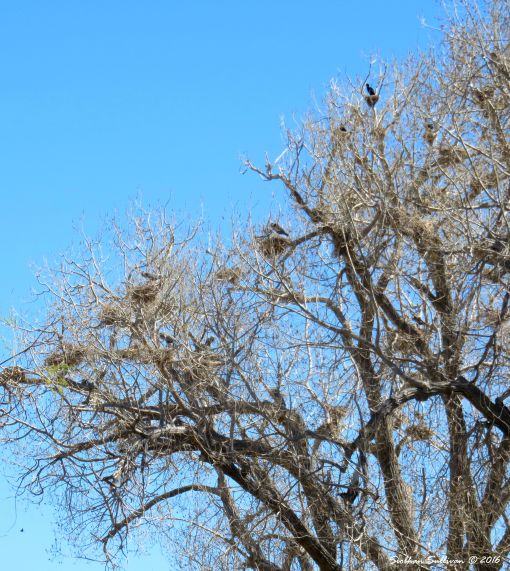
Go on…zoom in.

If we learn to focus in on things and look closer, we sometimes find the unexpected.
In this case, it’s a double-crested cormorant and great blue heron rookery. These birds look and act so differently yet they manage to get along.
This rookery is located at the Sod House Ranch at Malheur NWR. It was built by cattle-baron Peter French in the late 1800’s. The ranch was the headquarters of the French-Glenn Livestock Company that at one time covered 140,000 acres.

Have you been pining away wishing you knew more about porcupines? Well today is your lucky day! Here’s everything you ever wanted to know about the North American porcupine, Erethizon dorsatum, but were afraid to ask.
The North American porcupine ranges throughout most of Canada and the western United States south to Mexico. They also live in the northern Great Lakes and northeastern United States regions.
North American porcupines are a large rodent with black to brownish-yellow fur and distinct quills that cover most of their bodies. They range in weight from 11 to 30 pounds and measure 24 to 36 inches in length. Porcupines are excellent climbers with short strong legs, long claws, and hairless soles on their feet. They have a small head and rounded ears.
Continue reading
Mountain cottontail, Sylvilagus nuttallii
In the sagebrush sea
Where bunchgrass waves in the wind
Alone he grazes
Nose twitching, large eyes gazing
Cottontail punctuating

There are certain members of the plant and animal world that I call successful invaders. Some are admired; others are reviled. A few are both liked and despised at the same time.
Where I live, the Western juniper, Juniperus occidentalis, fits into that last category. It is a native species but due to fire suppression and habitat destruction, it has spread like -excuse the reference- wildfire. Juniper has taken advantage of the situation and has significantly expanded its range. I have heard a lot about how much water it can suck out of the landscape – supposedly 30 gallons a day. Its root system taps downwards and outwards to effectively use the available water. Many people don’t like them for that reason and because at times they have a not-so-pleasant scent. I’ll always remember listening to a person that lives in the wealthy part of town saying that she eliminated all 18 junipers on her property as soon as she moved in. Eighteen trees.
However, juniper also has its good side. As it ages it epitomizes the image many people associate with the Wild West. I love to photograph them. The form of the tree generally changes from a pyramid-like shape to a twisted, sprawling irregular one. It can be covered by purplish berries (that are really cones) and these are used in gin production. Wildlife loves it for cover, nesting, and food. Its wood is bi-colored and long lasting.
Continue reading