This year I went on a quest with the goal of finding fall colors. Here’s a 4-part haiku story based on pictures taken on the Mount Hood Scenic Byway in Oregon.
Deep in the mountains Mount Hood surveys the landscape Anticipation
Draped in mossy robes Rooted in shades of autumn Fall’s gala begins
In April 2019, I went on a field trip to see petroglyphs & pictographs in Harney County, in eastern Oregon. This is one of the many trips offered as a part of the Harney County Migratory Bird Festival. Our guides that day were Bureau of Land Management archaeologists, Scott Thomas and Carolyn Temple.
One of the first things we learned was the difference between petroglyphs and pictographs.
Pictographs
Pictographs, like the images shown below, are painted onto rocks. These works are generally drawn with red, black, white, or yellow paint.
Pictographs frequently include depictions of animals. For example, the drawing at the top of the picture below appears to be a lizard.
This Mother Bear sculpture is in a roundabout located in Madras, Oregon. Christopher Buffalo Folsom created this work of art. Can you spot all three of the mother bear’s cubs?
I’m pleased to announce that one of my short stories was recently published in Placed: An Encyclopedia of Central Oregon, Vol. 1. This slim volume, however, is not an encyclopedia in the traditional sense of the word. It contains a collection of poetry and prose about this part of the planet. Central Oregon includes sagebrush deserts, thick pine forests, winding rivers, and volcanoes lining the horizon. Placed embraces tales of the wild, but also stories related to unique features – like Ocean Rolls from a local bakery.
My contribution is The Toad Queen, written after encountering a Great Basin spadefoot toad in my yard. It is one of the most unique things I’ve observed in Oregon – unlike anything I have ever seen. I snapped a couple pictures of it and gently pushed it off the trail. This creature with such an odd appearance and life history deserves a special story.
Like the rest of you out there, I’ve been spending a lot of time at home. This week I’m featuring photos taken in a High Desert yard near Bend, Oregon.
If your gaze is focused downward lately, look at the elements of earth in a new light. This layer cake rock is interesting in color and form.
As your gaze moves up, notice the textures you may have overlooked. The multilayered bark of juniper trees always catches my attention.
I found a feather on the forest floor in the Metolius Preserve, near Sisters, Oregon. This 1,240-acre Preserve, managed by the Deschutes Land Trust, includes pine, larch, and fir forests.
This feather is about 12 inches long – maybe from a large raptor such as a hawk or owl. The feather rests on a pinecone pillow and bed of ponderosa pine needles.
This peninsula of flowers was seen in the Old Mill district of Bend, Oregon. The gardeners do a great job maintaining these picturesque flowerbeds. They brighten up even the darkest of days.
This golden-mantled ground squirrel was not exactly shy. It came right up to me looking for a snack at the High Desert Museum. Yes, it was cute but it didn’t get anything from me besides a photograph.
These wooden wheels are featured in a display at Baker Heritage Museum in Baker City, Oregon. This museum offers visitors glimpses of everyday objects from another time.
The Bird Weekly Photo Challenge this week is birds whose names start with an ‘a’. I’m sharing photos of American Avocets I took in the spring and fall.
The Migratory Bird Festival was cancelled this year so I had to look in my archives for these photos. One of my favorite field trips in past years was the Circling Steens Mountain Tour. Lots of opportunities to see birds of the shore, fields, and mountains.
Avocets look much different in the fall. Their cinnamon-colored plumage fades to black and white.
I saw these avocets in November at Summer Lake Wildlife Area in Central Oregon. Can you see the dust storms in the distance? I have featured Summer Lake in several past posts. It’s a great place to see waterfowl, shorebirds, and songbirds.
Rockridge Park, in northeast Bend, is a nice place for walks and more. Bend Park and Recreation preserved features of High Desert habitat in this 36-acre park and added a few unique activities. It’s one of 82 parks in the city.
You’ll see a “forest” of juniper tree trunks near the small parking area. This play area for kids includes black “talk tubes” that connect underground. Primitive cell phones. 😉
I’ve been keeping an eye out for fall foliage and this park had several colorful trees. The maple trees are beginning to turn red and the paper birch leaves are turning a lovely shade of gold.
The trails in this park include a paved one-mile+ trail and more than a mile of unpaved bike trails. The beginner and intermediate bike trails include boardwalks and other obstacles.
This month, for First Friday Art, I’m sharing an American kestrel study I drew in pencil. When I took an ornithology class in college we learned about anatomy by studying specimens in a museum.
These sketches helped me learn more about birds, but they also turned out to be great tools for future works of art. I have referred back to them when working on pen-and-inks and paintings.
Here’s a photo of an American kestrel I saw in Malheur National Forest last year. They have beautiful coloring.
Vaqueros, otherwise known as buckaroos, worked the range in eastern Oregon for many years. The spurs and ring bit pictured were handcrafted by a silversmith in Mexico, circa 1750.
These pieces are on display in the small museum located at the Pete French Round Barn. It’s a great place to visit from an historic and architectural perspective. The barn is one of my favorite local attractions.
Bachelor buttons up close in our garden. I never knew they had so many colors. This flower has such an interesting structure – like a bouquet of tiny trumpets.
I saw a patch of blue in the smoke-filled landscape today. Air quality is hazardous and skies are smoky over Bend, Oregon, but one of my notoriously camera-shy mountain bluebirds paused for a portrait. I needed that today! My main computer decided it no longer wanted to wake up from sleep mode.
Here is the air quality reading yesterday afternoon over Bend.
Here are the readings from in and around Bend yesterday.
Fires are far from Bend, but wind blew smoke our way.
Wildfires are raging over much of the west. We are looking forward to a little rain this week.
Thanks to the firefighters at work on these fires! May they find their own patch of blue.
When I first saw this praying mantis on hop plants in our garden of plenty, I thought it must be a species I had never seen. Its coloring was so light it was almost white. I learned that when some types of mantis shed their skin, they stay white for a short period of time. They can molt 10 times before reaching their adult size. This one will probably turn green, like others I have seen on our property.
Winds shift and winter blows In from the farthest reaches of North, carried on cold fronts Turning landscapes into Enchanted scenes Resplendent with crystals of snow
You can take in the views from this comfortable bench or…
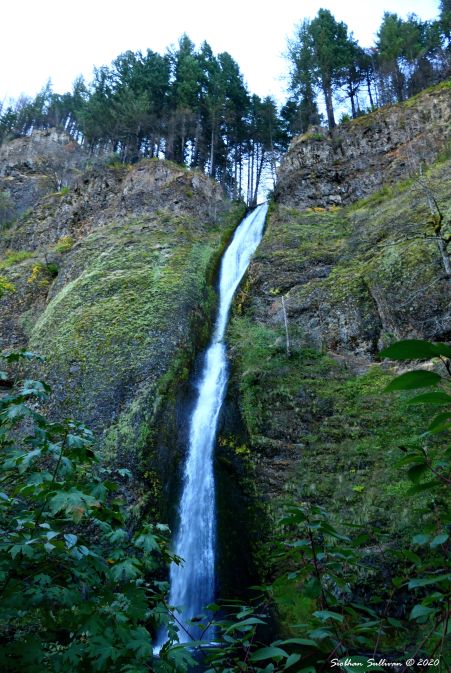
Get great photos of this 224-foot tall waterfall from the roadside.
I liked the interesting rock formation to the left of the falls and the layers of green moss and ferns.
You can also get a good Horsetail Falls view from Horsetail Falls Trail #438. This 2.3-mile loop trail takes you past Horsetail Falls, Ponytail Falls, and Middle Oneata Falls.
Check ahead of time before visiting. The site may be closed because of COVID-19 restrictions, wildfires, or for other reasons.