Last weekend I was out looking for some of the 11+ species of woodpeckers that can be seen near Sisters, Oregon. The Dean Hale Woodpecker Festival brings birdwatchers from all over the world into the woodpecker-rich habitats in the area. East Cascades Audubon Society has been putting on the well-attended event since 2011. There were 17 different field trips this year.
Black Butte & Mt Jefferson, Oregon
It was a hot day and stunning views of the Sisters peaks, Black Butte, and Mt Jefferson welcomed us.
Sky. Where I live in central Oregon, it’s big and bold. The sky is rarely shrouded in shades of gray. Sunsets are painted with bold strokes of golds, pinks, and purples.
Scattered clouds on sunny days are referred to as “beauty clouds” by the local weatherman. My daughter thinks they look like the clouds in The Simpsons cartoon. Flat on the bottom with perfectly sculpted puffs on the top.
Wild creatures and plants
The colors of the sky are reflected in the local plants and wildlife. Mountain bluebirds surprise with their intense colors. Wildflowers like Oregon sunshine shine forth in warm golden tones. Perfect pink bitterroot flowers provide punctuation. Ancient twisting western juniper trees frame the scene.
Volcanoes bordering the High Desert are often encircled with crowns of clouds. Cool white clouds appear to temporarily cool the hot magma rumbling below.
The sky here is an ever-changing message. Clouds, rainbows, and rain and snow are the emojis on the big blue screen. Wind sweeps them to the side to create another conversation. Look up and notice what the sky is saying and listen to its meaning.
Is this Mendel’s garden? I think the Gene Jeannie has been at work in my backyard. I planted one purple and white lupine and it has multiplied. Now I have a violet and purple one, two purple and white ones, a violet and white one, and an all white one.
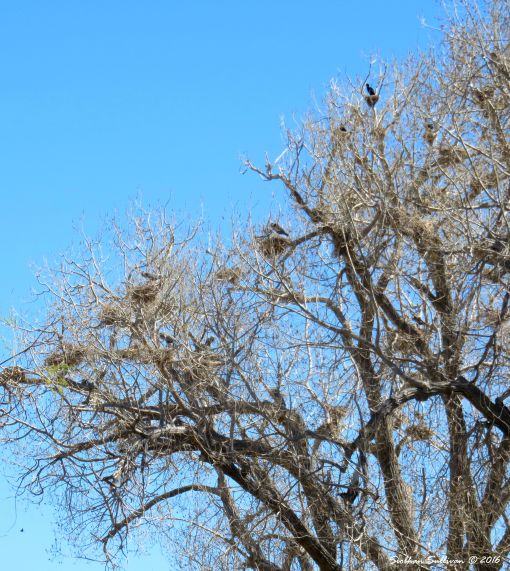
If we learn to focus in on things and look closer, we sometimes find the unexpected.
In this case, it’s a double-crested cormorant and great blue heron rookery. These birds look and act so differently yet they manage to get along.
This rookery is located at the Sod House Ranch at Malheur NWR. It was built by cattle-baron Peter French in the late 1800’s. The ranch was the headquarters of the French-Glenn Livestock Company that at one time covered 140,000 acres.
Have you been pining away wishing you knew more about porcupines? Well today is your lucky day! Here’s everything you ever wanted to know about the North American porcupine, Erethizon dorsatum, but were afraid to ask.
Range:
The North American porcupine ranges throughout most of Canada and the western United States south to Mexico. They also live in the northern Great Lakes and northeastern United States regions.
Identification & unique characteristics:
North American porcupines are a large rodent with black to brownish-yellow fur and distinct quills that cover most of their bodies. They range in weight from 11 to 30 pounds and measure 24 to 36 inches in length. Porcupines are excellent climbers with short strong legs, long claws, and hairless soles on their feet. They have a small head and rounded ears.
Maybe Newberry National Volcanic Monument can light its own candles for its 25th birthday celebration. It’s young as a monument and is also young in geological terms.
Big Obsidian Flow
Mordor?
The amazing, and appropriately named, Big Obsidian Flow feature was formed a mere 1,300 years ago. You can walk up a trail that winds through a massive mountain of sparkling obsidian. When I say massive I mean MASSIVE – 380 million cubic yards! From a distance, the landscapes appear to be a real life version of Mordor. Up close, the shimmering reflections all around you are dazzling.
You can get to top of the Lava Butte cinder cone by hopping onto a shuttle or taking a short hike from its base. The 500-foot tall butte is located at the Lava Lands Visitor Center in the Newberry National Volcanic Monument about eight miles south of Bend, Oregon. Lava Butte is one of the hundreds of cinder cones in the immediate area.
Benham Falls trail
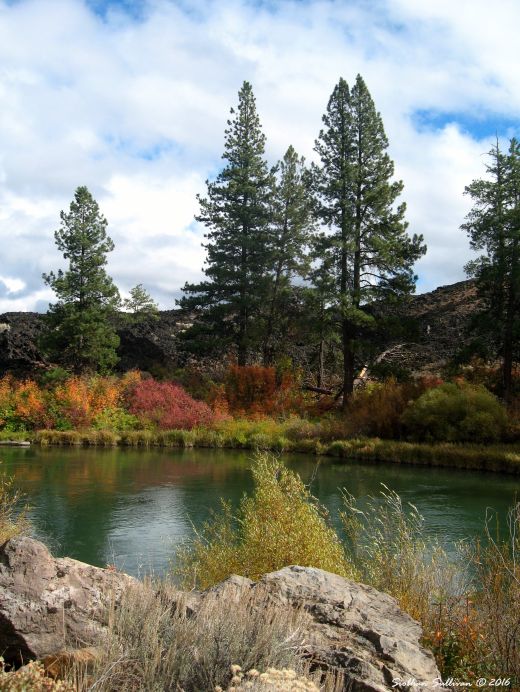
Lava Butte erupted about 7,000 years ago. There are several trails that wind through the ancient lava flows and onto the flanks of the butte. There were three main gutters where most of the lava flowed. Ten square miles of pine forest were buried by lava. The lava flows blocked the Deschutes River in five places. If you walk the trail to Benham Falls you can see where the river has made its way through the lava rock.
It’s meadowlark time! I couldn’t find a clock I really liked so I made one with some leftover scraps of wood. I painted a Western Meadowlark, Sturnella neglecta, on it because it’s our state bird. It’s also the state bird of Montana, Wyoming, North Dakota, Kansas, and Nebraska.
They are a beautiful bird with bold, bright markings. They have a cheery sounding song that always reminds me of the Wild West. Listen to it here. Western Meadowlark song.
Last week I took a quick trip to see the sunset from Smith Rock State Park. Sometimes you forget to appreciate what is in your own backyard. I will go back again when I have more time…
His twittering voice kept leading me on through the wilderness. It seemed like every time I raised my binoculars to my eyes, he would make a quick getaway.
I followed him on winding trails bordered by bubbling and spouting geysers. He flitted through pine forests doused by thunderstorms. Gusts of wind kept pushing him just out of my reach.
Finally, finally, I came eye to eye with the mysterious beast. A Yellow-rumped warbler, Setophaga coronata auduboni. This pint-sized songbird perched in the tree and stared at me as if he was shouting, “Ollie, Ollie in come free!” Our game of hide and seek was over and he stayed in plain sight on his home base.
The tree clung to the side of a cliff overlooking Tower Fall. The little bird had lead me to an important spot in Yellowstone National Park.
When you go outside into parts of the 135-acre property, you will be able to visit various exhibits. The Autzen Otter area is being renovated and won’t be open again until sometime in the spring of 2016. Be sure to stop by to see the entertaining otters once the exhibit reopens.
Feeding Station
Cooper’s Hawk
Keep going around the trail and make a brief stop at the wildlife viewing area. Here you might get a glimpse of woodpeckers, nuthatches, chickadees, squirrels, and chipmunks. You might get lucky and spot a hawk or owl waiting to get a snack.
The Wind, Earth, and Fire Trail is nearby and it shows how fire plays an important role in forest development. Keep following the trail and stop into the Changing Forests exhibit to learn about forests in the area.
Miller Ranch
Miller Cabin
Looking back in time
Next you will see the Miller Family Ranch. The buildings there are built to show what a farm in 1904 would have looked like. Peek inside the cabin to see how a family lived and watch interpreters demonstrate life in those times. There’s also a barn, corral, chicken coop, saw mill, and even an outhouse. The woven wood corral is practical but also a work of art. You may see horses, donkeys, and chickens at the ranch.
Tucked away in the pines south of Bend, you will find a magical place. The High Desert Museum may not be what you expect when you see the word “Museum” in its name. Yes, it does have artifacts in permanent and rotating exhibits but they are beautifully displayed in buildings that blend into the environment. There is much more to this place than traditional exhibits.
Sage Grouse exhibit
Tough By Nature exhibit
What to see at the High Desert Museum
The rotating exhibits cover many facets of the high desert. In December of 2015, these included one on weather, one on sage grouse, and another on women of the American West. There are daily talks and demonstrations about nature and history related to exhibits at the Museum. The Museum also has people dressed in period clothing interpreting history and a small collection of desert wildlife.
High Desert Ranger Station
One of the first things you see as you drive up the long driveway is the small High Desert Ranger Station. This was an actual station and it was built in 1933 and moved here in the 1980’s. It’s only open during the summer months.
Game of Thrones fans may know what dragonglass is but the rest of you may be going, “Huh?” The rock plays an important role in the story. Most people know it by the name obsidian. Like glass, obsidian fractures into pieces with sharp edges. It can be found in a wide variety of colors.
Obsidian from my yard
Obsidian forms when lava from a volcano cools rapidly with minimal crystal growth. Volcanic activity in Central Oregon is recent, in geological terms, so obsidian is fairly common in some areas. Lava flows covered hundreds of acres in this region. I have found obsidian in my yard between the sagebrush and bunchgrass. Isn’t this a cool piece?
I had to go north to Seattle for a couple days but it’s great to be back to my home on the range. I saw these two does, appropriately, near the town of Antelope, Oregon.
It’s ironic that a bird that almost disappeared from the face of the earth has their name associated with the phrase “swan song” that means “final appearance.”
A species on the brink
At one time the population of the Trumpeter Swan, Cygnus buccinator, was thought to be down to fewer than 70 birds. They were just steps away from their swan song. The birds were overhunted and their feathers were used to adorn hats and make writing quills while their skins were used to make powder puffs. They were also hunted for their meat and eggs.
In 1932, the last known remnants of the population lived near Yellowstone National Park. Their swan song was imminent.
It is easy to see why the Painted Hills are designated as one of Oregon’s Seven Wonders. The Painted Hills Unit of the John Day Fossil Beds National Monument , located nine miles northwest of Mitchell, Oregon, is 3,132 acres in size.
Painted Hills Unit of John Day Fossil Beds National Monument (US National Park Service)
If you visit the Painted Hills after rainstorms move through the area, the colors will look more intense from the recent moisture. The colors are striking no matter what season it is. It is like looking at a parfait of luscious layers spread out before you. The deep crimson and black layers at the base of the hills contrast with the sandy browns and golds of upper layers.
Jays have insisted on being a part of my life since I was a young child. They are brash, bold, raucous, and not easily ignored.
As a five-year old living on a wooded lot in Maryland, the Blue Jay, Cyanocitta cristata, introduced itself to me with little formality. Its loud voice and striking appearance said, “Notice me!” Its frequent companion, the Northern Cardinal, also made it hard for me to look away. I guess that must be why I have a thing for birds with crests on top of their heads.
When I moved back across the country to Washington State, I met more Jays. On camping trips with my family, the Gray Jay, Perisoreus canadensis, made its kleptomaniac presence known. Otherwise known as the Camp Robber, this gray bird has a way of sneaking in and taking what it wants.
Gray Jays
I had a boyfriend in high school named Jay. One winter I was out of town for a couple of weeks and when I came back he broke up with me. He told me he had started going out with “Mary” while I was gone. He said he had gone outside in the middle of the night and shouted to the world how much he loved Mary. Like I said, Jays have a way of being loud and taking what they want.
Steller’s Jay
The next Jay played an important role in my life for many years. Steller’s Jays, Cyanocitta stelleri, are a deep azure blue topped with a black crested head. They like to imitate Red-Tailed Hawks and other birds. Steller’s Jays also have an appetite for other bird’s eggs and young. They especially like to prey on the endangered marbled murrelet, a small seabird that breeds in inland forests. While working on a project to preserve a forest where murrelets nested, I learned more about the football-shaped seabirds and their predation by jays than I knew about any pigskin football.
Western Scrub Jay
The latest Jay in my life is the Western Scrub Jay, Aphelocoma californica . When we first considered moving to the high desert of Oregon, I remember looking at potential houses and thinking, “What is that bird I keep seeing?” The bird raised its white eyebrows, cocked its head, and regarded me curiously. When we found the place we eventually bought, the blue, white, and gray Western Scrub Jays were in the backyard shouting a welcome.
Jays, with their distinctive appearance and mannerisms, always seem to be a part of my life.
If you drive just a couple of hours east of Bend, Oregon you’ll find strikingly painted hills and a center devoted to paleontology. The Thomas Condon Paleontology Center will impress you with fascinating information and artfully displayed artifacts. Wow! What a place.