
Weekly Photography Challenge – Narrow
Weekly Photography Challenge – Narrow

Last weekend I was out looking for some of the 11+ species of woodpeckers that can be seen near Sisters, Oregon. The Dean Hale Woodpecker Festival brings birdwatchers from all over the world into the woodpecker-rich habitats in the area. East Cascades Audubon Society has been putting on the well-attended event since 2011. There were 17 different field trips this year.

It was a hot day and stunning views of the Sisters peaks, Black Butte, and Mt Jefferson welcomed us.
Continue reading
Looks like an old homestead, right?

Look closer.
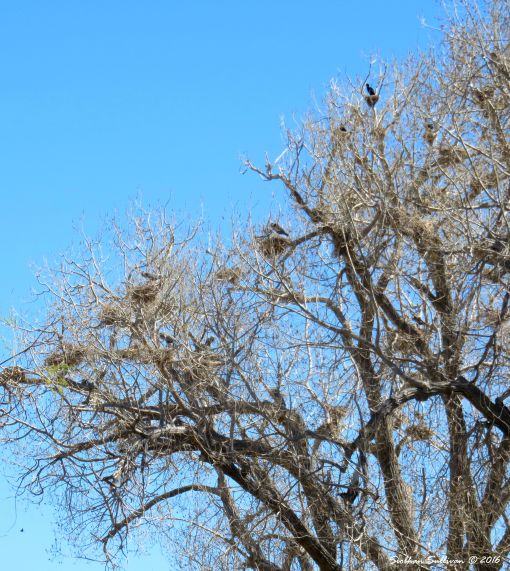
Go on…zoom in.

If we learn to focus in on things and look closer, we sometimes find the unexpected.
In this case, it’s a double-crested cormorant and great blue heron rookery. These birds look and act so differently yet they manage to get along.
This rookery is located at the Sod House Ranch at Malheur NWR. It was built by cattle-baron Peter French in the late 1800’s. The ranch was the headquarters of the French-Glenn Livestock Company that at one time covered 140,000 acres.
In the Spring, the flocking begins.

Flocks alighting,
Optics focusing.

Nature’s fireworks on display
Exploding in a timeless rhythm.

Wings fluttering,
Voices trumpeting.

Welcoming visitors to share
In a celebration of Spring.
Flocking to Malheur.

Hmmm…a predominantly pink woodpecker named after a famous early American explorer and a wily relative of the crow named after his partner. That might make for an interesting bit of writing. I started to research the topic and decided to create a Lewis and Clark Critter Quiz.
Little did I know there was controversy linked to the plants and animals “discovered” on the Lewis and Clark expedition. The expedition supposedly discovered 178 plants and over 122 animals previously unknown to science. Or did they?
Other sources say they “encountered” or “reported” certain wildlife and plants. Due to discussions as to the accuracy of previously published lists, one recent list is divided into two sections: Discovered (for the first time by European Americans) and Described. Some of the flora and fauna species had been discovered in other parts of North America (or the world) prior to the time of the expedition while others had been a part of native people’s life for many years.
I am lucky to have seen many of the wildlife species that Lewis and Clark discovered and described. Many of these creatures live in and around Yellowstone National Park, which I have often visited. Here is a quiz that includes pictures of wildlife encountered on the expedition.
Did the Lewis & Clark expedition Discover them or Describe them? The answers are at the end of this quiz.
Continue reading
This peace tree was seen in my backyard. Please share this image and the words I wrote to go along with it.

It’s meadowlark time! I couldn’t find a clock I really liked so I made one with some leftover scraps of wood. I painted a Western Meadowlark, Sturnella neglecta, on it because it’s our state bird. It’s also the state bird of Montana, Wyoming, North Dakota, Kansas, and Nebraska.
They are a beautiful bird with bold, bright markings. They have a cheery sounding song that always reminds me of the Wild West. Listen to it here. Western Meadowlark song.
Songsters of the Spring has photos of other yellow-colored songbirds of the High Desert.

Thinking about trying out snowshoeing? Last weekend I went out for the first time to try out snowshoeing on Mt Bachelor as part of a free guided tour. Knowledgeable volunteers take you out for a 90-minute walk in a forested area near the ski runs. The tours leave at 10:00 am and 1:30 pm. Snowshoes are provided (thanks to REI for donating them) or you can wear your own.

The volunteers will give you a quick talk on a few of the dangers associated with this sport such as tree wells. This is the area that forms in the snow close to a tree that people can fall into and sometimes not be able to get out of. I also learned that predators like to go into them in search of entrances to the burrows of small mammals. Kind of like a vending machine area for them.
Continue reading
The birds at Malheur National Wildlife Refuge were so joyful, some of them walked on water in a happy dance.
Video of Western grebes dance…

His twittering voice kept leading me on through the wilderness. It seemed like every time I raised my binoculars to my eyes, he would make a quick getaway.
I followed him on winding trails bordered by bubbling and spouting geysers. He flitted through pine forests doused by thunderstorms. Gusts of wind kept pushing him just out of my reach.

Finally, finally, I came eye to eye with the mysterious beast. A Yellow-rumped warbler, Setophaga coronata auduboni. This pint-sized songbird perched in the tree and stared at me as if he was shouting, “Ollie, Ollie in come free!” Our game of hide and seek was over and he stayed in plain sight on his home base.
The tree clung to the side of a cliff overlooking Tower Fall. The little bird had lead me to an important spot in Yellowstone National Park.
Continue reading
Jays have insisted on being a part of my life since I was a young child. They are brash, bold, raucous, and not easily ignored.
As a five-year old living on a wooded lot in Maryland, the Blue Jay, Cyanocitta cristata, introduced itself to me with little formality. Its loud voice and striking appearance said, “Notice me!” Its frequent companion, the Northern Cardinal, also made it hard for me to look away. I guess that must be why I have a thing for birds with crests on top of their heads.
When I moved back across the country to Washington State, I met more Jays. On camping trips with my family, the Gray Jay, Perisoreus canadensis, made its kleptomaniac presence known. Otherwise known as the Camp Robber, this gray bird has a way of sneaking in and taking what it wants.

I had a boyfriend in high school named Jay. One winter I was out of town for a couple of weeks and when I came back he broke up with me. He told me he had started going out with “Mary” while I was gone. He said he had gone outside in the middle of the night and shouted to the world how much he loved Mary. Like I said, Jays have a way of being loud and taking what they want.

The next Jay played an important role in my life for many years. Steller’s Jays, Cyanocitta stelleri, are a deep azure blue topped with a black crested head. They like to imitate Red-Tailed Hawks and other birds. Steller’s Jays also have an appetite for other bird’s eggs and young. They especially like to prey on the endangered marbled murrelet, a small seabird that breeds in inland forests. While working on a project to preserve a forest where murrelets nested, I learned more about the football-shaped seabirds and their predation by jays than I knew about any pigskin football.

The latest Jay in my life is the Western Scrub Jay, Aphelocoma californica . When we first considered moving to the high desert of Oregon, I remember looking at potential houses and thinking, “What is that bird I keep seeing?” The bird raised its white eyebrows, cocked its head, and regarded me curiously. When we found the place we eventually bought, the blue, white, and gray Western Scrub Jays were in the backyard shouting a welcome.
Jays, with their distinctive appearance and mannerisms, always seem to be a part of my life.

Working at saving a special place or creature can sometimes be a struggle. But then they express their gratefulness to us and it’s all worth it.
This is a red-tailed hawk perching on a sign at Hart Mountain National Antelope Refuge. I worked at Hart Mountain many years ago and it holds special place in heart.

There are certain members of the plant and animal world that I call successful invaders. Some are admired; others are reviled. A few are both liked and despised at the same time.
Where I live, the Western juniper, Juniperus occidentalis, fits into that last category. It is a native species but due to fire suppression and habitat destruction, it has spread like -excuse the reference- wildfire. Juniper has taken advantage of the situation and has significantly expanded its range. I have heard a lot about how much water it can suck out of the landscape – supposedly 30 gallons a day. Its root system taps downwards and outwards to effectively use the available water. Many people don’t like them for that reason and because at times they have a not-so-pleasant scent. I’ll always remember listening to a person that lives in the wealthy part of town saying that she eliminated all 18 junipers on her property as soon as she moved in. Eighteen trees.
However, juniper also has its good side. As it ages it epitomizes the image many people associate with the Wild West. I love to photograph them. The form of the tree generally changes from a pyramid-like shape to a twisted, sprawling irregular one. It can be covered by purplish berries (that are really cones) and these are used in gin production. Wildlife loves it for cover, nesting, and food. Its wood is bi-colored and long lasting.
Continue reading


I was out looking for jays at the High Desert Museum yesterday and didn’t see any. However, this Northern Flicker, Colaptes auratus, happily posed for me. Beautiful colors on this fall flicker!

In late October I visited the Indian Ford Preserve, which is located several miles northeast of Sisters, Oregon, with Deschutes Land Trust (DLT) leader Kelly Madden. This is the flagship property of the group and it was purchased in 1995. Preserves are purchased outright, donated, or are protected through easement agreements with the owners. This property is 63 acres in size and consists of meadow, forest, and stream habitat. Indian Ford Creek meanders through the property. It is on the border of land dominated by Ponderosa pine or Western juniper.
