
Wordless Wednesday
Wordless Wednesday
Did you know that you can surf on the Deschutes River? Yes, thanks to the creation of the Bend Whitewater Park you too can hang ten on the river that flows through Bend, Oregon. Maybe you would rather float down in an inner tube – you can do that too. Maybe you want to get a glimpse of some wildlife – that’s also an option. The river was split into three channels: the Habitat Channel for wildlife; the Whitewater Channel for kayaks, surfboards, and stand up paddleboards; and the Passageway Channel for inner tubes and small rafts.

A 100-year old dam was recently removed from the river near the Colorado Avenue Bridge and an “amusement park” was put in by Bend Parks and Recreation. At a cost of nearly $10 million dollars, some questioned its value. Bend Paddle Trail Alliance, one of the local groups in support of this park, contributed over $1 million towards the project. The voter-approved bond said that water recreationists would have “safe passage” once the project was completed. That’s a good idea since people were injured or lost their lives because of the dam.
Continue reading


Harnessing hot air into giant works of art makes for some hot air extraordinaire. We went to Balloons Over Bend last weekend for a couple of their events. There were plenty of opportunities for photographs. In these first photos, I decided to focus in on some of the colorful shapes and interesting lines.


Life can take a lot of twists and turns so it’s nice to get a bouquet once in a while. This giant size balloon bouquet was my cherry on the top of a great weekend. They were here for the annual Balloons Over Bend event.
Weekly Photo Challenge – Cherry on the Top

Sky. Where I live in central Oregon, it’s big and bold. The sky is rarely shrouded in shades of gray. Sunsets are painted with bold strokes of golds, pinks, and purples.

Scattered clouds on sunny days are referred to as “beauty clouds” by the local weatherman. My daughter thinks they look like the clouds in The Simpsons cartoon. Flat on the bottom with perfectly sculpted puffs on the top.


The colors of the sky are reflected in the local plants and wildlife. Mountain bluebirds surprise with their intense colors. Wildflowers like Oregon sunshine shine forth in warm golden tones. Perfect pink bitterroot flowers provide punctuation. Ancient twisting western juniper trees frame the scene.

Volcanoes bordering the High Desert are often encircled with crowns of clouds. Cool white clouds appear to temporarily cool the hot magma rumbling below.

The sky here is an ever-changing message. Clouds, rainbows, and rain and snow are the emojis on the big blue screen. Wind sweeps them to the side to create another conversation. Look up and notice what the sky is saying and listen to its meaning.

Silent Sunday

You can get to top of the Lava Butte cinder cone by hopping onto a shuttle or taking a short hike from its base. The 500-foot tall butte is located at the Lava Lands Visitor Center in the Newberry National Volcanic Monument about eight miles south of Bend, Oregon. Lava Butte is one of the hundreds of cinder cones in the immediate area.
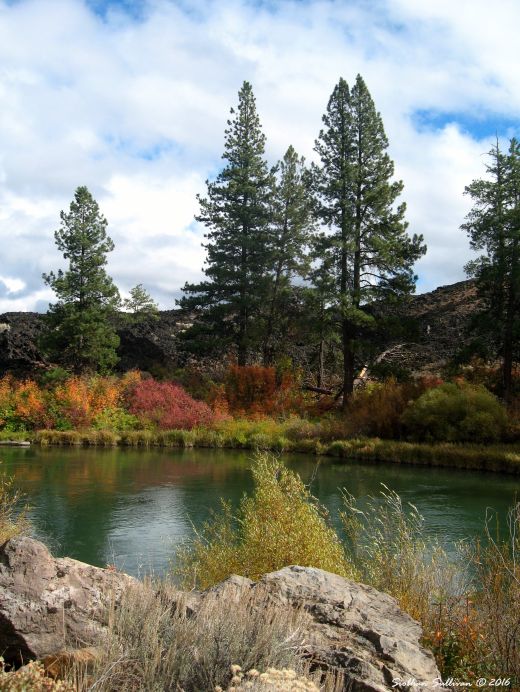
Lava Butte erupted about 7,000 years ago. There are several trails that wind through the ancient lava flows and onto the flanks of the butte. There were three main gutters where most of the lava flowed. Ten square miles of pine forest were buried by lava. The lava flows blocked the Deschutes River in five places. If you walk the trail to Benham Falls you can see where the river has made its way through the lava rock.
Continue reading


Oregon WinterFest celebrates the winter season here in Central Oregon. This is the 17th year of the event. Here are few photos from the recent event.
Continue reading
Thinking about trying out snowshoeing? Last weekend I went out for the first time to try out snowshoeing on Mt Bachelor as part of a free guided tour. Knowledgeable volunteers take you out for a 90-minute walk in a forested area near the ski runs. The tours leave at 10:00 am and 1:30 pm. Snowshoes are provided (thanks to REI for donating them) or you can wear your own.

The volunteers will give you a quick talk on a few of the dangers associated with this sport such as tree wells. This is the area that forms in the snow close to a tree that people can fall into and sometimes not be able to get out of. I also learned that predators like to go into them in search of entrances to the burrows of small mammals. Kind of like a vending machine area for them.
Continue reading

Did that get your attention? I went to the Oregon WinterFest event here in Bend this weekend and took some pictures of the Fire Pit Competition that I wanted to share with you. This is the 17th year of the festival so it has a long history in the area. This is the fourth year for the fire pit competition and there are more entries every year.


The dragon and a fire pit with the flag bridge and Deschutes River in the background.
Continue reading
Hanauma Bay, Hawaii
What does the Owhyee River in southeastern Oregon and Kanaka Flat near Jacksonville, Oregon have in common? Both place names refer to the Hawaiians that lived in Oregon in the 1800’s.
In 1811, Jacob Astor hired the first Owyhees, an older spelling of Hawaii, to work in the fur trade. A post was established in Astoria, Oregon and was later turned over to the Montreal-based North West Company. The fort was eventually renamed Fort George and it was moved to another location.
How did Hawaiians get to the mainland? Captain James Cook discovered the Hawaiian islands in 1778 and named them the Sandwich Islands after the Earl of Sandwich. Ships stopped in Hawaii for provisions and since the native people were well known for their maritime expertise, they were hired as replacement workers. They were also known to excel in swimming, fishing, hunting, and in the construction of posts and forts.

Waimea Falls, Hawaii

Events and exhibits related to photographer Edward S. Curtis were located all over Bend. Edward S. Curtis Fever took place in September and October. Curtis documented Native American tribes living in many parts of North America in the late 1800’s and early 1900’s. Part of his work is featured in the 20-volume set of books and 20 separate large-format portfolios entitled Edward S. Curtis’s: The North American Indian. An estimated 10,000 people were featured in his work.
Continue reading


Clouds…
Obscure what was once clear
Release things that burden them
Blanket the cold nights
Shine brightness on what’s to come
Surround us in the divine

The Lava Lands Visitor Center has interpretive exhibits that focus on local volcanology, geology, ecology, and archeology. As I entered the exhibit area, the red “lava flows” in the carpet guided me you through the center. Display boards are big, bright, and bold. They contain A LOT of information.

This small center is a great place to start a visit to the 54,000+ acres of the Newberry National Volcanic Monument near Bend, Oregon. The Monument was created in 1990. It encompasses unique geological features, lava flows, and many lakes.
Continue reading
I recently went on a Deschutes Land Trust hike just west of Bend, OR to learn about fire ecology. The area we hiked in is known as the Skyline Forest. There were fires in this vicinity in 2010 and 2014 and together they burned about 6,000 acres. The area is currently privately owned but the Deschutes Land Trust has been trying to acquire it.
Our guide, Pete Caligiuri with The Nature Conservancy, informed us that this area has about the steepest environmental gradient in the world. In the Cascade Mountains the precipitation can be as high as 160 inches per year while less than 25 miles away, it can be as low as 10 inches per year. Plants respond to the extreme amount of variability in this gradient. In the past, fire and moisture limited the number of trees in the forest. Now there can be as many as 800-900 trees per acre in this area.

We looked around to see how many large stumps left over from timber harvesting we could see. There weren’t many at all. At one time this forest had the trees much more widely spaced. We noticed the high number of young trees with branches reaching down closer to the ground. There was also a thick growth of underbrush that included bitterbrush and manzanita. The forest floor was covered with pine needles and fallen branches. The closer spacing, higher number of shrubs, and accumulation of litter on the forest floor makes this forest more vulnerable to fire.
Continue reading
A fluttering of wings draws my attention.

Looking out of my window, I see a Townsend’s solitaire beating its wings and attacking its reflection in the side mirror of my parked car. It has been there for hours. Long strokes of white droppings adorn the side of my car. At first I assume the bird must be a male defending its territory.
Townsend’s solitaires are a drab gray relative of the American robin that most people wouldn’t even notice. They are not showy.
Male birds are usually the ones with colorful plumage but that is not the case with solitaires; the male and female look almost identical. I guess they decided not to follow the theory that a male is more brightly colored to attract females and the female has duller colors so she can sit undetected on a nest.
Continue reading
Fall begins with joyous laughter and warm caresses that
Nod and wink as they cloak you with a touch of frost
Standing there entranced, you are enveloped by color
 Cool greens evolving into explosions of vibrant
Yellow, orange, and crimson
North winds swirl about you encircling you
 Wrapping you in the scent of remembrance
Snaps and crackles sound under your feet
Inviting you to grab handfuls and throw them into the air
 You smile as the coolness surrounding you is
Warmed by a shower of brilliant laughing tones
Emanating from falling leaves readying themselves for winter

If you type “John C. Frémont” into a search engine, you will turn up places named after him in over a dozen states in the U.S. So who was this guy and why were so many things named after him? To find out, I visited the Deschutes Historical Museum in Bend, Oregon to see their current exhibit about Frémont. The Museum was lucky to get the exhibit and it will be on display there until the end of December 2015.
This exhibit focuses on Frémont’s Second Exploring Expedition that occurred in 1843-1844. Many consider it to be the apex of his career. The purpose of this trip was to explore the Oregon country. Frémont, together with 27 handpicked men, including the explorer Kit Carson, set out to map the second half of the Oregon Trail.


I can always tell when fall is on the way here because the rubber rabbitbrush, Ericameria nauseosa, gets out its bright yellow pom pom flowers and cheers into the wind.

The High Desert Museum introduced a new North American river otter, Lontra canadensis, into the otter display last summer. Rogue, the Museum’s 4-year old otter, was anxious to meet the new addition. After a short period of adjustment, they became the best of friends. Here’s a bit more about river otters:
The North American River Otter ranges throughout most of North America including parts of Canada, the Pacific Northwest, the Atlantic states, and the Gulf of Mexico.

A fluttering of wings draws my eyes. An unknown call turns my head. Finding birds and figuring out what they are is like working as an investigative detective. You notice things that don’t fit into the puzzle that forms the background environment. I’m no expert but I look for clues such as the silhouette, size, markings, behavior, and sound. Apps such as iBird and various field guides help you narrow down the list of possible suspects when you are out birding. Sometimes you know what something is right away; other times you need to confer with others. There are times when you have only a fleeting glimpse so then you might refer to the bird as an LBJ – Little Brown Jobbie.

Mountain Bluebird
Though Bend is located in a desert environment, there is no shortage in the number and variety of birds that live here. We are fortunate that there are so many organizations involved in educating visitors and residents about the wealth of feathered creatures in the area. I have been on birding walks with the High Desert Museum, East Cascades Audubon Society, Sunriver Nature Center, and Deschutes Land Trust. People who go on the walks range from novice to very experienced birders.

Sharp-shinned Hawk
Many of the guided walks have one thing in common – water. Even in my own yard a water feature attracts birds like some super powerful magnet. Lakes, rivers, ponds, and even small backyard water features, draw birds in.
I see a rainbow of birds in my backyard from the comfort of my La-Z-Boy recliner. The constant flurry of activity includes the brilliant blue of mountain bluebirds, yellow of lesser goldfinches, red of Cassin’s finch, impossibly smooth tannish-brown and butter yellow of cedar waxwings, and soft gray of mourning and Eurasian collared-doves. A sharp-shinned hawk occasionally comes in for a quick meal. I also get to see unusual visitors such as leucistic American robins and dark-eyed juncos. Leucistic birds have plumage that is partially white and they really catch your eye.
Deschutes County has a wide variety of habitats ranging from high elevation mountains with alpine plant communities to lower elevation sagebrush steppe. You might see gray-crowned rosy finches on the way up South Sister or sage grouse on a lek at lower elevations near Millican. Several websites list birds you are likely to see at various locations. The Birding Oregon site has some detailed information on where to go. Here is the Deschutes County link http://birdingoregon.info/Home/DeschutesCounty/tabid/168/Default.aspx .

I moved to the high desert a couple of years ago and thought I left some of my favorite friends behind. One of my favorite birds where I lived before were the cedar waxwings. I felt lucky when I saw one.
If I could use one word to describe cedar waxwings it would be “smooth”. Whenever I see one I have an urge to reach out and touch it. Its tawny feathers ombre into a creamy yellow on its underparts and gray near its tail. The feathers connect together so tightly that they give it a silky smooth appearance.

Cedar waxwings get their name by a unique feature on the tips of their wings and tail. They look as if they got too close to a craft project that involved melting crayons. Their tail are tipped in Sunshine Yellow. Small waxy droplets of Sizzling Red tip the wings.
They seem to wear a disguise on their faces. Black masks bordered with white frame their eyes. They raise a small crest of feathers on the tops of their heads as part of their communication. It alters their appearance so that they look like someone else.
Their voices are a wispy series of notes. I always recognize it even if I don’t see the bird. It is very high pitched, making them sound smaller than they actually are. One time I saw a grosbeak feeding one and thought it might be because it mistook the call for one of its young.

At some times of the year, waxwings flock together. I see specks flying high across the sky announcing their identity with their distinctive calls. Where I lived before, I was happy to see one or two waxwing birds at a time. Now I see flocks in my yard.
I left behind people I had grown close to to move here, but now I flock with different crowds. Sometimes they remind me so much of someone I knew before. Are they wearing disguises or did a special piece of my past follow me to my present?
Why, you may be asking, is she writing about beer on a site that is supposed to be related to history and nature. Well… beer is a big part of Bend’s history.

Deschutes Brewery Black Butte Porter and a growler
Earlier this year, the High Desert Museum had a great exhibit about brewing. It was a temporary exhibit and it has closed but I can still share part of what I wrote about the exhibit. Here is an excerpt:
“The exhibit follows the history of brewing with an emphasis on activity in the Central Oregon region. What started out as saloons set up in tents has evolved into brewpubs that can be found throughout the area. Brewing slowed down during the Prohibition period of 1920 to 1933. Prohibition actually started four years earlier in Oregon due to the protests from some of its residents. Many women that participated in the temperance movement were upset by the bad influence alcohol had on their lives. At one time, there were breweries in nearly every Central Oregon town.
After Prohibition ended, new businesses opened that served a wide variety of alcoholic beverages. Grant’s Brewery Pub located in Yakima, Washington, was the first craft brewery in the northwest. It opened in 1982. In 1983, after a series of legislative measures passed it became legal to produce and sell beer from independent breweries in Oregon. Craft brewing started in Bend in 1988 when Gary Fish opened Deschutes Brewery. As craft beer became more widely accepted, other breweries opened in two successive waves of activity that began in the 1990s. There are currently 26 breweries in the area with five more rumored to be opening in the not too distant future. Continue reading
Skeleton Cave – the name immediately brings questions to your mind. The designation refers to the discovery of several animal skeletons found inside of the cave. This lava tube cave is located south of Bend off of the China Hat Road (also known as Road 18). Incidentally, 690 caves have been discovered in Deschutes County and 577 of them are lava tubes.

There is currently a metal staircase leading down into the cave. In the past it was just like a large pit trap that animals sometimes fell into and then could not escape. Because of this, skeletons and fossilized remains of several species of animals have been found within the cave. These included horse, deer, elk, bear, fox, a large hyena-type canid, lynx, a small carnivore, and various rodents. The horse skeleton found in the cave was determined to be that of Equus niobrarensis. It lived during the Pleistocene era that ended 10,000 years ago.

The cave was discovered in 1924, although writing on the cave wall indicates it may have been visited in 1894. An old still was found in the cave. It was surveyed by Walter T. Perry and Phil Brogan. They measured the main cave at 3,036 feet long with a side passage of 1,734 feet. Later, in 1971 Jim Neiland measured the cave more accurately at a length of 3,560 feet.
Lava tubes are tunnels that form when slow moving lava develops a hard exterior crust that thickens as the interior, faster flowing, lava continues to flow through until it drains away.

On the ceiling of Skeleton Cave you can see “lavacicles” which are a variety of stalactites. They form as the lava drips from the roof of a cave and cools and hardens.
This cave is especially popular with visitors and many have enjoyed exploring it. The temperature inside the cave averages 43 degrees Fahrenheit. Visitors can walk into the first part of the cave and explore deeper sections by climbing and crawling.
Continue reading