This high-flying eagle is in a small museum near Fishing Bridge. It looked so real swooping over our heads.
We saw this pronghorn buck near Mammoth Hot Springs. Most people drove right past him. You have to learn to look for pieces that don’t quite fit into the landscape puzzle to spot wildlife.
I watched one smart squirrel figure out how to get around the “squirrel-proof” cover on this bird feeder. It knocked seeds to the ground and feasted on them. Clever little creature.
I watched squirrels at other feeders here on another day and they gave me quite the scolding. Here’s a short poem I wrote about them.
On a recent trip revisiting Steens Mountain, I thought back on what this place looked like decades before. When I got home, I browsed my photos and realized several pictures I took on this trip were taken in nearly the exact same spot.
Places seem to me to have some kind of memory, in that they activate memory in those who look at them.
W. G. Sebald
Some places call you back to them. While revisiting Steens Mountain this summer, I realized it is one of those places for me.
Here are a few “then” and “now” pictures I took of the Steens.
Then: From the East Rim with the Alvord Desert in the backgroundNow: From the East rim with the Alvord Desert in the backgroundContinue reading →
I’m treasuring Friday flowers with a friend before the weather changes. It was warm and sunny here yesterday but snow is predicted this weekend. The weather in the high desert is always interesting. 😁
Camp Hart Mountain was constructed by the Civilian Conservation Corps (CCC) and operated from 1937 to 1941. Hart Mountain National Antelope Refuge , established in December of 1936 by President Franklin D. Roosevelt, helped protect pronghorn antelope.
The CCC crew stationed at Camp Hart Mountain helped with many projects such as building roads, stringing telephone lines, and building new structures. After their work was completed, most of the buildings at the camp were taken down. The building in the distance was the infirmary and it’s the only historical building remaining at this site. There is currently an RV campground located here.
By the way, I worked at Hart Mountain years ago and saw pronghorn regularly. Here’s a story of one such encounter.
This lone California Quail perched on a fence post near Winter Ridge and called loudly. Listen to the distinctive Chi-ca-go call of the California quail.
All About Birds describes this bird as “a handsome, round soccer ball of a bird with a rich gray breast, intricately scaled underparts, and a curious, forward-drooping head plume.” A great description of this bird!
“We’re almost there,” Pa said. He pointed
towards a low sagebrush-covered hill. “It’s just over that rise.”
“How many times have you said that, Pa?” I
said to myself. I shaded my eyes and looked at the dismal landscape. Dusty
sagebrush and clumps of dry grass for as far as I could see.
Covered wagon and rabbitbrush in bloom
The year is 1853 and my name is Lizzie. My
family is heading west along the Oregon Trail. It’s not a trail so I don’t know
why they call it that. Some people call it Emigrant Road, but I don’t think
that’s right either. It’s a rough meandering pathway to a new life, that’s what
it is. That’s why so many of us are making this journey, no matter what the
cost.
We have traveled nearly 1,600 miles so
far. On a good day we make 20 miles but on most days we travel 10-15. It’s been
five months since we left Missouri.
We came here because of the promise of
free land. If Pa was a single man, he could claim 320 acres; since he’s
married, he and Ma can claim 640 acres. Was it worth it? I sure hope so. Based
on what I’ve seen so far, I don’t think this is “The Land of Milk and Honey”
that everyone said it was.
Killdeer in the rushes bordering a hot spring at Yellowstone National Park, Wyoming. I assume they have tough feet since we saw them regularly wading into the hot springs in various locations.
I saw this flying saucer cloud hovering near Steens Mountain a few days ago. I see why lenticular clouds, like this one for example, are often called UFO clouds.
I dug through my archives to find pictures of this mellow fellow we once had as a pet. Calypso Blue was a miniature horse and he measured 32 inches at his withers. He was one of the mellowest horses I ever met. His companion, Scooby, pictured here, was a lot more feisty.
I think I took these photos on the day we bought him. It took a LONG time to brush out that mane and tail.
It’s hard to tell in these photos, but underneath all that mane he had piercing blue eyes. We sold him when we moved. This mellow fellow went to a home with a little girl who showered him with affection.
You can find the Tin Pan Theater tucked away in an alley in downtown Bend, Oregon. If you didn’t know it was there, you could walk right past it.
This tiny theater only has 28 seats. You might not see the next Avengers movie there, but you will see some great movies. Indie films like The Nightingale, Linda Ronstadt: The Sound of my Voice, and Maiden. They also feature foreign films.
Get there early because seats fill up fast. You can enjoy some popcorn and drinks while you’re waiting–including some local brews.
This theater received good news recently. BendFilm purchased the property in May 2019. The BendFilm Festival takes place in October and films can be viewed at this theater and several other locations. This festival was recently recognized by MovieMaker Magazine as being one of the 25 coolest film festivals in the world.
Catlow Cave artifacts, including sagebrush bark sandals, grass & bark baskets, and arrowheads & spearpoints, are displayed at the Harney County Historical Society Museum in Burns, Oregon. There are a couple pointed sticks that may be “knitting needles”, used to knit the sagebrush bark together.
These cave artifacts are between 9,000 to 10,000 years old. The Northern Paiute people lived in this region. There are several caves in the Catlow Valley cliffs. Petroglyphs adorn some of the rock faces.
Do you want to learn more about the native peoples who lived in this area thousands of years ago? Consider taking a guided tour to the Fort Rock Cave hosted by Oregon Parks and Recreation. Be sure to visit the nearby Fort Rock Valley Historical Society Homestead Museum. This small museum has more examples of cave artifacts from this region. The woven items were practical but also works of art with distinctive patterns.
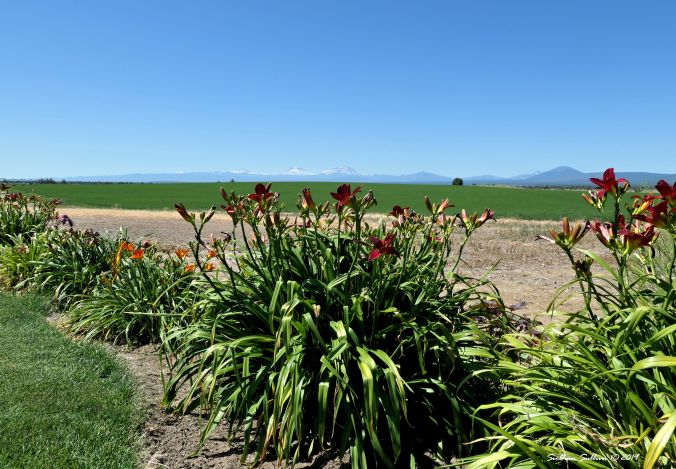
I saw many plants I’m familiar with on this tour. Some I knew the names of, others I was like, “Uh… what was your name again?” Fortunately, the plants were labeled or the person whose garden it was could tell you.
I was visiting one of my favorite plant nurseries recently and saw a little sign on one of their grape plants. It says the plant is not currently for sale because it is occupied by a robin and her hatchlings. In other words, this bird is not for sale. You can see her with her beak pointed up in the air at the top of the picture. She is one proud and protective mother!
Birds of the shore are common in the spring in parts of eastern Oregon. Why? Because flood irrigation is one of the main methods used to water the crops. As the snow melts off surrounding mountains, it collects in rivers and reaches the lower elevations.
Harney County basin flood irrigation. Sandhill cranes collecting around the water.
It is released in controlled amounts in the Harney Basin, where 320 bird species congregate. This ancient method of irrigation benefits the rancher and the birdwatcher.
Birds such as sandhill cranes take advantage of all of that water. You can see flocks of them in the photo above and a single bird below.
I saw plenty of raptors on a Birds of Prey tour in the wide-open country of Harney County, Oregon last April. We ventured briefly into the Malheur National Forest in search of eagles. Though we didn’t see any eagles, we did get a nice view of an American kestrel.
American kestrel
We saw immature and mature bald eagles later that day. It’s always exciting to see them.
Immature bald eagle
Bald eagle in flight
Adult bald eagle
Some of the wildlife out there was keeping an eye on us. This herd of elk on a distant ridge top watched us for a while.