While out walking my dog, I noticed this mule deer who appeared to be 1st in line for the next concert at the Hayden Homes Amphitheater in Bend, Oregon.
She stood there gazing at me for a moment, then walked even closer. When she paused about eight feet away from me, I thought I better continue on my way.
These photos really show the beautiful color of mule deers’ summer coat. In winter, it’s much heavier and more gray in color.
I passed by this flower border a couple of minutes after seeing the deer. I wonder if she wandered over there to munch on the flowers. It’s kinda like a smorgasbord for deer. 😉
I saw these iceplants in California up close at Leffingwell Landing Park. This plant, Carpobrotus chilensis, is known as an iceplant or sea fig.
Iceplants in California are considered an invasive species. It is native to South Africa. The iceplants form dense mats in habitats near the sea. The picture below shows them growing under pine trees.
I was a little puzzled when I noticed they had some flowers that were pink, and others that were yellow. Then I read about how the flowers start out yellow and fade to pink. Interesting…
I pause beside an ancient one. She is broad and strong at the base, with outstretched branches reaching for the sky.
I continue wandering beneath the giants until I find him, the oldest one of them all.
His branches tremble and point towards a burned-out tree. The fire exposed its heart, but its thick bark protected it for many years.
I notice the toes of the tree curling. It is struggling to keep itself upright.
Then… whoosh, boom! It falls to the ground. The voices of the trees around it rise in a song of mourning.
The burned wood at its core falls away. Its wrinkled bark flakes off, exposing a more youthful surface. The hollowed out tree shares its soul with curious visitors who marvel at the wonder of its life.
This Smokey Bear mural is located in Burney, California. I liked the muted colors in the background of this mural. I’m not sure when it was painted, but it looks old.
In 1944, the U.S. Forest Service introduced Smokey Bear as part of a campaign to prevent fires. The slogan, “Only you can prevent forest fires,” was first used in 1947. In 2001, it was changed to, “Only you prevent wildfires.” This change reminds people to prevent fires in other habitats, like grasslands. This Smokey Bear mural shows the older slogan.
Fun fact: Did you know Bambi, from the Walt Disney movie, appeared in fire-prevention ad campaigns prior to Smokey’s creation? His likeness was “loaned” to the government for only a year.
Monday Mural
Bend Branches always appreciates your comments and likes. Comments may not appear right away since they’re screened for spam prior to posting. Thanks!
Today I’m featuring photographs of blazingstars near and far.
The first picture shows the Sierra blazingstar, or saffron blazing star, Mentzelia crocea. I took this picture in Kings Canyon National Park, California. This 3-foot tall plant blooms from April to June. I like the numerous delicate stamens in the middle of each flower. It is classified as an annual wildflower.
This blazingstar grows in the foothills of the Sierra Mountains. It grows in a relatively small area of California. It is endemic to that region.
The next photo shows the giant blazingstar, or smoothstem blazingstar, Mentzelia laevicaulis. I took this photo at Pilot Butte State Scenic Viewpoint, Oregon. Pilot Butte is an extinct cinder cone in Bend, Oregon. This species grows from 3-6 feet tall and blooms from June to September. The petals are narrower on their flowers, but they still have a lot of stamens. It is classified as a biennial or short-lived perennial wildflower.
The giant blazingstar grows from southern Canada through the western United States. It’s much more widespread than the Sierra blazingstar.
As I noted on a previous post, the flowers stay open from mid-morning through the night. Blazingstars attract pollinators during evening hours, including hawk moths. The giant blazingstar can also self-pollinate.
I took this photo of the Sentinel standing watch in Sequoia National Park in California. This giant sequoia tree measures 257 feet tall and 25 feet in diameter, four feet above the base, making it the 43rd largest in the world and 26th largest in the Giant Forest. It’s estimated to be 2,175 years old.
The largest giant sequoia, Sequoiadendron giganteum, is located nearby. The General Sherman tree measures 272 feet in height and 25 feet in diameter, four feet above its base.
In photographs taken from this angle, it almost looks like it’s a sentinel standing watch on long reddish-brown legs.
The Sentinel tree is growing right next to the Giant Forest Museum. This museum is small, but nicely laid out and informative.
Ten years ago today, I published my first post on this blog. I am celebrating Bend Branches birthday with a little treat.
My first post was titled, Time. It featured a photo of my favorite western juniper tree in my yard in Bend, Oregon. A winter sunset paints the skies in the background.
My post also included the following observation:
“The twists and turns of time can ravage one or make them into a thing of beauty.”
Thank you to my followers and to others who stop by to view my posts. Your likes and comments have encouraged and inspired me. I hope to celebrate another Bend Branches birthday ten years from now.
Bend Branches always appreciates your comments and likes. Comments may not appear right away since they’re screened for spam prior to posting. Thanks!
You can get creative on blog posts in several ways.
Artwork
You may want to showcase your own artwork.
This rock was the perfect shape for a barn owl painting. I used acrylic paint on this rock. First, I applied a cream colored base coat, then used small brushes to add the details. I perched it in the fork of a tree in my yard for the photo.
The next photo shows a magpie flying over the Painted Hills. As I’ve mentioned in previous posts, the bird is a character in a book I’m working on. For this painting, I used watercolors and ink from a Chinese inkstick.
In the next drawing, I used pen and ink. This a stylized drawing of a grizzly bear. I had forgotten it was on the back of another drawing I had done of a bear.
Photo Bloopers
You can be creative in other ways. I like to occasionally post photo bloopers. This is where I post pictures that didn’t turn out as expected, so I add a little humor to them.
One day, I was following a family of Trumpeter Swans near the Sunriver Nature Center in Oregon. As soon as I started taking pictures, they did this.
The caption reads, “She’s about to take our picture. Quick, everyone put your head underwater!”
The next one shows the Three Gossips rock formation in Arches National Park in Utah.
One of the gossips is saying, “Then Rocky told me he’d give me the latest scoop.” Another says, “Really?” The last one says, “Cliff, you really shouldn’t spread that kind of dirt.”
The next photo shows a close up of wrinkly bark on a western juniper tree.
The caption reads, “Uh… the anti-wrinkle cream doesn’t seem to be working.”
Photo Processing Effects
Another way to get creative on your blog is to use photo processing effects. I use Corel PaintShop Pro 2021 to edit my pictures.
The first shows a cloud-filled sky over Playa at Summer Lake. If you move the slider, you can see how the original compares to the edited version. I increased the contrast and used a black and white film effect. This effect works well with cloud formations.
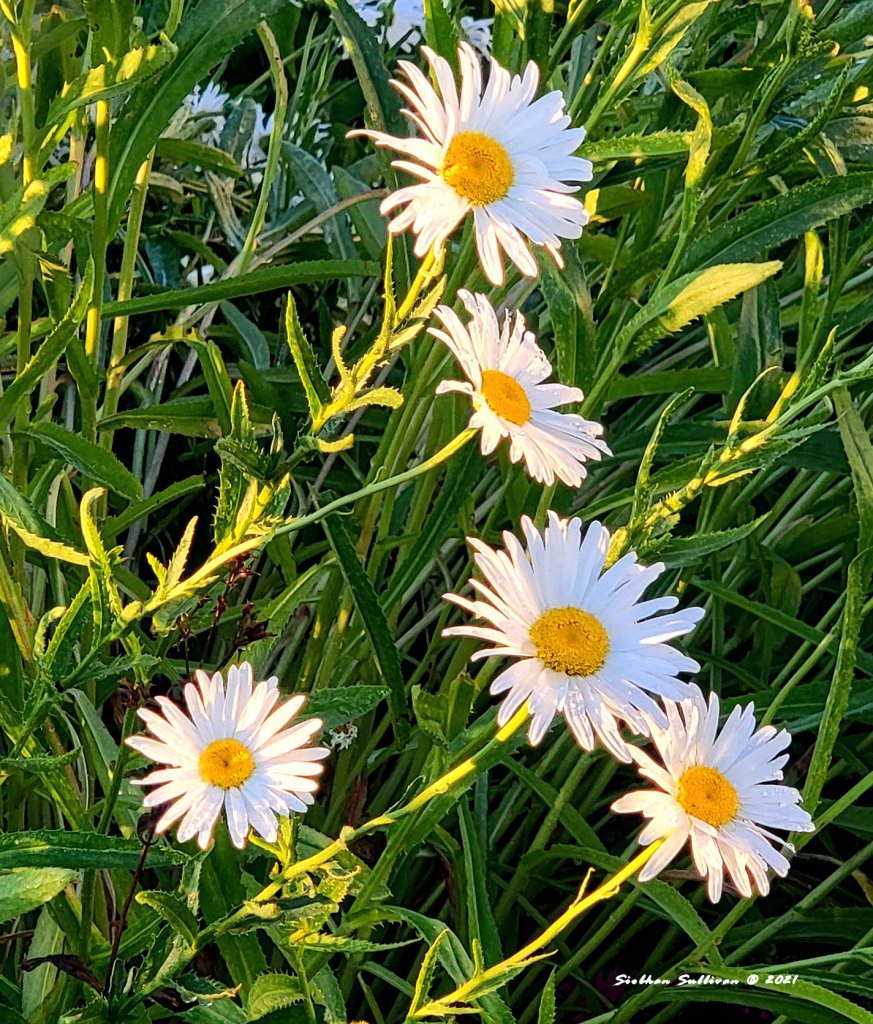
In the next photo, I used a colored edges effect on a picture I took of daisies. I like this one because it almost looks like a drawing with this effect.
The last photo shows a windmill at Fort Rock Homestead Village Museum in Oregon. For this picture I used a glowing edges artistic effect. It makes all the details stand out.
Here’s a photo of part of Grizzly Falls in B & W. I took this picture in Kings Canyon National Park and thought it looked best with a monochrome effect. Grizzly Falls is a 75-foot tall waterfall right beside the road.
I took pictures of this checkerspot butterfly up close on Winter Ridge in Oregon. I believe it’s a Anicia Checkerspot, Euphydryas anicia, based on the description on the Butterflies of Oregon website.
It’s a beautiful checkerspot butterfly on its own, but I noticed it blended in really well with its environment. Can you see how all the colors on the butterfly’s wings are also in the lichens on the rock? Was it just a coincidence, or did it land here on purpose? Hmm…
Today I’m sharing a few rattlesnake drawings and a couple of recent photos I took. I did these drawings when I was working on a writing a character in a book. When I draw a character, it helps with my writing.
Roca, the rattlesnake character, gets his power from thundereggs. Thundereggs are the official state rock in Oregon. As of this year, they have been designated as the state rock for 60 years.
Here’s a photo of a giant one that I had cut in half. I found it at the Priday Polka-Dot Agate Beds, located near Madras. Read more about this amazing site here.
Anyway… back to rattlesnakes. While participating in a workshop through Playa at Summer Lake, we stopped at Abert Lake. At the north end of the lake, we saw not one, not two, but three rattlesnakes rattling their rattles. Here’s one of them.
In Oregon, there are two subspecies of Western rattlesnakes. The one pictured above is a Great Basin rattlesnake, Crotalus oreganus lutosus. The other subspecies is the Northern Pacific rattlesnake, Crotalus oreganus.
Here’s another snake nearby.
We may have seen three snakes in close proximity because they denned together over the winter and recently emerged. Reptiles have a hard time regulating their body temperature. In the winter, they gather together and go into a kind of suspended animation called “brumation.”
Though people may fear them, it should be remembered snakes play an important role in maintaining the balance in ecosystems. They play a significant role in controlling rodent populations.
Do you have artwork you would like to share? Be sure to include the First Friday Art tag.
Today I’m sharing a couple photos of a dwarf purple monkeyflower up close. This tiny flower is blossoming now in my High Desert yard near Bend, Oregon. They bloom from May to August. In years with ample precipitation, this plant produces branches bearing dozens of flowers.
The dwarf purple monkeyflower, Diplacus nanus or Mimulus nanus, is a native plant that grows in parts of California, Oregon, Washington, Idaho, Nevada, Montana, and Wyoming. It grows in sagebrush-steppe and open pine forest habitats.
To show just how small they are, I photographed two plants next to a quarter.
I wrote a 9-sentence short piece about a tree’s birth as part of a recent writing workshop. Author Pam Houston taught the More Than Human World online course.
Old western juniper tree at dusk
In class, she gave us the following prompt. We had to complete it in about five minutes.
Nine Sentence Writing Exercise
Sentences 1-3 Describe a natural object’s birth. It can be an animal, plant, rock, etc.
Sentences 4-6 Describe what else is happening at the time of the object’s birth.
Sentences 7-9 Put the birth in an ancestral context.
Western juniper seedlings
A tree’s birth short story
Here is what I wrote…
A Tree is Born
By Siobhan Sullivan
I am emerging from the sand of the High Desert. The first thing I do is send a taproot down, seeking water. After that, I send a stem up, covered with sharp, scaly leaves on its branches. I feel the earth trembling beneath me. In the distance, I see dense clouds forming over a sharp peak. I smell a powerful scent, like rotting eggs. Above me, my great grandfather shifts his branches to shelter me from the ashfall. He has lived on this hilltop for 5,000 years. I am a juniper, grateful to be a part of his family and a part of this developing world.
Generative writing
When you do generative writing like this, you’re forced to think fast, sort of like an improv actor. I usually type everything I write on my desktop computer or other device. However, when I take writing classes with prompts, I often use longhand. Why, you may be asking. It uses a different, sometimes more creative, part of your brain. I can write and cross things out quicker in longhand.
Here’s a picture of the first draft I created in class. It includes a quick sketch of a tree. Yeah, it’s messy!
Is this short piece about a tree’s birth the best thing I’ve ever written? No, but I can see how something similar could be incorporated into some of my other writings.
I was inspired to create this piece by western junipers growing on my property in Bend, Oregon. I often use the tree in the first picture as my muse. Can you see why?
Today, I’m sharing a pygmy rabbit drawing I created with pen and ink. These tiny rabbits are the epitome of cute. They are the smallest rabbit in the world.
Life history
This rabbit weighs between 9 to 15 ounces and measures between 9.2 to 11.6 inches in length, small enough to fit in your hand.
Pygmy rabbits, Brachylagus idahoensis, live in sagebrush-steppe habitats. Unlike other rabbit species in North America, they dig their own burrows. Their range includes parts of Oregon, Montana, Idaho, Utah, Nevada, and California. Washington and Wyoming’s populations are genetically isolated. The Washington state population is endangered and attempts to captive breed them with rabbits from other locations have met with limited success. Elsewhere in their range, biologists classify them as Least Concern.
Comparing pygmy rabbits to mountain cottontails
I saw this rabbit on my back porch one day and I believe it’s a pygmy rabbit. Their fur color is uniformly brown to dark grey and their ears are small and rounded. Pygmy rabbit’s short brown tail is nearly invisible under their fur.
I’ve also seen black-tailed jackrabbits and mountain cottontails on our property. This photo, also taken on my back porch, shows a mountain cottontail face to face with my cat for comparison. It had a white tail and undersides and large ears. Yes, my cat enjoyed the free show. 😉
More life history
In the winter, pygmy rabbits feed primarily on sagebrush. In spring and summer months, they add grasses to their diet. Pygmy rabbits also eat roots, wood, bark, stems, and seeds, grains, and nuts. Weasels, coyotes, foxes, badgers, bobcats, owls, and birds of prey feed on this rabbit. Predation can eliminate up to 88% of juveniles and adults. Other threats include habitat loss, competition with heavy livestock grazing, severe weather, isolation of populations, and road mortality.
Though we have limited information on their reproduction, they produce 4-8 offspring in late winter and early spring. They may raise their young inside burrows, but no one has found any.
Do you have artwork you would like to share? Be sure to include the First Friday Art tag.
This Plesiosaur model can be seen at the Museum of the Rockies in Bozeman, Montana. This museum has an amazing collection of fossils, articulated skeletons, and models.
Plesiosaurs were always one of my favorite dinosaurs as a kid. Pterodactyls, a flying reptile, were also a favorite of mine. I must have admired these creatures’ ability to travel through water and air, respectively.
Plesiosaurs were 11 to 14 feet long and weighed between 400 to 1,100 pounds. They fed on fish, reptiles, and cephalopods. Plesiosaurs disappeared at the end of the Cretaceous period.
In my quest to get more familiar with my drone, I flew it above Big Sky Park in Bend. This park, a few miles from my home, is 97 acres in size. It includes playing fields, an off-leash dog park, miles of trails, picnic areas, and a new bike park. It’s a great place to go for walks.
On this trip, I wanted to try out a couple specific video features on my DJI Mini 4 Pro drone.
MasterShot
With this option, you get several effects with the push of a single button. You select a point of interest (POI) on the screen by dragging a shape around it. The drone then goes through a series of maneuvers. It goes up high and points in one direction, then it points right below. It zooms in on the POI, a goal net in this case. Then it circles high, moves closer to the POI, then farther away. It goes high and looks in the opposite direction of the first shots. Finally it focuses on the POI.
Asteroid above Big Sky Park
Another option I tried that day was Asteroid. The drone flies backward and upward, takes several pictures, then returns to the starting point. It then combines the footage it takes into a globe shape. The video I took above Big Sky Park turned out really cool!
Active Track
I’ve tried the tracking option a couple of times. Last week, we went to a hilltop park with rocky trails. I selected myself as the POI, and had my drone track me as I walked. When you fly drones, you should always be aware of your surroundings. The drone pilot watches the drone’s progress on the controller screen, while the spotter helps keeps track of where the drone is. Unfortunately, I was paying too much attention to the screen and not enough to the trail. Since I had both hands on the controller, I tripped and fell face first. Yikes, how embarrassing!
I had a few cuts and some swelling on my nose, but otherwise was okay. I spent the rest of the day icing my face off and on. A couple doses of Acetaminophen eased the pain.
The funny thing is, my drone recorded the fall. The picture above was part of the video it recorded. Sorry to tell you, but I will NOT be sharing the entire video.
Here’s a photo of my drone following me at Ochoco Wayside State Park before I fell. The lesson I learned that day was, keep your hands on the controller, but your eyes on what’s going on around you.
On a recent sunny day, I decided to take pictures above Haystack Reservoir in Central Oregon. Here in the High Desert, reservoirs provide much of the water used in local agriculture.
The first photo shows the dam on the reservoir. There’s a fishing dock in the lower right corner. Visitors can catch largemouth bass, crappie, rainbow trout, kokanee, brown trout, and brown bullhead here.
My next picture shows a view towards the west. There’s a corner of the reservoir in the lower right. The snow-covered peak of Mount Jefferson is in the distance.
When I pointed my drone towards the east, it almost looked like a different location. The rising sun is reflected in the reservoir’s waters in a nearly monochrome image.
The next picture shows Mount Jefferson on the left and Mount Hood on the right. Volcanic peaks are ever-present characters in our landscape.
Looking again to the east, the morning light begins to brighten the scene.
Towards the south, you can spot one of the reservoir’s campgrounds. There are three campgrounds at the reservoir, including one specifically for groups.
When I zoomed in a bit above Haystack Reservoir, I saw the Sister’s peaks peeking out from between the hills.
The last picture, is looking to the southeast. Gray Butte is in the middle of the picture. It’s a great place to hike and find gorgeous wildflowers in the spring.
In past years, this and other Central Oregon reservoir levels were low due to an ongoing drought. However, we had higher than average precipitation this winter and there is currently no drought in Oregon.