It’s always hard to pick favorite photos at the end of the year. Here are several representing nature, history, and culture. Enjoy and have a great New Year!
Nature


Nature’s Icing on Christmas
Just enough of Nature’s icing on our wreath to brighten up the holidays.

“He who marvels at the beauty of the world in summer will find equal cause for wonder and admiration in winter.”
John Burroughs
Blue Pool Reflections: LAPC
The Artwork of Nature
I visited Blue Pool on a cool September day. Mother Nature was busy there producing colorful works of art. The colors in the pool are unbelievably beautiful and intense. On this day, the warm colors of fall leaves were reflected on the water.
As I mentioned in Blue Pool is a Jewel, the reflections look like Impressionist paintings. I could have stayed there for a long time taking pictures. Can you see why?


Fuzzy lupine blossoms: Friday Flowers

Big Cone – Yellowstone Lake: Wordless Wednesday

Wordless Wednesday
Seasons – Glimpses of Oregon: LAPC


Colorful Border on Fall’s Eve: Friday Flowers

A colorful border full of flowers on the last day of summer at Oregon Garden in Silverton, Oregon.
Friday Flowers
Reaching for the Sky: Wordless Wednesday

Wordless Wednesday
The Story Who Came to Visit: RDP
Last month, The Darkness of Hills, The Lightness of Wings came to visit me for 25 days. Yes, that was a long visit. She spoke a little bit to me each day until she was 50,129 words long.

I started her as part of the NaNoWriMo challenge. That’s short for National Novel Writing Month. The goal is to write 50,000 words in a month. It’s a commitment I wasn’t sure I could make, but I did it.
I knew I wanted the story to take place in the late 1800s and I wanted to include a Chinese girl who moves to Oregon to work with her grandfather. He’s a doctor and she knows how to make herbal cures. That’s all I knew when I started writing.
I found my inspirations to build a story from several sources.

A dusting of snow: Wordless Wednesday
 Wordless Wednesday
Corn Flowers: Friday Flowers

“A light wind swept over the corn, and all nature laughed in the sunshine.”
Anne Bronte
Friday Flowers
Making a Splash: LAPC
As you wade through the waters of your life you often end up making a splash. Sometimes you make a big loud splash and other times you need to make a quieter one. Maybe only a ripple. Here are photos of quieter splashes I have seen in Oregon.

Common merganser pair on the Deschutes River
Quote on the Cosmos: Friday Flowers

Other times, you’re doing some piece of work and suddenly you get feedback that tells you that you have touched something that is very alive in the cosmos.
Leonard Nimoy
Friday Flowers
Popcorn Factory: Wordless Wednesday
 Wordless Wednesday
Viewpoints of Oregon: Photo Challenge
The challenge on Travel with Intent today is Viewpoint.
Here a few viewpoints of Oregon from places I’ve visited. Some are from places labeled as a viewpoint; others are taken where people stop to see a special view.

The Painted Hills in eastern Oregon

The view of a great horned owl nest south of Burns

The view of Mt. Hood from Highway 26
Branches in a new light: LAPC
These images show branches in a new light…

Reclining and resting in a sea of green

Coated with a covering of snow

Framing a fiery sunrise

Burdened with a bounty of fruit

Shrouded by the smoke of a prescribed burn
Lens-Artists Photo Challenge – Magical Light
High Desert Roomba: Wordless Wednesday
 Wordless Wednesday
Yellowstone Hidden & Revealed: LAPC
In Yellowstone National Park, much of the wildlife is hidden from view. You have to look carefully to find the animals and sometimes they will reveal themselves to you.
 Elk in the Lamar Valley are hidden as they blend into the landscape traveling along a ridge top.
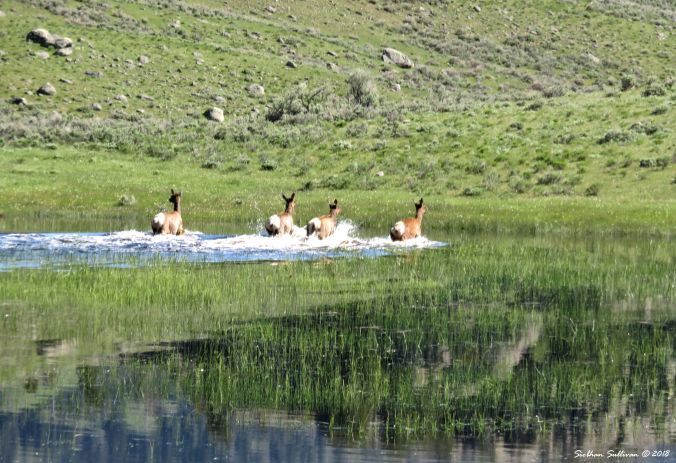 However, when they cross a pond they are revealed. The splashing water draws your attention and their pale colored rumps make you take notice of them.
Purple Crocus Vignette: Friday Flowers
 Friday Flowers
Blue Basin Bridge: Wordless Wednesday
Fun photos: Photo Bloopers 3
Fun photos
It’s time for some fun photos to go along with the Lens-Artists Photo Challenge theme of Just for Fun. Here are some of my photo bloopers for your enjoyment. This is what I do with some of my photos that don’t turn out quite right.

Grizzly bear and ravens at West Yellowstone, Montana

The Three Gossips at Arches National Park, Utah

Swallows at Summer Lake, Oregon
Fiery Foliage of Fall: FOTD

Textures of Arches National Park


Warner Valley: Wordless Wednesday
 Wordless Wednesday
Visiting Sunriver Nature Center
Learn about the natural world by visiting Sunriver Nature Center
Sunriver Nature Center & Observatory is a great place to learn more about the natural world. This small interpretive center is on the west side of Sunriver, Oregon. It’s in an area that includes pine forests, meadows, and the meandering Deschutes River. The “edges” between these habitats are good places to see wildlife.


You can observe local wildlife by walking the trails on your own or going out with a guide. The Sam Osgood Nature Trail winds around the property. In the spring and summer keep an eye out for trumpeter swans. Guided bird walks take place every Saturday morning in the spring, summer, and fall. I have been on several of the walks. You’ll see waterfowl in the pond, raptors flying overhead, and songbirds along the walk. Great gray owls have been spotted in the area occasionally. You never know what you might spot on one of these walks.


There are also programs for families and kids. There are Kids Nature Camps for kids 4-10 years of age at certain times of the year. Family programs might include offerings such as Family Birding, Aquatic Explorations, and Eco Bike Tours. During the school year, staff travel to nearby schools to give presentations.
Purple polka dot pansies: Friday Flowers
Pretty purple pansies.

Friday Flowers
High Desert Sunrise: Wordless Wednesday

Wordless Wednesday
Looking up at Fort Rock: LAPC
Looking up while looking back

These images from Fort Rock, Oregon focus on looking up. In this photo you see what a town from the early 1900’s may have looked like. Buildings were moved to this site to create the Fort Rock Valley Historical Society Homestead Village Museum. Each building is decorated with artifacts so it’s easy to imagine yourself stepping back in time.

Pioneers were promised rich and fertile land. That was not the reality in this arid high desert. Many settlers moved away after unsuccessfully trying to cultivate the land.
Oakleaf Hydrangea: Friday Flowers & FOTD
Unusual hydrangea

This type of hydrangea has interesting flowers and foliage. This shrub blooms over a long period of time in the summer. The white flowers fade to pink in the fall. The large leaves turn maroon, orange-bronze, or red in autumn.
Flower of the Day – Pink hydrangea
Friday Flowers
Favorite Tree: Wordless Wednesday, CB&W

Desert Path to Chimney Rock: LAPC

Ancient trees direct
An ensemble of moist clouds
Over the desert
Lens-Artists Photo Challenge – Path
Antelope bitterbrush in bloom: Friday Flowers
Bitterbrush blossoms

The antelope bitterbrush appears to be reaching for the sky in this photograph. This plant gets its common name due to the fact that it is so important to wildlife. Deer, elk, moose, mountain sheep, and pronghorn (antelope) browse on its small three-toothed leaves and use its dense growth for cover. It’s also important for deer mice, kangaroo rats, sage grouse, and Lewis’ woodpecker.
 I have seen plants over twelve feet tall but in my yard, they only reach a height of about three feet. My “landscapers” love to prune them. In certain parts of this plant’s range, bitterbrush can comprise up to 91% of mule deer’s diet in September.
Friday Flowers
Outdoor Bonsai: Artful Miniatures LAPC
A sculpted garden of outdoor bonsai plants
I saw these outdoor bonsai trees on the High Desert Garden Tour in Bend, Oregon this summer. I marveled at the artistry that went into sculpting these plants. Though I’ve seen bonsai trees in the past, I was pleasantly surprised to see tree species that grow locally sculpted into small replicas of full size trees. You can see why they are referred to as “living art.”

Cotoneaster

Maple

Larch

Juniper

Juniper
Lens-Artists Photo Challenge – Small is beautiful
Powerful Presence: Wordless Wednesday
 Wordless Wednesday
Flower Border at Old Mill: Friday Flowers
Flower border in full bloom
 It’s been a while since I walked one of my favorite short trails in Bend, Oregon . The flower border along the Mill A Loop trail is spectacular right now. Even my dog had to stop and smell the roses.


Friday Flowers
Summer & Winter Prickly Pear Cactus: Friday Flowers
Prickly pear cactus in my garden


The prickly pear cactus in my garden are highlighted in the summer with bright yellow flowers and in the winter with layers of snow. The sharp needles make their presence known throughout the year.
Friday Flowers
Tons of Towers: Wordless Wednesday
 Wordless Wednesday
Red fox in action: Lens-artists challenge
A lucky sighting of a red fox

We saw this red fox in Yellowstone National Park in June of this year. This is the Rocky Mountain subspecies, Vulpes vulpes macroura.
The red fox is not seen often in the park because they are nocturnal and they blend into their preferred habitats along the edges of meadows and forests. The females nurse their kits during late spring and this may have been a female out looking for food. Foxes usually use dens created by other animals.

We were fortunate to see a female with kits on another spring visit to Yellowstone. Litter size averages four to eight kits. Vixens gives birth in late March to April. Both parents care for the young through their first few months of their life.
When wolves were introduced into the park, many coyotes were eliminated by the wolves and this may have caused an increase in the number of foxes. Coyotes prefer sagebrush and open meadow habitat and hunt more by day so they don’t compete as much with foxes.

The red fox is the smallest dog-like mammal in the park. The males weigh 11-12 pounds and the females weigh 10 pounds. They average 43 inches in length. Most foxes live 3-7 years but in Yellowstone can live up to 11 years.
Ascent: Climbing Explored Exhibit
Reaching for the sky in the Ascent exhibit

Sometimes you may have looked up at rock climbers on Smith Rock (near Terrebonne , Oregon) and wondered what drives them in their quest to reach the top. This new exhibit helps answer that question. Ascent: Climbing Explored, looks at the history, evolution, and culture of climbing and mountaineering in the West. What began as scientific exploration, grew into an activity people take part in for sheer joy of the experience.

One of the first things you see in the exhibit is a journal entry from John Muir. Muir taught people about conserving wild places through his eloquent writings. In another section of the exhibit, the artwork of Thomas Moran is featured. The paintings he created of Yellowstone in 1871 helped to establish the world’s first national park. The artwork and writings of early explorers were the “social media” of their day. Artist Sarah Uhl, also featured in this exhibit, presents landscape art that is a continuation of themes first presented by 19th century artists. James Lavadour, of the Walla Walla tribe, did the bold bright paintings of mountains near the exhibit entrance. His paintings, and the clean lines of the exhibit, bring a modern look to the displays.
Can I help?: Wordless Wednesday
 Wordless Wednesday